HARTLEY KNOW HIM: Meet the Prolific Anti-Bike Lane Lawyer Who Can’t Get a Win
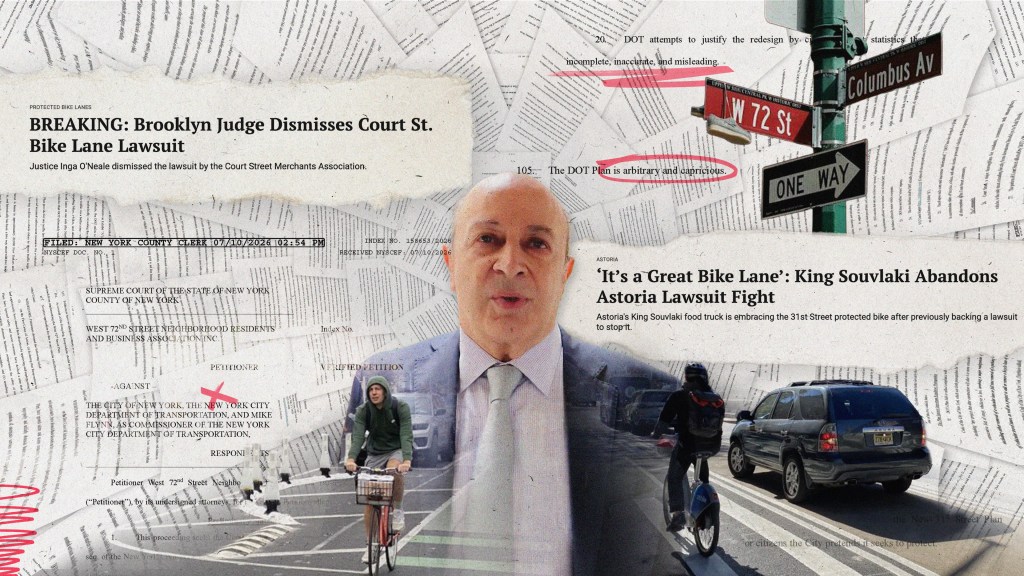
Mayor Mamdani’s bike lane projects keep running into the same foe: Hartley Bernstein, a retirement-aged Manhattan lawyer and convicted securities fraudster who has sued the Department of Transportation five times in three boroughs to little success.
Instead, Bernstein has exploited the judiciary’s slow and deliberative process to delay, or attempt to delay, critical safety upgrades on 31st Street in Queens, Court Street in Brooklyn, and most recently, W. 72nd Street in Manhattan. In each case, he relies on the same failed playbook to try to chip away at the Department of Transportation’s expertise, arguing the safe streets infrastructure actually endangers residents and undermines businesses — despite reams of evidence to the contrary.
The once-disbarred attorney is waging a losing battle, his critics say. Courts have for years upheld DOT’s jurisdiction over city street design.
“They’re clearly nuisance lawsuits. I don’t know what they’re designed to do other than slow down the process, because the precedent is all on the side of DOT and its ability to redesign the street relying on its expertise of what makes a street safer,” said longtime street safety booster Eric McClure, who now heads the political action committee StreetsPAC.
McClure has pushed for safety redesigns since the days of the ur-lawsuit against protected bicycle paths on Prospect Park West, when Mike Bloomberg was mayor.
Bike lane opponents may have never won, but their suits still have an impact because judges take time to review lawsuits, which keeps unsafe road designs in place for longer.
“The longer we have to wait for these projects to go in, the greater the likelihood of someone getting hurt or injured because of the existing street design,” McClure said. “That will be on the hands of the attorneys and plaintiffs suing to slow these projects down.”
That litigation over Prospect Park West tried to undo the project on procedural grounds, but such suits have repeatedly met the same outcome and failed to achieve much beyond grabbing headlines.
“It’s just wasting everyone’s time, because it’s basically using the lawsuit as a platform for making your policy point,” said attorney and street safety activist Steve Vaccaro. “‘Ooh people are suing’ – but it’s not going to go anywhere. The big picture is that they ain’t gonna stop this bike lane.”
Bernstein declined Streetsblog’s requests for comment, but took to billionaire John Catsimatidis’s radio show to spout off common grievances against DOT’s work and e-micromobility. He accused DOT of “ignoring the needs of communities.”
“It’s a fight in all of the boroughs on behalf of communities that are just being ignored by the city, by the Department of Transportation, and by people who should care about what they need and want,” Bernstein said during the July 26 radio appearance. “The city and the Department of Transportation are accelerating building these protected bike lanes all over the city and ignoring the needs of the communities, creating tremendous congestion, stopping deliveries from getting through, and creating safety hazards for people who just want to get across the street.”
His talking points and legal filings ignore the reams of research showing that injuries have gone down in New York City, even as bike trips soared.
A decade-spanning review of protected bike lane projects between 2009 and 2018 showed protected bike paths led to a 34-percent drop in risk, meaning the number of bike injuries per mile divided by the estimated volume of cyclists. Those numbers dropped as much as 60 percent on the city’s highest-risk streets, DOT found.
The benefits extend beyond cyclists to everyone, with an 18-percent reduction in deaths and serious injuries where DOT has installed protected bike lanes. The benefits are even greater for pedestrians, logging a 29-percent decline and seniors on foot, who saw a drop of 39 percent, according to the agency.
“They’re grasping at anything they possibly can, because there’s this bike-lash in their heads,” said Peter Beadle, a Queens-based lawyer and advocate with Transportation Alternatives. “There’s now a mountain of data that street redesigns or protected bike infrastructure increases the safety of all users, and almost ironically it increases safety for car drivers and pedestrians the most – it’s just all rubbish.”
From fraud to bikelash
Bernstein has had a colorful career without a clear connection to local transportation issues until recently.
A one-time Manhattan prosecutor, before becoming a “well-known securities lawyer,” by the 1990s, Bernstein was disbarred in 1999 after pleading guilty to securities fraud, conspiracy and perjury. He forfeited $850,000 in illegal profits, the New York Times reported.
While banished from the bar, Bernstein ran a blog from a “spare bedroom of his eight-room Georgian-style apartment on Park Avenue,” according to the Times.
His blog flagged scams in the stock market and restored his reputation from disbarred fraudster to watchdog.
He was readmitted to practice law in New York in 2007, and now operates a “boutique full-service law firm” with his wife, Debra Cherney. His work in recent years includes property disputes, commercial cases, contract violations and torts.
A high-profile win Bernstein boasts on his website is a case from 2019 representing an online auction site over a contested sale of Madonna’s personal effects by her former art advisor, including some of the singer’s personal effects, including a “brush full of hair,” lingerie, and a breakup letter from the late rapper Tupac Shakur.
Lawsuit bonanza
Since April 2025, Bernstein has sued DOT over protected bike lanes on 31st Street in Astoria, Court Street in Brooklyn, and 72nd Street.
All these bike lanes had support from their local community boards or Council members, or both, despite Bernstein’s claims about DOT ignoring communities.
Each proposal had drawn some backlash from local businesses and sometimes area firefighters, but the often car-focused local community boards have endorsed DOT’s plans on all three streets. Two of the three projects Bernstein’s clients sued over, 31st Street and Court Street, have since been installed and, in the case of the former, expanded.
In the case of the 2025 suit against half-installed paths on 31st Street, Queens Supreme Court Judge Cheree Buggs granted an order telling DOT to rip up the paths, arguing the agency had failed to certify that it had consulted with other city agencies as required by law. The Mamdani administration appealed the decision and released an even longer redesign in April, prompting Bernstein’s clients to file another petition in court this month. (DOT installed the bulk of the project in recent months.)
Last fall, Bernstein sued on behalf of businesses on Court Street in brownstone Brooklyn over an almost-finished bike lane there. A Brooklyn judge ended up dismissing the case in January. Bernstein filed a notice of appeal a month later that’s gone nowhere — opponents recently posted a fundraising appeal, seemingly to cover legal fees, on a local Facebook group.
And just last month, Bernstein took two more cases against DOT’s W. 72nd Street redesign to state and federal court. The area’s elected leaders and local community boards back the proposal, as does the mayor, but a small cohort of residents had mobilized against the redesign.
The legal filings paint a vast conspiracy behind the redesign, claiming that disabled residents will become shut-ins, similar to an ongoing federal lawsuit brought by opponents of DOT’s open streets program in 2023. Perhaps unsurprisingly the argument has failed to stop the Open Streets program, currently in its seventh year.
The W. 72nd Street lawsuits grew out of a May protest, after which opponents organized and hired Bernstein, according to one Upper West Sider who said a neighbor recruited her to file an affidavit in support of the state-level lawsuit.
“There was a meeting on 72nd Street in front of the train station. … It all sort of gelled after that,” Susan Purcell told Streetsblog. “The boards got together from several buildings on the street, and they hired him [Bernstein].”
Bernstein’s legal strategy starts Article 78 proceedings, referring to a state law that allows New Yorkers to sue government if its actions are “arbitrary and capricious.”
The high-profile failure of attempts to kill the Prospect Park West project didn’t keep others from trying to sue against street redesigns they didn’t like in the decade-and-a-half since.
Yet, judges rejected multiple similar well-funded Article 78 lawsuits, just look at:
- placement of Citi Bike docks
- bike lane on Central Park West
- bus lane on Fresh Pond Road
- busway on 14th Street
- road diet on Morris Park Avenue
- busway in Flushing
- bike lane in Long Island City
In each instance, judges ruled that DOT planners had the expertise and authority to overhaul city streets based on safety data and experience, and that doing so is neither arbitrary nor capricious.
Rehashing the same flawed arguments against street safety projects will become increasingly hard to justify as these failed cases keep piling up, according to Beadle.
“The law is becoming increasingly clear that New York City and the Department of Transportation have inherent discretion to make changes to the city’s streetscape to improve the safety of all New Yorkers,” the lawyer and street safety advocate said. “If you’re going to challenge it you really need to come up with some basis that goes beyond ‘we don’t like this.’”
Repetition, bad data
Bernstein’s legal filings against the three redesign projects largely run on the same set of arguments. Each petition is about 20 pages long and asks the judge to annul the redesign in question and restore the previous street layout or prevent the changes from happening.
He sues on behalf of groups with names such as the “31st Street Business, Parents, and Residents Association Inc.,” the “West 72nd Street Neighborhood Residents and Business Association Inc.,” and the “Court Street Merchants Association Inc.” that fakely imply bike lane opponents represent the consensus opinion of their communities.
The lawsuits all claim the redesigns actually endanger New Yorkers and hurt businesses, and that officials failed to go through the proper review procedures.
However, the filings are highly similar, so much so that Bernstein seemingly neglected to swap out the street names between the separate lawsuits. In his recent petition against DOT’s 31st Street redesign, Bernstein argued how the redesign would make W. 72nd Street more dangerous.
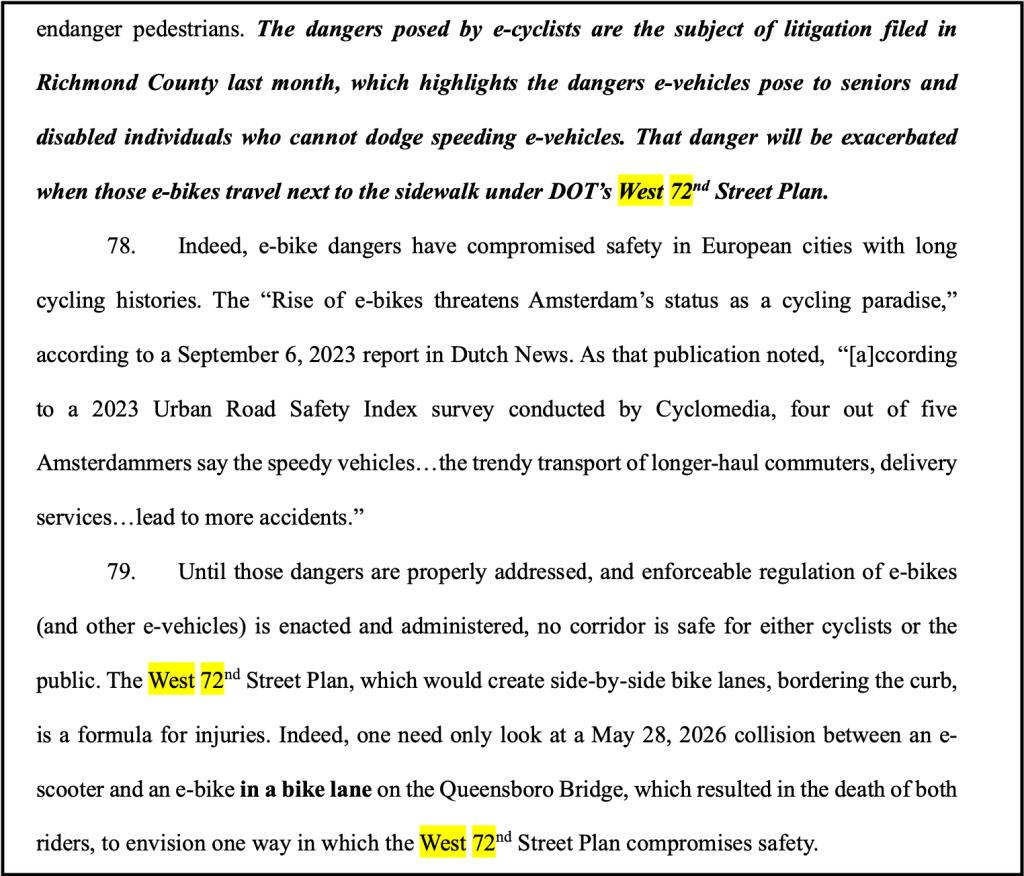
“This is very sloppy,” said Brandon Chamberlin, a bike- and pedestrian-focused lawyer at the Law Office of Adam D. White. “This just goes to show that he’s just trying to shut down all protected bike lanes where he can I guess convince some local businesses to put money in his pockets.”
Bernstein’s filings question safety benefits of protected bike lanes, citing the same 2020 study by the Insurance Institute for Highway Safety in each lawsuit. That research relies on a separate 2016 report published by the Swiss-based Multidisciplinary Digital Publishing Institute.
Bernstein’s filings question the safety benefits of protected bike lanes more generally, claiming they do “not necessarily provide greater protection for cyclists,” by relying on the research, which actually found 23-percent fewer injuries on streets with protected bike lanes, albeit those injuries tended to be worse, based on data from 839 cyclists treated at Bellevue Hospital between 2008-2014. They claim DOT’s redesigns benefit “a relative handful of cyclists” over everyone else, including pedestrians and local businesses — even though the city has deployed parking-protected bike lanes for nearly two decades.
Growing evidence puts the lie to Bernstein’s claims: businesses have actually logged improvements when the city installs protected bike lanes, a trend that extends to car-free spaces like open streets as well.
Bernstein v. Mamdani
In all three of his lawsuits, Bernstein takes aim at DOT’s process, accusing officials of falling afoul of the lengthy outside reviews for even simple bike lane projects under the controversial “major transportation projects” law.
That Bloomberg-era bikelash regulation requires DOT to get feedback for any street redesign exceeding 1,000 feet or three blocks from the Police Department, the FDNY and the local firehouses, the Department of Small Business Services, and the Mayor’s Office for People with Disabilities.
The extensive process has delayed countless projects and given non-transportation experts in other agencies a platform to undermine critical safety upgrades proposed by experts at the lead agency.
But change is on the horizon, as Mamdani’s Commission on Government Efficiency put a law change on the November ballot that would speed up street safety infrastructure by 33 percent, by consolidating – albeit not eliminating – cross-agency feedback and make it harder to sue DOT on these procedural grounds.
Bernstein called out those reforms on Catsimatidis’s radio show, falsely claiming that DOT could change streets “without anybody’s approval.”
“The mayor has now proposed that the Charter Commission put a resolution on the ballot this November that eliminates that requirement. So the Department of Transportation – if it passes – will be able to simply change every street it wants without anybody’s approval,” Bernstein said.
A change of heart
At least one former client of Bernstein’s regretted going to court over a bike lane, and has embraced the street safety upgrades now that they’re in place.
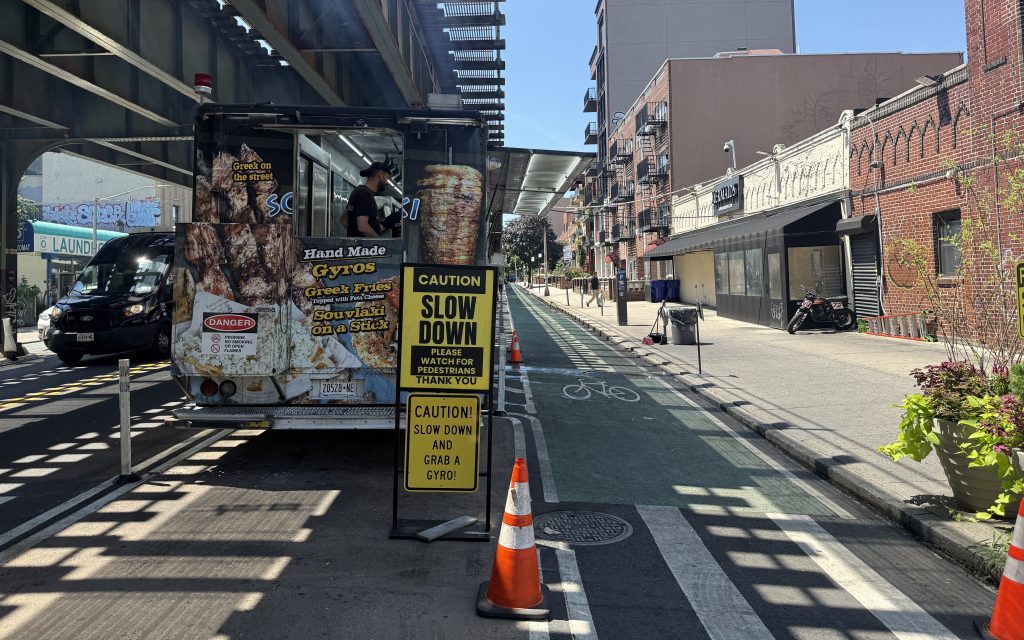
Lampros Tsampas, a co-owner of King Souvlaki, a food truck on 31st Street, was part of the initial lawsuit against the bike lane, and recently told Streetsblog he now likes the redesign.
He got involved in the fight after paying into the business association, saying the effort was “a bunch of people calling each other.”
“It wasn’t worth it because the bike lanes happened either way and we didn’t have to end up moving. So that’s good,” Tsampas told Streetsblog.
Bernstein never guaranteed the businesses they would be able to stop the bike lane in court, Tsampas said, but the lawyer told the merchants he would see what they could do.
“It was pretty much like, ‘Oh, we’ll see what we’re going to do. We’ll fight it and can’t promise anything and we’ll see what happens,'” Tsampas said.
Additional reporting by Emily Smith

Read More:
Streetsblog has migrated to a new comment system. New commenters can register directly in the comments section of any article. Returning commenters: your previous comments and display name have been preserved, but you'll need to reclaim your account by clicking "Forgot your password?" on the sign-in form, entering your email, and following the verification link to set a new password — this is required because passwords could not be carried over during the migration. For questions, contact tips@streetsblog.org.