FDNY Brass Lobby Against Bronx Harlem River Greenway
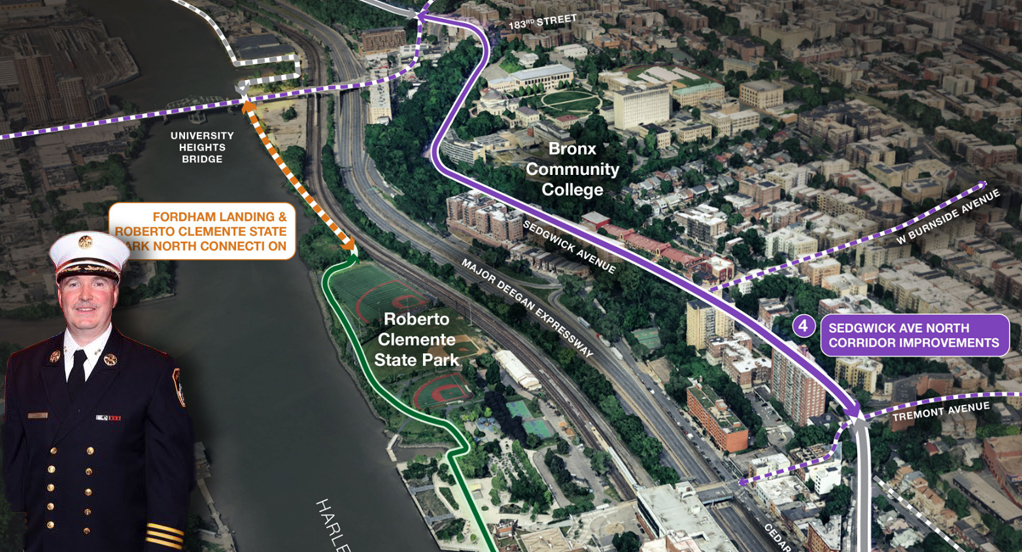
Top Fire Department leaders are trying to kill a Harlem River greenway segment of protected bike lanes in the Bronx as part of an ongoing effort by agency chiefs to extinguish decades of city street safety policy, Streetsblog has learned.
FDNY’s Chief of Fire Operations and vocal bike lane skeptic Kevin Woods penned a letter to Department of Transportation leadership in April opposing a proposed section of two-way bike lanes on Sedgwick Avenue.
DOT made adjustments to the project — only for a local battalion chief to testify in uniform against the proposal at a community meeting last week, putting public pressure on transportation officials to kill the bike lane segment.
Both senior firefighters claimed without evidence that the bike lane will endanger New Yorkers by slowing down response times and blocking rescue access. Bronx bike advocates worried the pushback from the top ranks of New York’s Bravest — who seem to ignore the relationships between reducing traffic injuries and emergency response times — would kneecap the most ambitious bike infrastructure for the Boogie Down in decades.
“It really feels like that opposition in the Bronx can really stop a project, so I’m very concerned about the position that was made at the community board,” said Chauncy Young, the coordinator of the Harlem River Coalition. “We’re getting more protected bike lanes in the Bronx but we have been far behind the other boroughs and part of it is opposition like this.”
The backlash marks the latest instances of firefighters and FDNY leaders undermining the City Hall’s support for bike lanes and the urban design expertise of officials at the city Department of Transportation.
FDNY has increasingly become a clearinghouse for knee-jerk criticism of bike lane projects, a trend that threatens to stymie Mayor Mamdani’s agenda of making the Big Apple’s streets the “envy of the world.”
In the Bronx, the fear of losing street safety goes deep, as Young recalled that a decade ago, the FDNY got DOT to erase a small-but-key protected bike lane on 170th Street connecting to the car-free High Bridge.
“I’ve got like three, four generations back of firefighting, I respect firefighters, but I also believe in Vision Zero and having safe places for families to bike,” Young said.
That intra-governmental battle surfaced at a shocking City Council hearing in February where Woods said FDNY opposed protected bike lanes — to cheers from conservative car-first politicians and as DOT leaders sat right next to him. Woods later walked back his statement after Streetsblog asked the FDNY’s press team about it — insisting that FDNY opposed only some bike lanes.
Last month, firefighters in Astoria showed up in force and in uniform at a community board meeting to prop up opponents of an embattled protected bike lane on 31st Street, and their union came out in support of a lawsuit that tried to derail the cycling upgrades.
The maneuvers fly in the face of comments from FDNY Commissioner Lillian Bonsignore earlier this month reaffirming to the City Council that the agency does indeed support bike lanes.
Bonsignore’s predecessor Laura Kavanagh has also spoken out against those who try to pit New York’s Bravest and bike lanes against each other, noting that 86 percent of the department’s work is medical emergencies, including traffic violence, which safer street design would drastically curb.
Since the vast majority of FDNY’s work is with ambulances, the agency should embrace street redesigns that reduce crashes and injuries, according to advocates.
“The data is clear: protected bike lanes save lives. When we redesign our streets with safety as the priority, there are fewer car crashes — that means fewer emergencies that FDNY’s EMS crews need to respond to, and fewer deaths and serious injuries,” said Ben Furnas, executive director of Transportation Alternatives. “When FDNY vehicles need to get somewhere in a hurry, protected bike lanes are plenty wide, allowing them to skip past any car traffic that would otherwise be blocking the way.”
(The agency also has its own history of causing crashes, like a recent firefighter who slammed into three cars, killing a senior and injuring 10 others in southern Brooklyn in March.)
One-way thinking
In the latest governmental dustup, Woods and local firefighters singled out the Transportation Department’s plan to convert a 0.2-mile strip of Sedgwick, between Fordham Road and 183rd Street, into a one-way southbound street to accommodate the cycle path and remove dangerous turning conflicts at Fordham Road.
DOT’s proposal marks the next stretch of the planned seven-mile on-street Bronx Harlem River greenway first launched under former Mayor Eric Adams in 2023, and the agency unveiled the latest details for a 1.1-mile section along Bailey Avenue and Sedgwick Avenue in April, connecting Kingsbridge Heights and University Heights.
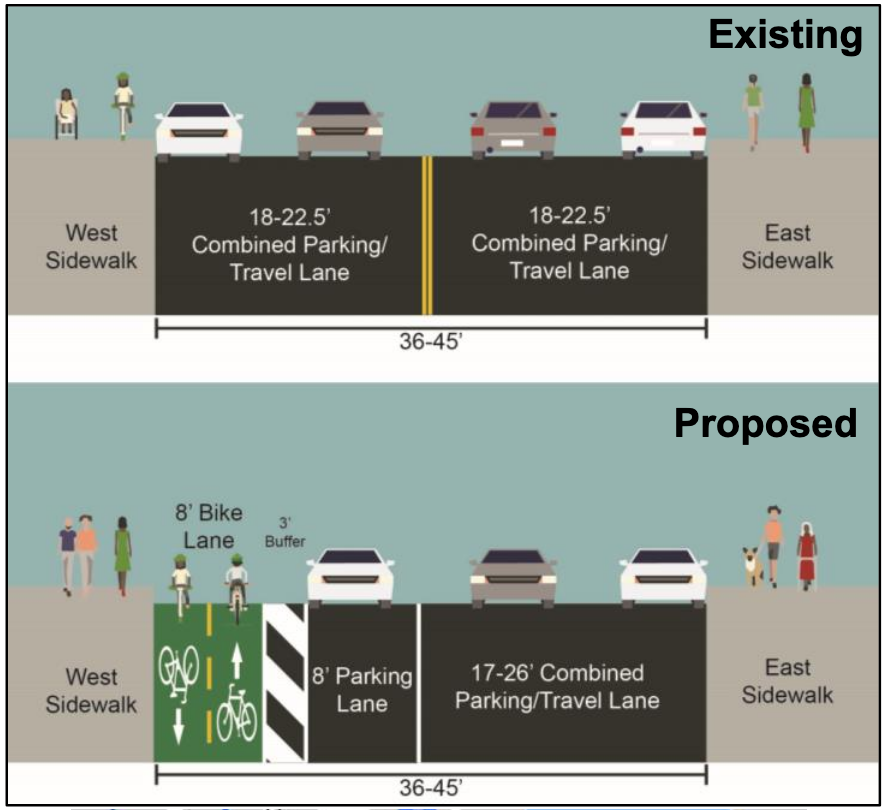
The greenway effort has drawn official ire before: When the city unveiled the first section going south from Van Cortlandt Park last year, father-and-son pols Assembly Member Jeffrey Dinowitz and Council Member Eric Dinowitz slammed the greenway as an “anti-car crusade.”
Woods in his letter to DOT claimed that redirecting northbound traffic to adjacent roads will delay response times for area firehouses.
“Converting Sedgwick to a one-way south only, would dramatically effect [sic] Engine 43’s and Ladder 59’s ability to respond to a highly populated section,” Woods wrote to DOT’s First Deputy Commissioner Margaret Forgione in an April 27 letter obtained by Streetsblog [PDF]. “It is nearly impossible for E43/L59 to safely travel against traffic to Fordham Road if this change of traffic pattern goes through and we will be forced to take alternate routes that will hinder response times significantly.”
Then last week, a local battalion chief echoed those sentiments at a local community board meeting, while testifying to the civic panel in uniform and spreading misinformation claiming the street redesign obstructs first responders’ access.
“This specific proposal to make Sedgwick Avenue a one-way south-bound is gonna cause an issue and I want to say that we’re opposed to it in the interest of safety,” said Battalion Chief 27 Liam Donnelly at Bronx Community Board 8’s Traffic and Transportation Committee meeting on June 18. “We won’t notice til afterwards, but I can tell you, a half mile through double-parked cars and traffic is going to add time to our response – potentially minutes.”
The corner of Sedgwick Avenue and Fordham Road is an official DOT Vision Zero priority intersection, meaning it is among the most dangerous crossings for pedestrians in the Bronx. A whopping 80 people were hurt in crashes at that corner alone between 2021-2025, according to the agency. DOT also noted in its presentation to CB8 that the one-way redesign preserves car parking.
DOT’s proposal included three other routes for drivers can still take if they’re heading north to Fordham Road: Cedar Avenue, Loring Place N., or University Avenue. In response to FDNY, the city also removed a parking lane on Cedar to provide more driving space, a City Hall rep told Streetsblog.
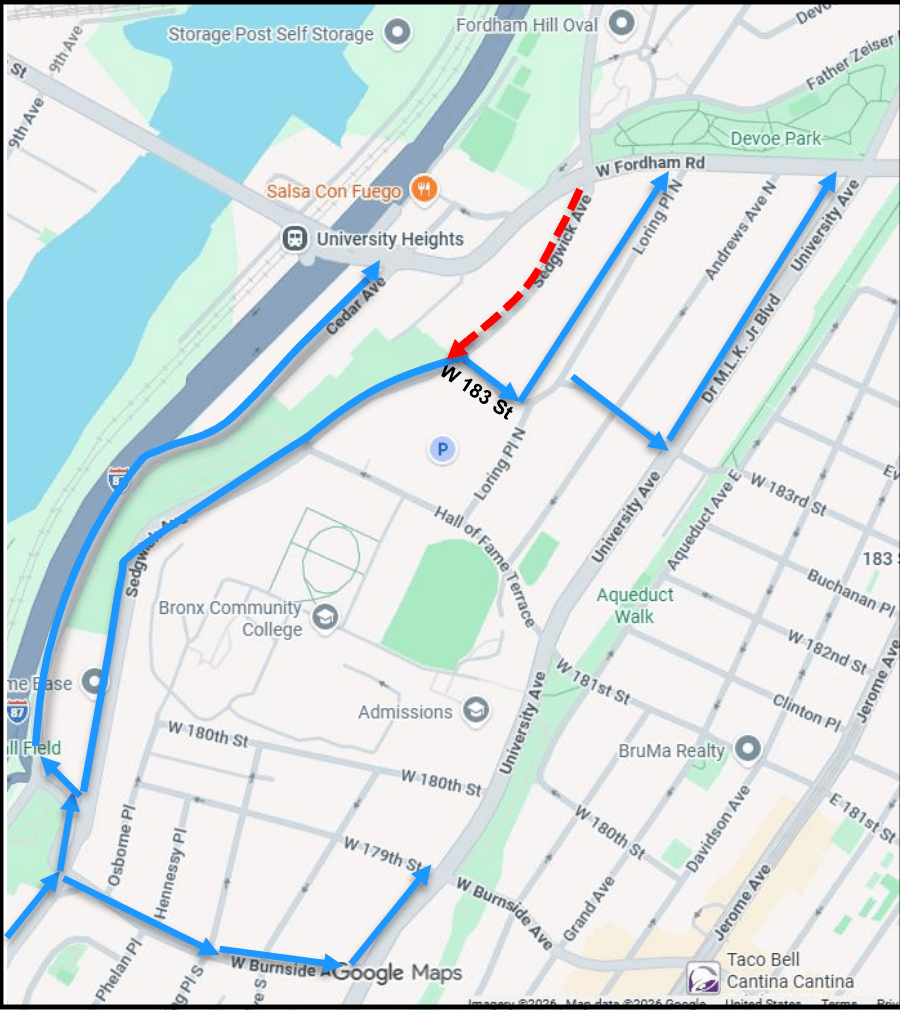
But Woods and Donnelly insisted the detours will become impassable if a driver double parks, or are too out-of-the-way.
“All the above streets are difficult for FDNY apparatus to navigate in even ideal traffic conditions. One single double-parked car will prevent any FDNY apparatus from responding to any alarm,” Woods wrote.
Similarly, Donnelly told CB8 members that taking alternate routes could be tight for the department’s huge trucks, while adding more than a half a mile of extra travel, setting back response times.
“We just can’t fit some of the rigs down those [streets]. They’re narrow, they’re winding, if that’s two ways and encounter double-parked cars or a truck, we just won’t be able to get through,” Donnelly said.
The Bronx smoke eater went on to claim that bike lanes “in general” block access for FDNY ladders to reach upper floors, because fire trucks can’t get as close to the curb — a claim DOT has already debunked.
“In general, bike lanes, you know, affect our operations in laddering buildings. The further they push us away from the building, the further ladders are – we just can’t reach the top floor. That’s happened in multiple areas,” Donnelly said.
The comments parroted a disproven claim the Uniformed Firefighters Association filed in a letter supporting a lawsuit against the 31st Street bike lane in Astoria.
A lawyer for the city at the time countered that DOT designs its protected bike lanes wide enough to specifically accommodate emergency vehicles. That means protected bike lanes allow first responders to bypass car traffic and get their vehicles closer to the curb than if there’s a row of parked cars blocking the way – particularly if those drivers are blocking hydrants.
The ease that these double-duty emergency lanes provide can be seen here, here, here and here:
Young, of the Harlem River Coalition, countered that there are many narrower streets in the city that firefighters don’t seem to struggle to navigate in their trucks.
“I just don’t understand how it could be more difficult than other parts of the city where this fricking works,” Young said.
Cars are the problem, bike lanes the solution
Despite the hysterics, neither FDNY (nor DOT) have ever provided data that proves bike lanes hinder first responders.
The FDNY’s criticisms reveal the actual impediment to fast emergency responses: drivers, especially those parking illegally, along with the FDNY’s oversize rigs that struggle to maneuver around anything other than wide open avenues.
In the case of Sedgwick Avenue, firefighters could, for example, use the two-way bike lane on the one-way stretch in a pinch. However, Woods threw cold water on that in his letter, claiming it would be “nearly impossible” to “travel against traffic.”
Woods also complained that the redesign would worsen “gridlock conditions” outside of the firehouse at the corner of Sedgwick and Burnside Avenue, hampering response times further. Google Streetview images reveal that much of the streetscape is taken up by illegal parking, as is common outside fire stations, police precincts and other agency buildings due to the proliferation of government parking placards.
The next planned phase of DOT’s greenway may very well be the source of FDNY opposition, because it will run outside that firehouse and threatens firefighter parking spots. DOT in the past has rerouted protected bike paths to the far side of the street outside station houses on Sixth Avenue in Lower Manhattan, citing FDNY’s “unorthodox parking.”
DOT by law has to consult with the FDNY headquarters on every street redesign that exceeds three blocks or 1,000 feet, as part of a lengthy outside-agency review process mandated by the City Council. The agency also has to notify the local firehouses, but Donnelly defended his decision to take the issue public in his comments to CB8.
“The DOT sends us an email with the proposal, and that’s just a box checked that we were notified,” Donnelly said at the CB8 meeting. “How we object to it, that’s through the inside inner workings of the Fire Department, going to community boards, but we have been notified of the change, but we’re not specifically in conversation.”
However, the FDNY provides official feedback to less than 40 percent of projects, Woods previously admitted during a Council oversight hearing. He declined when pressed by lawmakers at the time to set a deadline for reviewing proposals, so DOT doesn’t wait around for their input.
Fire and Transportation officials did not comment, but Sam Raskin, a spokesperson for Mayor Mamdani, contested that the former department was actively lobbying against the bike lane.
FDNY public pronouncements against the redesign are “exactly how the review process is intended to work,” Raskin said. The FDNY will be able to use the bike lane for emergency response, he noted.
“The FDNY and DOT worked collaboratively throughout the design of the Sedgwick Avenue project, with FDNY providing feedback and DOT incorporating that feedback into the design,” Raskin said in a statement. “This is exactly how the review process is intended to work, and FDNY and DOT will continue collaborating on this bike lane and future street safety projects.”

Read More:
Streetsblog has migrated to a new comment system. New commenters can register directly in the comments section of any article. Returning commenters: your previous comments and display name have been preserved, but you'll need to reclaim your account by clicking "Forgot your password?" on the sign-in form, entering your email, and following the verification link to set a new password — this is required because passwords could not be carried over during the migration. For questions, contact tips@streetsblog.org.