Mamdani’s FDNY Spews Anti-Street Safety Talking Points at Bizarre Council Hearing
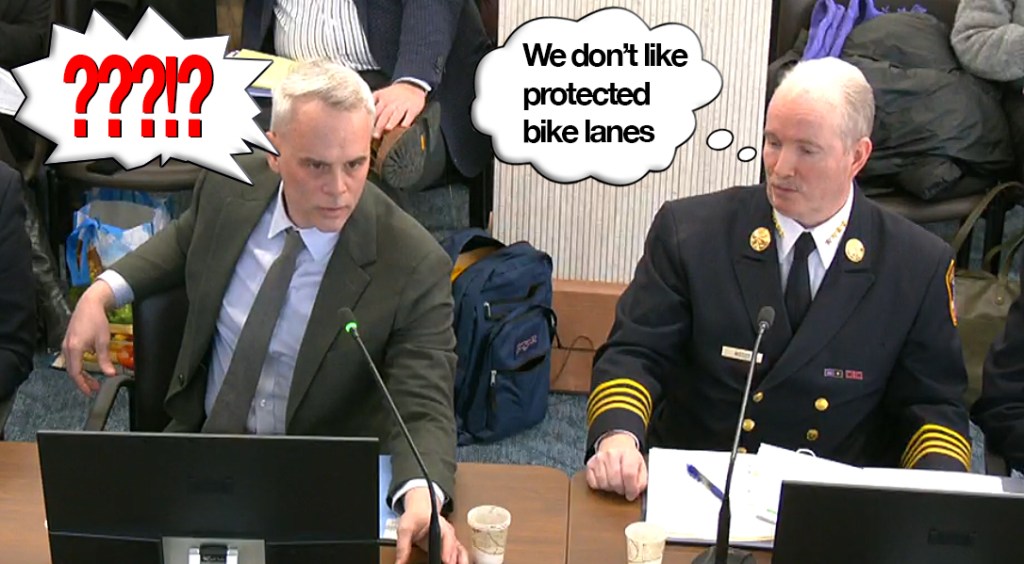
A top Fire Department official fanned the flames of anti-safety lies at a bizarre City Council hearing on Wednesday, claiming without evidence that protected bike lanes hobble first responders — testimony that counters Mayor Mamdani’s support for long-proven strategies for reining in traffic violence.
FDNY’s Chief of Fire Operations Kevin Woods, a 36-year veteran of the department, told lawmakers that the agency opposes protected cycle lanes — before walking back the comments — and contradicted Department of Transportation officials sitting right next to him.
“The Fire Department is not against bike lanes. We’re against the protected bike lanes,” Woods told the Council’s Committee on Fire and Emergency Management, which is chaired by the conservative car-first Queens Council Member Joann Ariola.
Woods, who oversees the day-to-day work of more than 11,000 firefighters, fire officers and chiefs, repeatedly criticized protected bike lanes, saying that when the DOT uses them to reduce a roadway to one car travel lane, the resulting configuration blocks car drivers from pulling out of the way, unless DOT creates “cutouts,” or no-parking zones — some of which already exist, but are often already filled with a car.
And the separated cycling paths force ladder crews to deploy further away from the building, he added – while inadvertently describing all the ways that cars get in the way.
“It reduces the real estate in that street,” said Woods, who made $271,476 last year, according to city records. “When you have curb, eight feet of bike lane, three-foot bumper, nine-foot travel lane, parked cars, [drivers] can’t pull over to the right, and we can’t go around that traffic to go into oncoming traffic because they can’t pull over to the right, either. So that’s a big, big obstacle for us … as well as laddering the building.”
The stunning statements contradict Mayor Mamdani’s transportation agenda to make the city’s streets “the envy of the world,” which includes deploying protected bike lanes, which have proven to reduce traffic deaths across the board by double-digit percentages, and bus lanes to fulfill his campaign promise of speeding up surface transit.
Other cities like Paris that have aggressively made their streets more bike friendly have reduced emergency response times as a result.
Streetsblog reached out to the city for a comment on Woods’s assertions while he was still testifying. Later in the same hearing, he backtracked, saying he was not against protected paths per se, just the “complexity” they add to the streetscape.
“Just for the record, I mentioned previously the FDNY was against protected bike lanes,” Woods said after our queries reached City Hall. “We’re not against protected bike lanes. We’re against the complexities that it brings on, and we’re willing to work with the DOT.”
Nevertheless, Woods’s testimony gave ample fuel for conservative bike lane foes to chastise transportation experts.
“I’m so glad that you went into that deeply how it affects your apparatus and your operation, and that is why you should never, DOT, implement any change without the confirmation from the FDNY,” said Ariola (R–Rockaway).
Ariola had called the Feb. 25 meeting to assess the impact of her legislation that now requires DOT to not only consult with FDNY’s headquarters, but also with each local firehouse, on many street redesigns. But the hearing quickly devolved into lawmakers grandstanding.
“It’s insane to me that we have put bike riders, and bus lanes, and bike racks taking up parking spaces over firefighters and putting out fires, which are becoming more and more as we do the batteries and everything else,” said Vickie Paladino (R–Whitestone). “You are butchering our streets and limiting our firefighters from doing their jobs.”
One progressive lawmaker criticized FDNY officials for opposing street-safety infrastructure.
“We know what designs work, that protected bike lanes will save lives, and the orientation that I’m hearing from the Fire Department today is that you’re unwilling to consider the evidence-based approaches that make our community safer, and that you’re unwilling to work cooperatively and collaboratively with the Department of Transportation to make projects better,” said Lincoln Restler (D–Brooklyn Heights).
Woods could not provide any data indicating that protected bike lanes hamper emergency services, but said it was “common sense,” when Streetsblog asked for concrete statistics after the hearing.
“We don’t have hard data, but anecdotally, when you go from two lanes to one, it’s going to create some bottlenecks,” said Woods, who is not a traffic engineer. “We look at it as common sense.”
That echoed the classic windshield perspective that bike lane opponents throw around at community meetings without evidence. Traffic engineers have known for decades that building more space for cars increases congestion, due to the phenomenon of induced demand.
Ariola’s law piled on yet another level of paperwork for DOT under the the so-called “major transportation projects” law dating back to 2009, which codified that any DOT street redesign more than three blocks long or open street needs the sign-off from the Fire Department, the Police Department, the Department of Small Business Services, and the Mayor’s Office for People with Disabilities, and provide a certification of those consultation.
Bike lane opponents have also successfully used that law to sue the city to stop projects, like on 31st Street in Astoria.
Former Fire Commissioner Laura Kavanagh, who worked for former mayors Bill de Blasio and Eric Adams, criticized lawmakers for weaponizing vague concerns about emergency services to attack bike lanes they don’t like.
Kavanagh and her predecessors have repeatedly made clear that the number one obstacle to first responders is car traffic, not bike lanes, but that fact seemed to be forgotten during the hearing.
Also unmentioned at a hearing ostensibly convened to make sure firefighters were getting all the help they need: the ongoing spike in drivers blocking hydrants that have led to fatalities and injuries in recent deadly fires.
DOT officials did do some damage control at the hearing by noting that they design protected bike lanes to also serve as a clear emergency access lane – like here in Midtown:
DOT’s lanes follow a standard they “met with the Fire Department on,” said DOT Associate Deputy Commissioner Sean Quinn.
“All our clear zones, all the guidance we give to clear the space for us is met with the standards of FDNY clear zones.”
But when Ariola asked about that, Woods opened his hose on DOT, asserting that New York’s Bravest don’t use the emergency lane.
“We don’t use a bike lane, and we don’t stress [to] our members to use a bike lane,” he said.
Streetsblog asked Woods to clarify the agency’s policy on using protected bike lanes after the hearing, he said that “there is no policy,” and said the lanes are too narrow for fire trucks and that cyclists wouldn’t expect emergency vehicles.
“As far as a fire truck, we don’t have the width of that lane. It’s about eight feet. Our rigs are nine-feet-plus,” Woods told Streetsblog. “It’s also a liability. We could hit a bicyclist. They don’t expect the fire truck to be driving down a bike lane.”
During the hearing, Ariola went through a slideshow of pictures and videos of fire trucks ostensibly struggling to get around granite blocks and planters that DOT uses to keep cars from illegally parking near bike lanes and at open streets.
She zeroed in on the recently installed Court Street protected bike lane in Cobble Hill, which also faced legal challenges, displaying a picture of a clear space between a fire truck and a hydrant as evidence that the street redesign was obstructing fire operations.
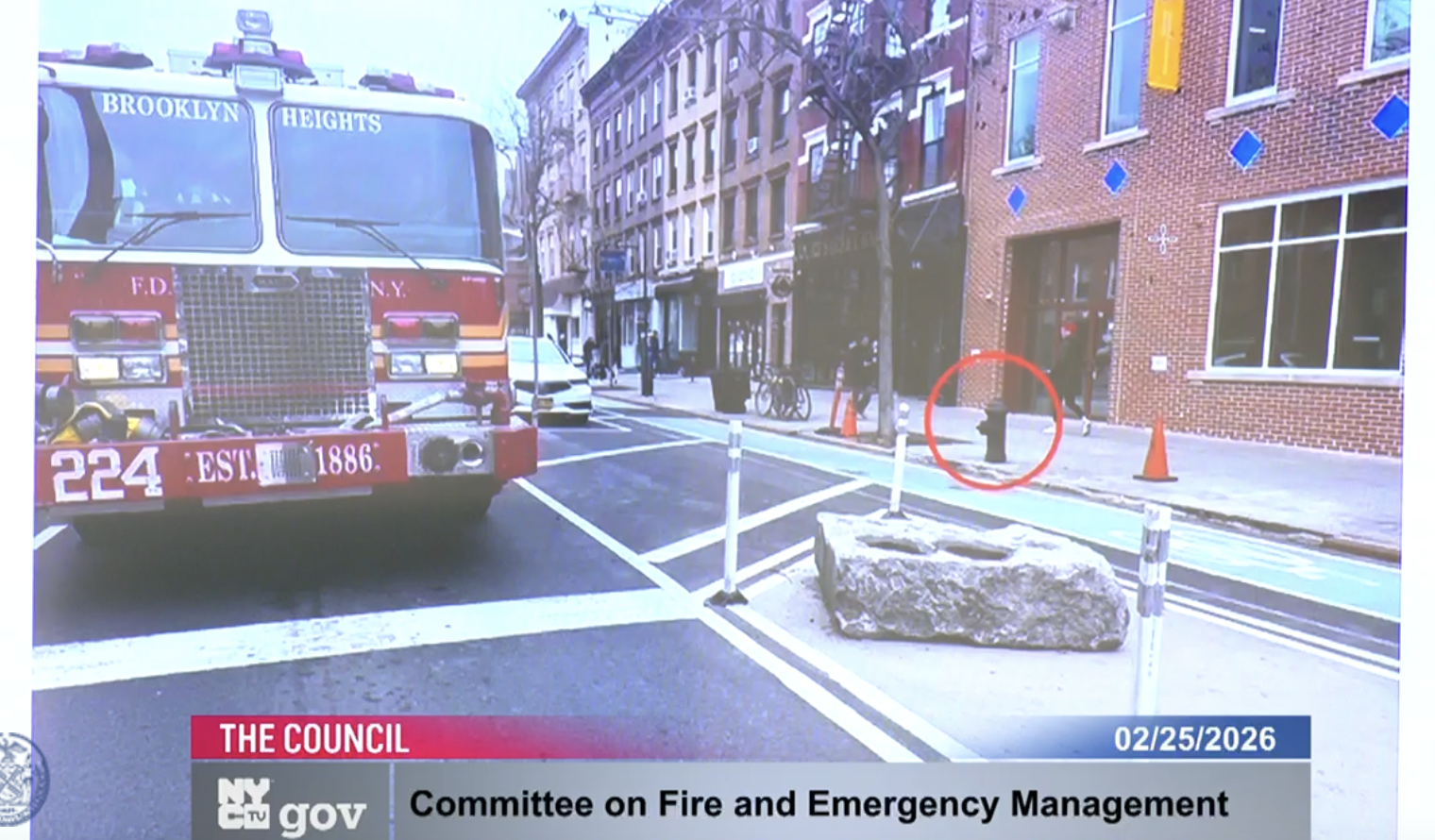
Woods argued that fire trucks can’t easily access hydrants next to protected bike lanes because they pull up further from the curb, arguing that they need more than the 15 feet of no-parking on either side required by city parking rules.
“Once you have that protected bike lane, we need more than 30 feet because you’re coming from a distance away from that curb now, you have to make a sharp turn into that hydrant, which means we could be blocking the street as well. So all of these additional obstructions affects life safety,” Woods said.
The picture Ariola showed actually includes a striped area DOT added that drivers surprisingly kept clear, and Quinn, who was sitting right next to Woods seemed perplexed by his comments.
“This is the first time we’re hearing about the additional feet needed beyond the 30 feet, so [we’re] happy to have those conversations,” said Quinn.
The hearing marked the second time in as many days that a top uniformed official defied the Mamdani administration. On Tuesday, Police Commissioner Jessica Tisch called people throwing snowballs at NYPD officers “criminal” just hours after the mayor said “it looks like a snowball fight.”
A City Hall spokesman disagreed that Woods was contradicting Mamdani’s transportation policies, adding that the FDNY would staff up to improve collaboration across agencies.
“Protected bike lanes are a key tool in the Mamdani administration’s safer streets agenda, and we fully support expanding them across New York City,” said Sam Raskin. “These lanes make the city work better for every New Yorker, whether they bike, walk, or drive.”

Read More:
Streetsblog has migrated to a new comment system. New commenters can register directly in the comments section of any article. Returning commenters: your previous comments and display name have been preserved, but you'll need to reclaim your account by clicking "Forgot your password?" on the sign-in form, entering your email, and following the verification link to set a new password — this is required because passwords could not be carried over during the migration. For questions, contact tips@streetsblog.org.