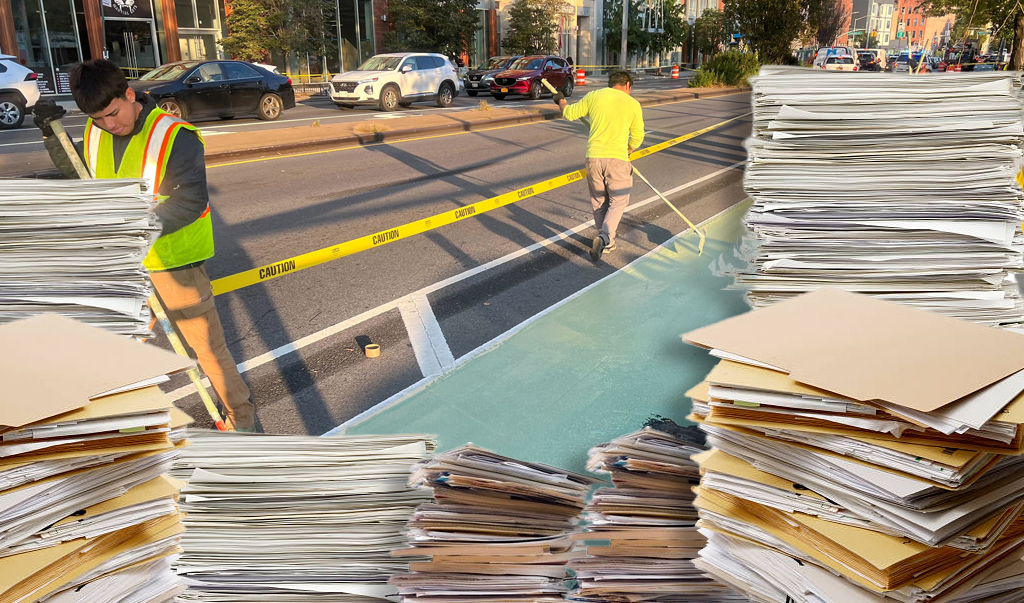
Streetsblog provides high-quality journalism and analysis for free — which is something to be celebrated in an era of paywalls. Once a year, we ask for your tax-deductible donations to support our reporters and editors as they advance the movement to end car dependency in our communities.
If you already support our work, thank you! If not, can we ask for your help?This year’s fundraiser includes a special gift for our biggest supporters. Don’t miss out.
Together, we can create a more livable, walkable, bikeable, equitable and enjoyable city for all. Happy holidays from the Streetsblog team!
An obscure 16-year-old city law that provided a Queens judge the pretext to kill a protected bike lane earlier this month continues fueling opposition to city street safety redesigns that have become well established, say advocates and former agency officials, who are calling for reform or outright repeal of the Bloomberg-era statute.
As a result of a 2009 Council law that defined bike and bus lanes as “major transportation projects” if they exceed three blocks or 1,000 feet, the Department of Transportation must spend months letting laymen on community boards and in the City Council review the work — and subsequent laws added extensive consultations with four other agencies.
Queens Supreme Court Judge Cheree Buggs last week cited the rule to order DOT rip out a half-finished bike path on 31st Street in Astoria, arguing that agency officials had not properly certified their communications with their Fire Department counterparts, overriding the agency’s well-established authority to manage the Big Apple’s streetscape as it sees fit.
The law was “absolutely created to gum up the works, and it’s still succeeding in 2025,” said Jon Orcutt, who was a director policy at DOT at the time and now leads advocacy with Bike New York. “That lawsuit would not have prevailed without that legislation.”
Meanwhile, another protected bike path on Court Street is also under threat after merchants sued, claiming DOT did also not do enough public outreach, despite multiple meetings with the community boards and surveys on the street and with businesses.
Transportation officials have adapted their process by doing copious amount of outreach beyond politicians and community boards, the latter of which tend to skew whiter, wealthier, older and more male than the neighborhoods they represent.
But the recent lawsuits lay bare how standard redesigns remain vulnerable to lengthy litigation. Getting input from residents can improve plans, but the rigid regulations add unneeded delays and are outdated at this point, said one expert.
“Community consultation makes better projects – DOT agrees with that – but there’s just no way to get through the calendar faster, because the calendar is in large part dictated with this law,” said another former DOT official, who asked to remain anonymous. “It’s a shame to slow down a potentially life-saving program for something like that.”
Bike lanes were new and controversial enough at the time to regularly make front page news, and car-focused politicians wanted to slow the progression of street redesigns with procedural road blocks.
“It was really just an obstructionist move to put a spanner in the works,” said Paul Steeley White, who fought the bill when he was the leader of Transportation Alternatives (he’s now the executive director of the statewide advocacy group Parks and Trails New York). “The Council members who really instigated these bills were definitely on the wrong side of history when it came to the bike lane wars in the late aughts.”
Alan Gerson, the Lower Manhattan Council member who wrote the 2009 law, denied that his bill sought to curtail bike infrastructure, saying he only wanted a check on DOT, whose projects did not previously require public scrutiny.
“Let me be clear, this was not an anti-bike-lane law by any means whatsoever. I personally support bike lanes, I’m an avid biker,” Gerson, who is now the general counsel for the Chinese-American Planning Council, told Streetsblog. “This was a basic good government bill.”
Gerson wanted to add more reviews to the city’s transportation work following Bloomberg’s attempt to redesign the chaotic Chatham Square in Chinatown by adding more pedestrian and cyclist space (a project that Mayor Adams has since revived).
“If a street has been a certain way for a generation, like Chatham Square was, those 65 days – what’s that, two months essentially, to get some city input? That’s not an obstruction, that’s just fairness to the community and maybe you wind up with a better project,” added Gerson.
In 2011, the Council passed another bill by eastern Bronx Democrat James Vacca requiring DOT to consult on these projects with Police Department, the Fire Department, the Department of Small Business Services, and the Mayor’s Office for People with Disabilities, and provide a certification of those consultation.
The Council added another regulation earlier this year, with a law by Queens Republican Joann Ariola forcing DOT to not only get the sign-off from the Fire Department headquarters, but also written confirmation that FDNY officials got feedback from all affected firehouses in the area of any three-plus-block project or open street.
As a result, DOT must consult with four of the city’s notoriously siloed agencies, and get top brass and workers in the field to sign off on paperwork — just to install a four-block bike lane with the same design DOT has been using for years.
“Right now DOT is responsible for providing internal Fire Department communications,” said Orcutt, “which is a total bureaucratic nightmare.”
Where there’s a will
Orcutt said that under a more supportive mayor — such as progressive Zohran Mamdani — the city could streamline its operations to announce the projects it planned to do at the beginning of each year, or use a clause in the law that allows “immediate implementation to preserve public safety.”
The public safety imperative is clear: more than 200 people die annually in crashes in the city.
“On Jan. 2, Mamdani could say, ‘We know if we do nothing else, 250 or more people will die on our streets,’” said Orcutt.
It’s unclear if the city has ever used that specific loophole, but in 2018, then-Mayor Bill de Blasio’s DOT moved swiftly to install a protected bike lane on Ninth Street in Park Slope, and did not worry about getting the community board’s endorsement. The quick change came after motorist Dorothy Bruns blew a red light and hit and killed two children and injured their two mothers, one of whom also lost a pregnancy.
However, relying on the “public safety” carveout could also backfire for transportation planners trying to do more work.
Lawmakers added the clause as a compromise with the Bloomberg administration, so the city could still work on shorter timelines in emergencies, and officials would likely open themselves up to litigation if they abused that bypass, according to Gerson.
“We had to entrust that the city officials would implement the law in good faith … and I think if there was an abuse of that, a court of law could call the city on that,” the one-time pol said.
The Council could also undo the law if it wants. For instance, in 2023, the legislature repealed an infamous 2011 law by late Council Member Lew Fiddler, that singled out bike lanes for a special 90-day advance notice requirement to community boards, as if bike lanes, not the roads they seek to calm, are a public danger.
DOT has also widened its net for getting feedback beyond electeds and community boards, who can often be resistant to change.
“If you’re in the abstract in a church basement, they’re gonna say, ‘I like the way it is,'” said the former DOT official who asked to speak anonymously. “When you talk to people in reality about, ‘Do you think it could be better?’ Of course they say yes.”
Agency staffers conduct surveys of passers-by and businesses along their corridors well in advance of proposals to show that people are eager to see street improvements. Officials also collect data on how people move to show that most don’t drive, and provide reality-checks for car-focused politicians.
Community boards could do some of the legwork to inform residents about changes and help them shape redesigns, rather than just be reactive naysayers, the former city official said.
“What are the community boards’ responsibilities to actually finding out what community sentiment is,” the person said. “All of the stuff we talked about DOT doing, community boards could be doing – and some do.”
Fodder for misinformation
Even if a mayor does speed up projects, the many requirements leave an administration more vulnerable to legal tactics to stall and kill projects.
In the recent Queens lawsuit, Judge Buggs zeroed in on DOT not getting a certified document showing it consulted with the FDNY on the project, even though they did review the redesign and get transportation officials to adjust it to make sure fire trucks could fit.
“DOT’s efforts may demonstrate engagement in a colloquial sense, it does not satisfy the plain language of [the major transportation projects law], which was enacted to ensure formal, documented, cross-agency review and to build a record of that review before major projects affecting emergency response and vulnerable populations are implemented.”
The judge’s ruling showed how bike lane critics often lean on vague notions that changes to the road block emergency services, despite these projects providing proven benefits for street safety and FDNY operations, which go hand in hand, according to Laura Kavanagh, who served as Mayor Adams’s fire commissioner until last year.
“Our modern mission is a lifesaving one, and people die on the streets at twice the number that as people die in fires,” Kavanagh told Streetsblog. “The number one thing that affects our response time is traffic.”
Protected bike lanes and bus corridors allow fast access for first responders, as can be seen here:
An ambulance glides through the midtown rush hour traffic thanks to the 6th Ave bike lane
Similarly, the 14th Street busway dropped response times, and making streets safer also reduces the amount of crashes paramedics have to respond to, Kavanagh noted.
The ex-commissioner, who now is a visiting urbanist fellow at NYU, recently criticized the judge’s ruling in Queens for using the fire department as a cudgel to roll back a much-needed bike lane. She said that citing emergency services each time opponents want to stop a bike lane “diluted” the rare cases when officials actually do raise concerns.
“If you say that every time, you’ve really diluted our ability to raise a red flag when there is one,” said Kavanagh. “I really hope that people would see the two agencies as partners in the fight to make streets safer, rather than as adversaries.”
Uniformed FDNY members check out each DOT street redesign project that could affect their operations, and give their recommendations to ensure maximum safety.
“At the end of the day, there are uniformed members who are actually doing the work of visiting those sites in person,” Kavanagh told Streetsblog. “I’ve rarely seen a case where our suggestions couldn’t be incorporated.”
Kevin Duggan joined Streetsblog in October, 2022, after covering transportation for amNY. Duggan has been reporting on New York since 2018, starting at Vince DiMiceli’s Brooklyn Paper, where he covered southern Brooklyn neighborhoods and, later, Brownstone Brooklyn. He is on Bluesky at @kevinduggan.bsky.social and his email address is kevin@streetsblog.org.
Streetsblog has migrated to a new comment system. New commenters can register directly in the comments section of any article. Returning commenters: your previous comments and display name have been preserved, but you'll need to reclaim your account by clicking "Forgot your password?" on the sign-in form, entering your email, and following the verification link to set a new password — this is required because passwords could not be carried over during the migration. For questions, contact tips@streetsblog.org.
President Trump sort of inadvertently made an argument for banning horse carriages from Central Park on Thursday when he critiicized the City Council's 40-7-2 vote to end the Central Park horse carriage industry with an ill-conceived analogy to cars.
The city's much-anticipated program to require speed-limiting devices inside the cars of repeatedly reckless drivers will launch next year, though questions remain.