Streetsblog provides high-quality journalism and analysis for free — which is something to be celebrated in an era of paywalls. Once a year, we ask for your tax-deductible donations to support our reporters and editors as they advance the movement to end car dependency in our communities.
If you already support our work, thank you! If not, can we ask for your help?This year’s fundraiser includes a special gift for our biggest supporters. Don’t miss out.
Together, we can create a more livable, walkable, bikeable, equitable and enjoyable city for all. Happy holidays from the Streetsblog team!
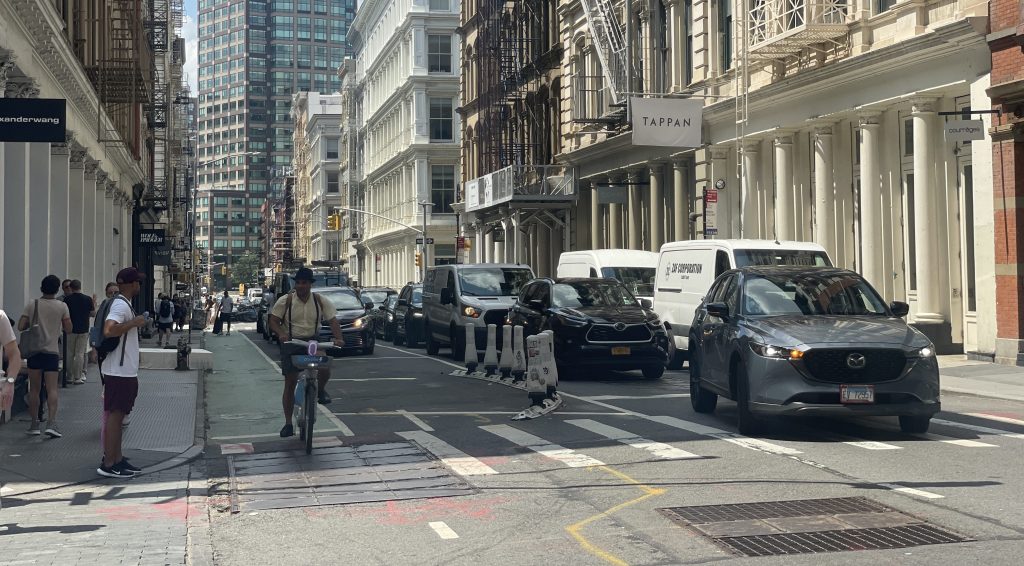
A Queens judge on Friday took the unprecedented step of ordering the city to rip up the partially installed protected bike lane on 31st Street in Astoria.
Judge Cheree Buggs waited until the last legally permitted day to issue the ruling, which defies years of legal precedent empowering the city Department of Transportation to redesign city streets as it sees fit.
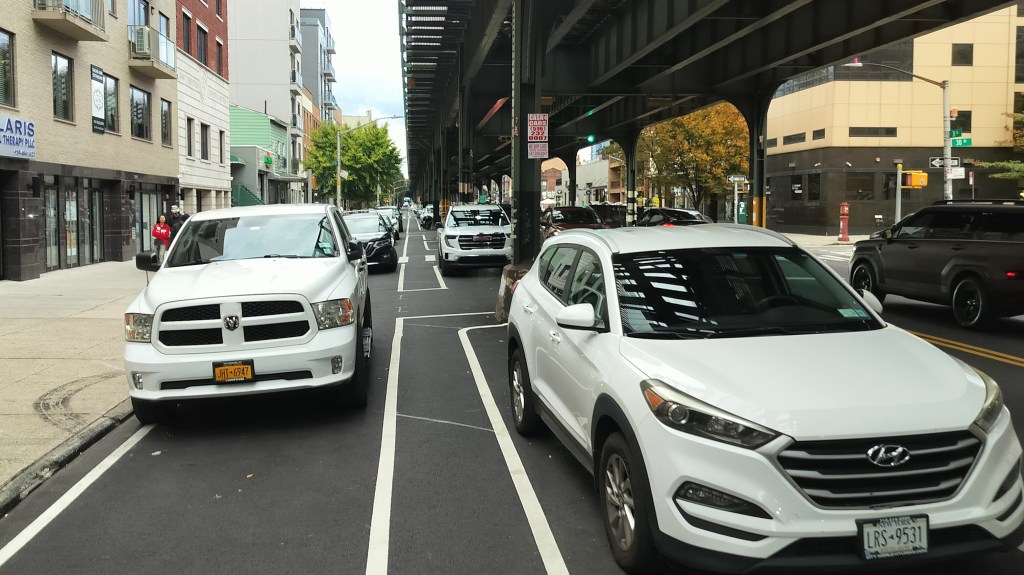
DOT installed the protected bike lane on one side of 31st Street between Broadway and 30th Avenue last summer before a group of revanchist businesses sued, and Buggs halted all work on the project. The full plan called for protected bike lanes on either side of the street between 36th Avenue and Newtown avenues.
“DOT shall take all steps reasonably necessary to restore 31st Street between 31st Avenue and Newtown Avenue … to substantially the same traffic markings, land configuration, and parking and loading regulations that existed immediately prior to commencement of work on the Safety Project in August 2025,” Buggs wrote, according to a screenshot of the document posted on Instagram by NY1 reporter Samantha Liebman.
In their suit, bike lane opponents, who include popular Astoria businesses like Parisi Bakery, Sotto la Luna and King Souvlaki, argued that the project would “jeopardize” the safety of cyclists and “increase the likelihood of injuries” to pedestrians — despite city data and mounds of research showing protected bike lanes do the exact opposite. They also asserted that the bike lanes would create “impediments for emergency service workers” — even though emergency vehicles can use bike lanes when necessary.
In the ruling, which Streetsblog obtained after initial publication of this story, Judge Buggs charged DOT with failing to demonstrate it met the law’s specific certification requirements associated with DOT’s obligation to inform FDNY, the Department of Small Business Services and the Mayor’s Office for People with Disabilities about the project.
It’s not clear, however, that those requirements outweigh DOT’s jurisdiction over city streets. In her ruling, Buggs took the extra step of siding with the arguments of bike lane opponents — without citing what part of the law gives their arguments any legal weight over DOT’s statutory power to redesign streets.
“The collective safety concerns expressed by FDNY, St. Demetrios School, local businesses and residents outweighs DOT’s policy considerations in adding bike lanes on the segment of 31st Street in Astoria, Queens,” the judge wrote.
The 31st Street corridor is one of the top 10 percent most dangerous roads in Queens, with 14 severe injuries or deaths and 139 total traffic injuries between 2019 and 2024, according to city figures.
A similar redesign of White Plains Road in the Bronx yielded a 41-percent drop in injuries to motor vehicle occupants and 10-percent decrease in overall injuries from traffic crashes, according to DOT.
Reps for DOT referred a request to comment to the city’s Law Department, whose spokesman Nicholas Paolucci said officials are “evaluating next steps.”
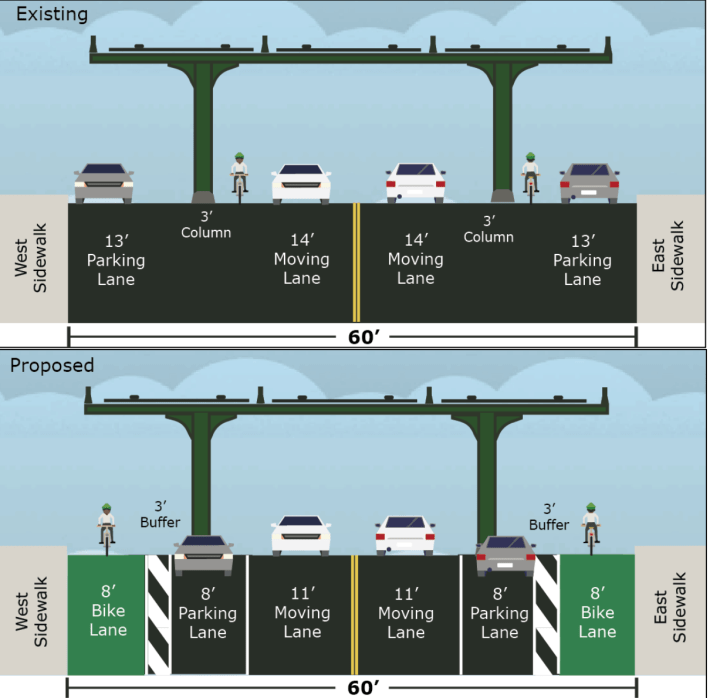
DOT’s plan to install a wide curbside protected on 31st Street beneath the elevated subway tracks. Graphic: DOT
Groups of neighbors and business owners frequently sue the city to protest the installation of a bus or bike lane, but judges routinely rule in the city’s favor, citing state law that gives municipalities broad discretion over how to layout roads.
And earlier this year, a Queens judge allowed the city to move ahead with a bike lane project in Long Island City. But it’s not just bike lanes. In 2019, a Bronx judge allowed the city to go ahead with its plan to remove a lane from Morris Park Avenue for a safety redesign known as a road diet.
That same year, a judge allowed the city to build the 14th Street busway.
And, of course, it goes both ways. Earlier this year, a Brooklyn judge allowed the city to go ahead with a plan to remove a bike lane, ruling with the same logic: the city is allowed to make reasonable changes to the streetscape.
Such suits are often brought under Article 78 of the state’s Civil Practice Law and Rules, which allows the public to challenge the actions — or inactions — of local government agencies. Article 78 allows for judges to rule on whether an agency acted beyond its authority or in an arbitrary manner.
“I stopped biking on 31st Street and I started biking on 35th Street because of the fact that I did not want to jeopardize my life each and every day,” Mamdani said at the time. “What I would tell those businesses, if they came to me, is that I stand with the DOT and with the other elected officials of the neighborhood in looking to ensure that every street is safe in our neighborhood.”
David was Streetsblog's do-it-all New York City beat reporter from 2015 to 2019. He returned as an editor in 2023 after a three-year stint at the New York Post and is now Managing Editor.
Streetsblog has migrated to a new comment system. New commenters can register directly in the comments section of any article. Returning commenters: your previous comments and display name have been preserved, but you'll need to reclaim your account by clicking "Forgot your password?" on the sign-in form, entering your email, and following the verification link to set a new password — this is required because passwords could not be carried over during the migration. For questions, contact tips@streetsblog.org.
A first full fleet inventory led to 70 fewer vehicles, fewer take-home cars and new accountability for crashes. Experts say New York’s deficit-ridden cities should audit their own.
He was struck and badly injured by a car driver. But his injuries weren't sufficient to trigger a real police investigation. And therein lies the problem.