Streetsblog provides high-quality journalism and analysis for free — which is something to be celebrated in an era of paywalls. Once a year, we ask for your tax-deductible donations to support our reporters and editors as they advance the movement to end car dependency in our communities.
If you already support our work, thank you! If not, can we ask for your help?This year’s fundraiser includes a special gift for our biggest supporters. Don’t miss out.
Together, we can create a more livable, walkable, bikeable, equitable and enjoyable city for all. Happy holidays from the Streetsblog team!
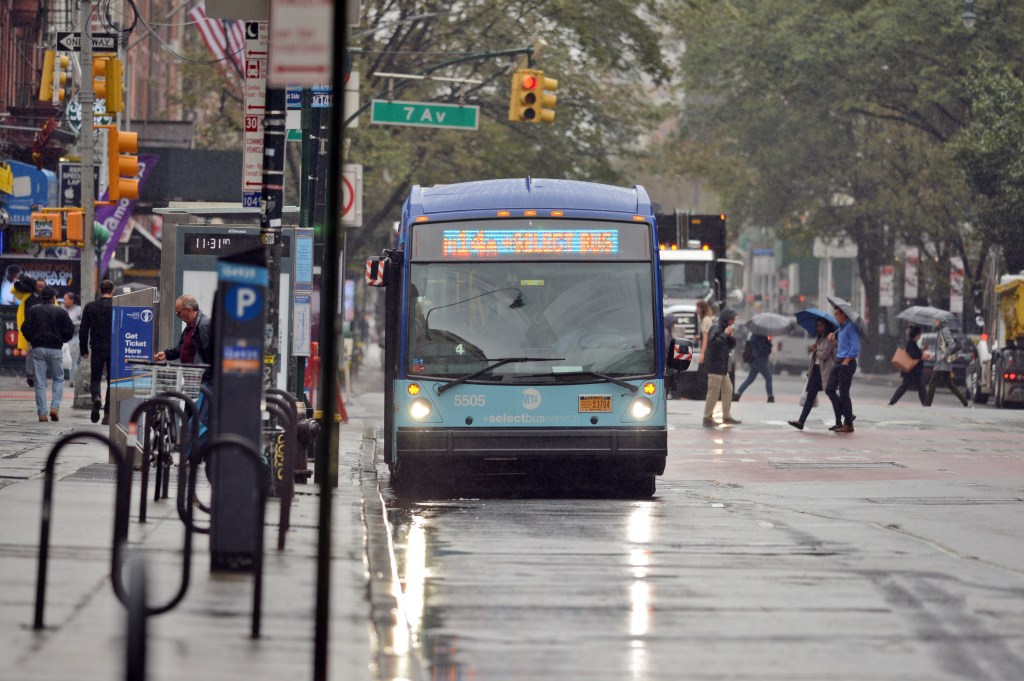
The residents of Curitiba recently witnessed the future of buses. Earlier this month, the Brazilian city unveiled a new kind of urban tram system: Electric buses that follow invisible, magnetic rails embedded in a fully-dedicated roadbed, carrying passengers for the equivalent fare of $1 per trip. It was a far cry from New York City, whose leaders too often treat buses, and their riders, as afterthoughts.
Mayor-elect Zohran Mamdani’s promise of fast and free buses is only a hint of what a modern bus experience should feel like. Yet some transportation experts have framed his priorities in terms of difficult tradeoffs. Our mental model of what the bus system could be is both far too small and limited by a zero-sum mentality. We do not necessarily need to choose between fast and free. We need a new way of thinking about, and building, the best possible bus experience.
Based on my work improving bus systems in ten cities across six countries—including New York, Rio de Janeiro, Mexico City, and Bogotá — and the thoughtful commentary of other transportation experts, I offer the following strategic roadmap for delivering a bigger dream for buses.
Get the governance right
The ways city agencies work together will determine whether the Mamdani administration succeeds or fails at transforming the bus rider experience. Getting the governance right will set the stage for the requisite policy, infrastructure, and operational changes.
Improving buses isn’t the sole job of the MTA and DOT. Speeding them up also requires definitive action from the Department of Design and Construction, for infrastructure such as level boarding islands; NYPD, for improved enforcement of bus-only street space; and Sanitation, for keeping bus lanes clear of debris.
A more holistic approach to the bus rider experience would also include agencies responsible for the sidewalks and streetscape used by bus riders (Parks, EDC), administration of the Fair Fares program (Social Services, Human Resources), and teaching children to use and respect transit services (NYC Schools).
For example, when I spearheaded a priority bus corridor in Bogotá, a city the size of New York, I worked with 18 different municipal agencies to improve the experience of the corridor’s 380,000 daily bus riders.
Aligning the interests and actions of multiple government agencies is a significant challenge. For this reason, Mamdani should create a new position: a special envoy for buses endowed with real political authority, including decision-making across mayoral agencies, negotiating power with the MTA, and direct access to the mayor. The mayor-elect must ensure that all agency leaders responsible for the bus experience are aligned around this new goal.
This alignment requires understanding and actively anticipating that major bus improvements will draw an uproar from car drivers and developing mechanisms to address their protests. The new administration could form a special “social management” team to work with community groups to resolve local concerns, such as curb management, that arise when we reconfigure streets to prioritize people over cars.
Quickly deliver on fast buses
For many riders, time is more valuable than their fare. Think about someone earning minimum wage who has an hour-long commute on the bus. Shaving 15 minutes off their commute — worth $4.25 of their time, at a wage of $17 per hour — would be worth $1.25 more than eliminating their $3 bus fare. In other words, the economic benefit of making buses faster may outweigh the benefit of making buses free. Several actions to speed up buses are within the mayor’s control without needing support from the MTA. These can be delivered quickly and lay the groundwork for longer-term solutions.
First, the mayoral team should accelerate existing MTA and DOT projects that have already broken ground. Drawing from the lessons of DOT’s “Smart Curbs” program, the department can implement curb management strategies across all five boroughs on the highest demand bus corridors to pave the way for bus priority. Second, accelerating the full implementation of automated camera enforcement on buses — through supplemental funding, advanced technology, and additional DOT staff to process tickets — can rapidly improve bus speeds by getting drivers and parked cars out of the way.
Third, DOT can use a combination of physical and digital infrastructure to raise bus speeds. In anticipation of permanent bus infrastructure, the department can install temporary physical barriers to create new bus lanes and protect existing ones. With GPS data, artificial intelligence, and software protocols known APIs — instead of hardware — DOT can also expedite the rollout of Transit Signal Priority on all bus routes.
Develop sustainable solutions for fast and free buses
A significant risk to Mamdani’s bus plan is that it could be undone by subsequent administrations at the local or state level. Solutions with sticking power often take longer and require more resources to develop and execute, because they tackle important but not necessarily urgent problems that will require politically and financially sustainable long-term solutions.
It is imperative that Mamdani’s administration create or identify a long-term, recurring stream of revenue to fund bus infrastructure and/or service.Radically raising speeds, providing higher frequency service, and making the fare free or discounted: All of these require stable revenue. Mamdani will struggle to achieve his bus objectives if he doesn’t figure out how to fund them.
Funds that simply cover current operating costs are insufficient. New revenue sources must allow for the increased service frequency bus riders are likely to expect, as well as the induced demand from free and reduced fares. This may mean following the example of other U.S. cities, like Los Angeles and Chicago, that use revenue collected from parking to fund transportation and neighborhood improvements. By contrast, 97 percent of parking in New York City is free. Whatever the final revenue source is, Mamdani must find a stream of revenue that cannot be easily reappropriated by his successor or Albany.
The long-term solution for faster buses is permanent, dedicated infrastructure. In major cities around the world, infrastructure in the form of Bus Rapid Transit, widely known as BRT, has dramatically improved bus speeds, safety, and customer experience. Yet the persistent reticence of elected officials to confront car drivers has left U.S. cities woefully behind their global peers.
In October, the New York Times highlighted how BRT would improve journeys on the B41, and international experts Annie Weinstock and Walter Hook provided data-backed recommendations for BRT locations throughout the city. Turning these recommendations into reality would require new mechanisms of accountability between DOT, DDC, and other NYC agencies that shape NYC streets to ensure time- and cost-efficient infrastructure design and construction.
Mamdani’s team will also need to develop a productive relationship with the MTA to enable faster bus operations. In the short term, adopting modern technology that integrates Transit Signal Priority with real-time information about bus locations to create a single source of truth for all stakeholders would enable DOT to better support bus operations. As bus speeds rise, better management of existing service, especially bus dispatching, will be critical.
Over the longer term, credible plans to build dedicated bus infrastructure will require modifications to MTA-procured vehicles. For example, some existing BRT systems use buses with doors on both sides of the vehicle to allow for flexible service plans that can use both BRT stations and regular bus stops to increase operational efficiency. Increased speeds will also require increasing the MTA’s bus fleet size to support existing or improved service frequency.
Elevate buses to democratize the street and dignify riders
The success of bus systems in peer cities around the world has created a new narrative about buses and their riders. In New York, buses are often marginalized and frequently subordinated to the interests of a much smaller number of drivers, in spite of the roughly 2.5 million people that ride the bus daily.
This is an opportunity to steer the political narrative around buses in the right direction, by focusing on democratizing scarce street space for the greatest number of people instead of the wealthiest. Permanently designating street typologies to place buses first in the NYC Streets Plan — which is due for an update in Mamdani’s term — would cement this priority. Behavioral campaigns that encourage New Yorkers to love their buses and treat bus operators with respect can transform the perception of buses and how their riders fit into our city.
To truly upgrade the bus experience in New York, we have to dream even bigger than “fast and free.” New York can lead and inspire other cities as a bus transportation innovator. And it can do so, if this administration chooses a new paradigm for buses that includes better service quality, more affordable transit services, and rebalanced streetscape geared toward a greater number of New Yorkers.
Becoming a city that dignifies the everyday experience of bus riders demands a concentrated, unified effort across the entire Mamdani administration and tough tradeoffs between powerful interests. If the mayor-elect has already proven anything, it is the ability to galvanize an unlikely coalition. His administration should put that to use and let New York City show the world what the future of buses can be.
Opinions and statements contained in this article are solely the author’s and do not represent the opinion or interest of New York State, the MTA, or New York City Transit. This article was supported with funds from the Moynihan Center at City College New York.
Streetsblog has migrated to a new comment system. New commenters can register directly in the comments section of any article. Returning commenters: your previous comments and display name have been preserved, but you'll need to reclaim your account by clicking "Forgot your password?" on the sign-in form, entering your email, and following the verification link to set a new password — this is required because passwords could not be carried over during the migration. For questions, contact tips@streetsblog.org.
President Trump sort of inadvertently made an argument for banning horse carriages from Central Park on Thursday when he critiicized the City Council's 40-7-2 vote to end the Central Park horse carriage industry with an ill-conceived analogy to cars.
The city's much-anticipated program to require speed-limiting devices inside the cars of repeatedly reckless drivers will launch next year, though questions remain.