Memo to Mamdani: When It Comes to Faster Buses, The Challenge Is Political
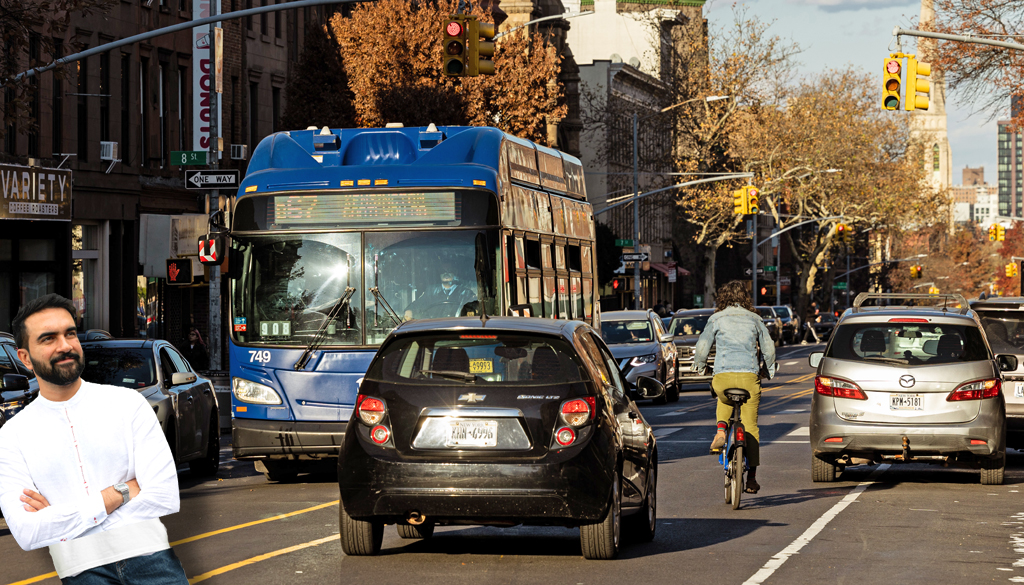
Zohran Mamdani’s election has the city on the precipice of what could be a transformative period for its slowest-in-the-nation buses — but only if the incoming mayor is willing to put his political capital on the line for bus riders.
Turning the campaign poetry of “fast and free buses” into the governing prose of real improvements is not a fait accompli, as any transit planner knows. However, with unwavering commitment to prioritize bus riders over private vehicles, and a strong working relationship with the state-run MTA, Mamdani, who will oversee the Department of Transportation, and Gov. Hochul, who oversees the MTA, have the potential to revolutionize the city’s buses to the benefit of all New Yorkers.
Technically speaking, the question of how to speed up the city’s bus system is not a difficult one.
Buses face three main sources of delay: traffic congestion, intersections, and bus stops. Transit experts have a slew of tools to address all these things — ranging from bus lanes to transit signal priority to bus stop balancing. Writer Jake Berman wrote recently in Streetsblog about how European cities have harnessed these tools. The National Association of City Transportation Officials, of which New York City was a founding member, has a Transit Street Design Guide full of recommendations to reduce bus delays. The city and the MTA have worked closely over the past 20 years to implement these recommendations on a number of bus routes.
Rather, the difficult questions are political. In particular, the Mamdani administration must emphatically answer yes to at least two questions if it is to achieve faster buses. Question 1: Is the mayor-elect willing to put his political capital on the line for the bus riders who swept him into office? Transportation politics is divisive, even within an otherwise united, progressive coalition. Reallocating street space for buses over cars will be vocally opposed by those with car based interests and their elected representatives, as I experienced first-hand as a transportation official in San Francisco. Mamdani will need to provide strong leadership and political cover for his DOT team to ensure that the millions of bus riders in this city — who, unlike other constituencies, generally do not or cannot advocate for themselves — get the street space necessary to have dignified bus service. DOT and MTA staff must of course engage proactively with the community and take care to minimize negative impacts. But when a key project inevitably hangs in the balance, Mamdani’s support, likely in the face of protests and lawsuits, will be key to get it across the finish line.
The second question is whether the mayor-elect can successfully engage the MTA on a shared vision for faster buses.
The MTA has a strong financial, operational and customer-focused motive to achieve this vision. Many of its efforts, however, need city endorsement to be successful. Ongoing initiatives such as congestion pricing and Automatic Camera Enforcement of bus lanes have sped up buses, but also elicit elected official calls to roll them back to protect private car use. Bus network redesigns and balancing bus stops are great ways to streamline bus service, but can get bogged down in City Council district and block-level negotiations. The mayor and governor must come together to champion an electrifying vision of the New York City bus system if Mayor-elect Mamdani has any hope of achieving his goal of fast buses.
Mamdani showed he can lead diverse coalitions at the highest levels by winning an outright majority in a three-way race for mayor while earning the most votes for any candidate for that office since 1965. He will now have to leverage these same skills to turn his vision of fast buses into reality. To do that, he must lead from the front and enable his team at DOT and his colleagues at the MTA.
Read More:
Streetsblog has migrated to a new comment system. New commenters can register directly in the comments section of any article. Returning commenters: your previous comments and display name have been preserved, but you'll need to reclaim your account by clicking "Forgot your password?" on the sign-in form, entering your email, and following the verification link to set a new password — this is required because passwords could not be carried over during the migration. For questions, contact tips@streetsblog.org.