DOT Re-Ups With Speed Camera Operator But Temp Tags Are Still Unticketable
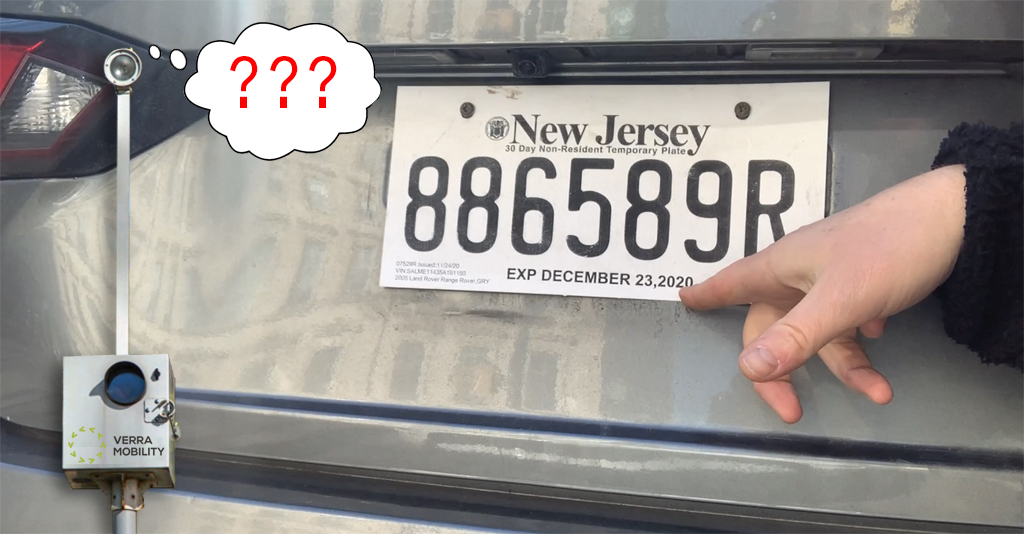
The city’s speed cameras still let drivers with temporary tags run wild, costing the city tens of millions in lost fines and incalculable lost safety, because the outside company that operates the system can’t obtain vehicle registration information for owners of cars with the paper plates.
But last month, the city Department of Transportation inked a new five-year, $1-billion contract with Verra Mobility, which has been operating the city’s speed-, red-light and bus-enforcement cameras for years.
The number of temporary tags, many of which were counterfeit, spiked during the pandemic, as scammers took advantage of closed Department of Motor Vehicle offices nationwide. But Streetsblog’s coverage, both in the form of an award-winning investigation of temporary tag fraud plus a viral social media campaign against temps or defaced plates (“criminal mischief“), led to some out-of-state reforms and highlighted the issue for city officials.
New York City’s cameras can detect and read the numbers and letters on temporary paper tags, whether they are legitimate temps that dealerships place on newly sold vehicles or simply fake temps. But in either case, the city can’t issue tickets to those scofflaws because even if the plate is legit, states do not provide access to the registration information. (And if the temp is fake, there is no registration information.)
A 2024 audit of DOT’s speed cameras by the city comptroller’s office identified the temp loophole as a major flaw, and recommended that the agency work with “law enforcement, state agencies, and other cities experiencing problems with missing, temporary, and obscured license plates” to identify potential solutions to the problem.
As a result, when Verra’s last contract was set to expire, DOT issued a request for proposals that specifically sought companies that would “establish new relationships, interfaces, and on-line connections with [state] Departments of Motor Vehicles” and “other governmental look-up services,” such as the National Law Enforcement Telecommunications Systems, which allows law enforcement agencies across the nation to exchange information such as criminal history and vehicle information.
Verra won the $998-million contract, but has failed to get states to provide the information. The company — a contractor receiving taxpayer money — declined to answer any questions from Streetsblog, referring us to DOT.
DOT told Streetsblog that temp tag fraud is on the decline, thanks to renewed focus and tightened laws out of state. In December 2025, for example, vehicles with temporary tags were snapped by cameras 12,775 times (or 3.2 percent of all camera triggers). That represents a 75-percent decrease from July 2024, when vehicles with temporary tags tripped the cameras 52,003 times (or 6.84 percent of all triggers).
Still, in 2024 and 2025, there were more than 766,000 camera triggers by vehicles with temporary tags, or roughly 4.8 percent of camera triggers in that period. If all of those triggers had resulted in the $50 tickets, the city would have taken in more than $38 million.
Advocates are frustrated.
“Ghost plates reward drivers who break the law, and put New Yorkers in danger by eroding the integrity of our automated enforcement system,” said Ben Furnas, executive director of Transportation Alternatives. “Cracking down on ghost plates and improper tags is critical for improving safety on our streets.”
The news is not all bad; DOT said that over time, Verra has been able to replace older cameras with newer equipment. As a result, the percentage of speeding or red-light transgressions that can’t be identified by Verra cameras has dropped from nearly 22 percent in July 2024 to 13.3 percent in December 2025.
The largest challenge right now, at least by percentage, is unregistered motorcycles, which comprised a plurality of unreadable plates in December 2025, oddly, the last month for which there is data.
Editor’s note: Data is provided by the city, but data expert Jehiah Czebotar makes it much easier to use by providing a running compilation on his website. We recommend it.
— with Gersh Kuntzman

Streetsblog has migrated to a new comment system. New commenters can register directly in the comments section of any article. Returning commenters: your previous comments and display name have been preserved, but you'll need to reclaim your account by clicking "Forgot your password?" on the sign-in form, entering your email, and following the verification link to set a new password — this is required because passwords could not be carried over during the migration. For questions, contact tips@streetsblog.org.