‘Broadway Vision’: City Will Revamp Six More Blocks By 2031
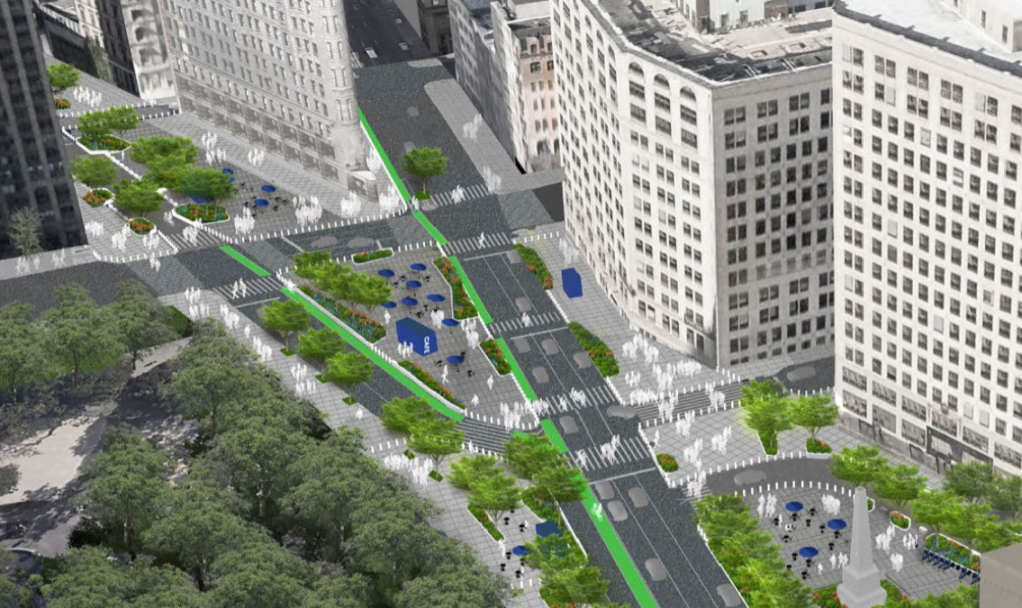
The city will bolster bike lanes and pedestrian plazas on Broadway north of the Flatiron Building with concrete plazas and expanded sidewalks, but the $156-million, six-block addition to the ongoing “Broadway Vision” overhaul won’t be done for another five years.
The 0.3-mile improvement between 21st and 27th streets [PDF] will be completed in 2031, according to the Department of Design and Construction, which has a history of slow-moving infrastructure projects.
The city has been reclaiming car space on Broadway for nearly two decades, but progress for a permanent streetscape redesign remains incremental on Manhattan’s diagonal corridor.
Advocates and experts have implored Mayor Mamdani to accelerate capital projects, drawing inspiration from other cities from Paris to Jersey City. Indeed, Broadway could become the new mayor’s proving ground, according to one transportation researcher.
“It is amazing that the city is moving to make permanent the Broadway pedestrianization,” said Annie Weinstock, director of programs at the organization People-Oriented Cities. “It’s a great sign that this administration is getting serious about the permanence agenda. It’s the kind of project that could become an example for other parts of the city.
“If the timeline for this project could be sped up, by reforming capital project delivery in the ways I discussed in this piece, it would be even more impactful,” Weinstock added. “It would obviously be great if the ribbon cutting could happen during the current mayoral term.”
The latest project is part of the Department of Transportation’s larger Broadway Vision project, “which looks to create a comprehensive pedestrian and cyclist priority corridor from Union Square all the way up through Columbus Circle,” Emily Weidenhof, the assistant commissioner of Public Realm for DOT, told Community Board 5 on Feb. 18.
“Over the years, we’ve continued to think about and respond and redesign the corridor, further developing it for pedestrians and cyclists,” Weidenhof added.
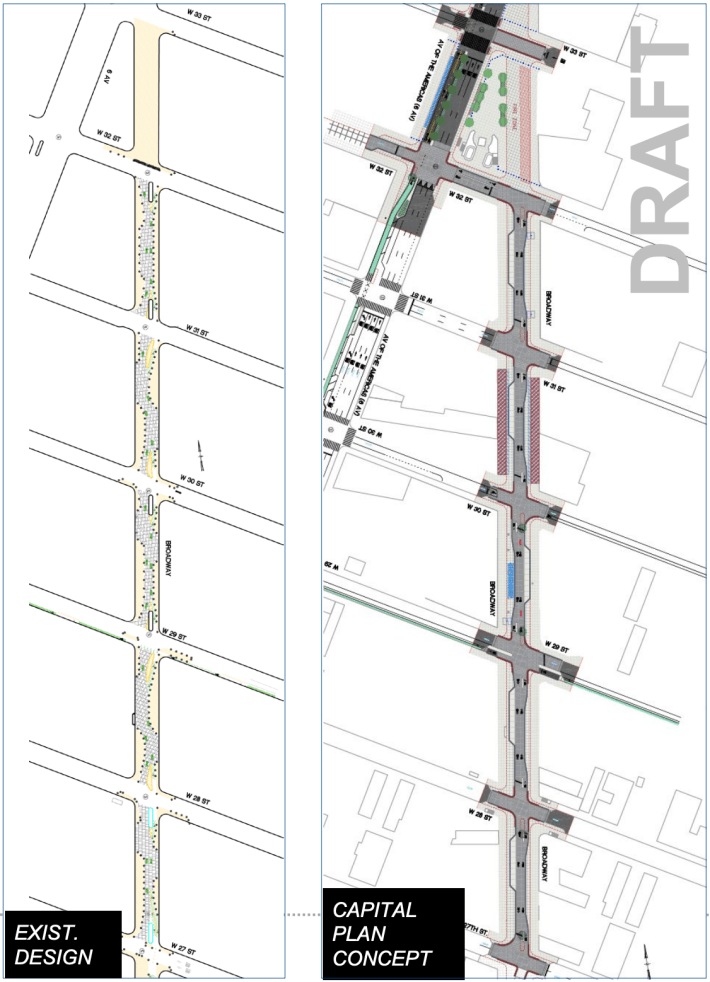
City planners are still working on the final redesign between 21st and 27th streets, with construction set to start in 2028.
City officials revealed draft renderings at last week’s CB5 Land Use, Housing and Zoning committee meeting, in a presentation that focused on an application for an expanded maintenance and concession agreement with the area’s business improvement district, the Flatiron NoMad Partnership.
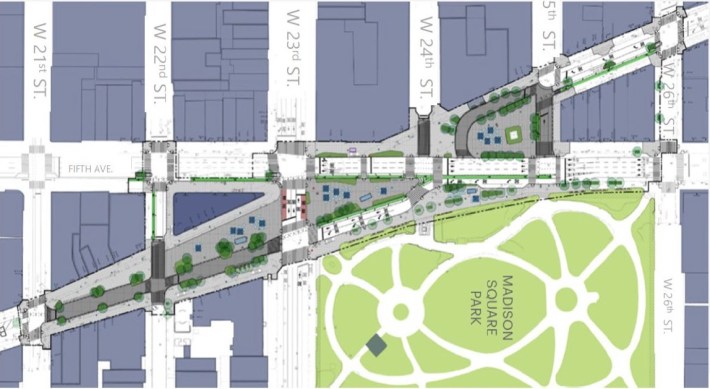
The work will essentially pour concrete streetscapes similar to what already exists in the form of beige gravel paint, such as the shared streets that prioritize bike and pedestrian traffic, and completely car-free plazas.
DDC officials estimate about $89 million for the street upgrades and $67 million for the underground sewer and water main work.
There will be five new raised blocks, pedestrian plazas, protected bike lanes, a new roadway alignment, and security bollards, according to DDC. There will also be curb extensions and raised crosswalks to calm traffic, landscaping, signage, planters, street furniture and concession kiosks.
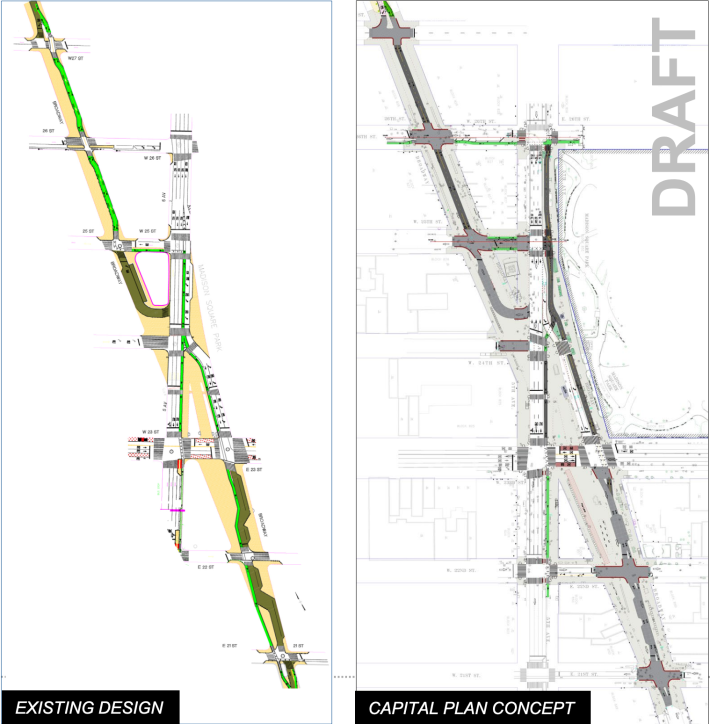
DOT also unveiled a future phase without a public timeline extending uptown to Herald Square. There isn’t a cost estimate for this stretch yet.
The city began installing pedestrian plazas around the wedge-shaped Flatiron Building all the way back in 2008, a year before then-Mayor Michael Bloomberg banished cars from parts of Times Square.
During the de Blasio and Adams administrations, DOT redesigned more parts of of Broadway all the way down to Union Square. Those redesigns heavily relied on paint, planters and plastic bollards to create shared streets and piazzas that flourished during the expansion of outdoor dining amid the Covid-19 pandemic. The first concrete build-out since Bloomberg’s Time Square redesign is now slated to start this September, covering 39th and 40th streets, which will take around two years.
DDC often takes years and spends millions for seemingly simple overhauls of the city’s public realm, as Streetsblog has documented extensively.
The agency dates back to the Giuliani administration, which wanted to speed up complicated infrastructure work that involved different agencies, such DOT and the Department of Environmental Protection, which manages the city’s sewer and water main network.
But DDC has struggled with its own bureaucracy, according to John Surico, a journalist and researcher of how to better deploy the city’s capital dollars.
Rules meant to root out corruption force the city to go with the lowest bidder, but that often results in shoddy work, Surico found. DDC must coordinate across several siloed agencies, each with its own review processes.
Projects can also suffer from so-called change orders, when an unforeseen issue like finding an extra sewer pipe nobody knew about forces the city’s alphabet soup of agencies to re-review plans.
“You basically have to reset the timer, you have to get all the approvals again, you have to go back to all the contractors – it’s such a mess,” Surico told Streetsblog.
The city could improve the process by incentivizing speedy delivery and allowing for more design-build projects, where the same company or consortium is in charge of both drawing up plans and constructing the same piece of infrastructure, so the city has to coordinate only with one entity.
DDC project managers don’t always share DOT’s sense of urgency for street redesign projects, Surico noted, so City Hall should push its construction arm to fast-track those priorities.
“There’s that cultural shift that needs to happen and there needs to be this incentive at DDC to bring this home,” Surico said. “Speeding up and delivering for the public is the goal.”
“Your playground should not be closed for six years, the streets should not be ripped open for four years,” he added.
A spokesperson for DDC justified the lengthy timeline and steep costs, saying that the project will redo the entire street above- and below-ground. It also required sign-off from a laundry list of agencies and more than a dozen studies for the design stage alone.
“This is a very complicated and comprehensive project that will almost completely rebuild a dozen blocks in a highly congested part of Manhattan both above and below ground,” said Ian Michaels in a statement. “Literally every square inch of the project area has been mapped and studied in three dimensions and is now being designed as part of a new streetscape.”
DOT acknowledged that this redesign is taking “some time,” but added that the agency is redoing sections of Broadway on an almost annual basis and is working to speed up its capital process.
“While this project is taking some time to come to fruition, it will bring a truly world-class street design that will last for generations,” said spokesperson Vin Barone. “NYC DOT is rapidly delivering transformative redesigns for new sections of Broadway nearly every year while we continue to work as a city to improve our capital project delivery.”

Read More:
Streetsblog has migrated to a new comment system. New commenters can register directly in the comments section of any article. Returning commenters: your previous comments and display name have been preserved, but you'll need to reclaim your account by clicking "Forgot your password?" on the sign-in form, entering your email, and following the verification link to set a new password — this is required because passwords could not be carried over during the migration. For questions, contact tips@streetsblog.org.