Council Leaders Push DOT In Both Directions On Streets Master Plan Goals
Who’s driving this budget?
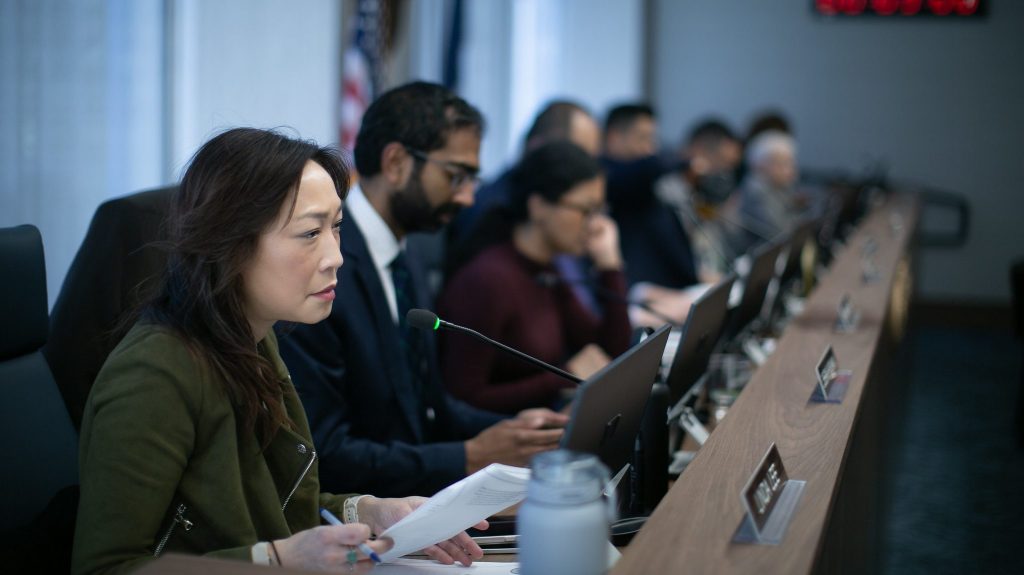
City Council Transportation Committee Chairman Shaun Abreu on Tuesday pushed Department of Transportation officials to commit to meeting the bus and bike lane mileage requirements of the Streets Master Plan, and to ask for more money if they can’t — only to be instantly undercut by Finance Chair Linda Lee, who joked that the agency should stop building bike lanes in her eastern Queens district.
At a budget hearing, Abreu repeatedly beseeched DOT Commissioner Mike Flynn to meet the goals of the Streets Master Plan, a 2019 law that sets legal benchmarks for the number of miles of bus lanes and bike lanes the city must install — numbers that the previous administration failed to meet.
“I don’t get to pick and choose which laws to follow, and I’m unsure why DOT feels that they have the authority to do that,” Abreu (D-Manhattan) fumed after Flynn wouldn’t promise to install the mandated 30 miles of bus lanes and 50 miles of bike lanes in 2026.
“They are legally required mandates of the department, not a suggestion,” Abreu said.
But Abreu, who is also the Council’s majority leader, got an immediate reminder of at least one reason DOT fails to meet those goals year after year: his own Council colleagues.
“If you guys wanted to slow roll the bike lane expansion, I know my district would be totally fine with that,” Lee said with a smirk at the outset of her own remarks, which came after Abreu’s back and forth with DOT.
Between 2023 and 2025, there were 5,093 reported crashes (or seven per day!) in Lee’s district. Those crashes injured 82 cyclists and 310 pedestrians and killed six pedestrians — few of whom found their injuries a laughing matter.
The Finance chair had earlier criticized 24/7 bus lanes when she asked MTA executives to reduce the bus lane hours in her district on Hillside Avenue — which carry 215,000 bus riders per day, according to MTA figures.
After the hearing, Abreu blasted out a triumphant press release celebrating how he “grilled” DOT during the hearing, but Lee’s comments about bus and bike lanes showed why he may need to turn his fire towards his colleagues if he wants to see the Streets Master Plan become a reality under his leadership.
A top agency official emphasized the importance of political support — seemingly anticipating Lee’s later line of questioning.
“The help that we need from the Council is not just monetary, it’s support for the projects that we have in place,” said DOT Executive Deputy Commissioner Paul Ochoa. “I think the mayor was very clear about the political support needed for a lot of these projects, so we would definitely appreciate that from every single Council member.”
Earlier this month, Flynn testified to Council members that DOT would focus on “outcomes, not just miles” in the next five-year streets plan, due at the end of the year. Even then, the Mamdani administration may prove to be a less pliant punching bag for Abreu than Mayor Eric Adams administration’s DOT was for then-Transportation Committee Chair Selvena Brooks-Powers, who rhetorically urged the agency to meet the master plans goals even as she opposed bike lanes in her own district.
Despite stark budgetary issues facing the city, Mamdani has proposed hiring 20 new DOT staffers dedicated to bus and bike lane projects, and baselined $5 million per year above what the agency previously spent on the projects. The cash boost should begin to dig DOT out of the years of funding shortcomings that agency officials and budget watchdogs have blamed for the Adams administration’s failure to meet the master plan’s benchmarks.
Mamdani also budgeted $25 million for the city’s secure bike parking program, which advocates want to hit areas far from Manhattan — areas like Lee’s district — to encourage New Yorkers to bike to and from transit hubs to get where they’re going.
On Tuesday, Flynn told Streetsblog that DOT won’t take Lee’s anti-bike advice — because there are people in Lee’s district, as in every part of the city, who need and want to get around safely without a car.
“Sometimes it’s about winning hearts and minds, and part of that’s using the data, but part of it is making sure we’re hearing from everybody, not just the loudest voices, not just the special interests,” Flynn said following the hearing. “We know even in neighborhoods where a lot of people drive, there’s plenty of people who don’t, especially for their commute. And so we need to make sure that all those voices are part of the conversation.”

Read More:
Streetsblog has migrated to a new comment system. New commenters can register directly in the comments section of any article. Returning commenters: your previous comments and display name have been preserved, but you'll need to reclaim your account by clicking "Forgot your password?" on the sign-in form, entering your email, and following the verification link to set a new password — this is required because passwords could not be carried over during the migration. For questions, contact tips@streetsblog.org.