The Mamdani ‘Streets Master Plan’: Big! Bold! No Mileage Benchmarks!
Benchmarks? They don’t have to show you any stinking benchmarks.
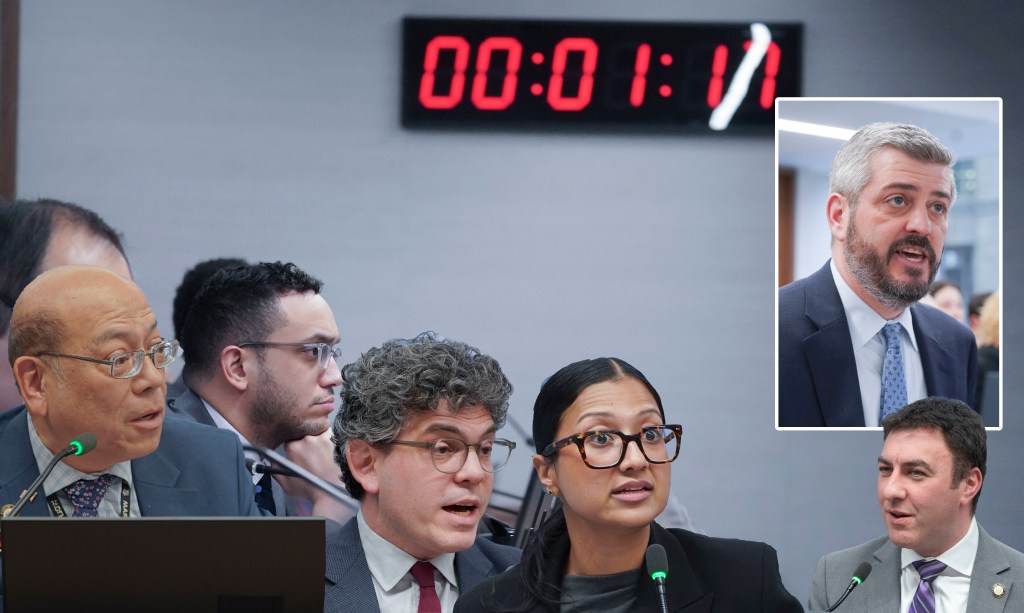
Department of Transportation Commissioner Mike Flynn told the City Council at a daylong Super Bowl Tuesday hearing that the next Streets Master Plan — the first of the Mamdani administration and due later this year — will not require the agency to build a set number of bus or bike lane miles, but will instead focus on “outcomes.”
“The city’s comprehensive vision [will] make our streets even safer, more welcoming, and more sustainable,” Flynn told the Transportation Committee, revealing that the Mamdani approach will set aside firm benchmarks. “This time, we’ll focus squarely on outcomes, not just miles.”
The first Streets Master Plan, which covers the years 2022 to 2026, requires DOT to protect 250 miles of bike lanes and create 150 miles of dedicated or camera-protected bus lanes over the five-year period. Rather famously, under Mayor Eric Adams, the agency fell short of hitting benchmarks that would accomplish those goals, year after year after year after year. That failure was self-inflicted in many cases, but the simple fact that the law demanded a flat number of miles also allowed Council members to play both sides of the equation, taking DOT to task for failing to hit the mileage benchmarks but also taking DOT to task for installing bike lanes.
The 2019 law that created the “streets plan” only set specific mileage benchmarks in the first version. Going forward, DOT has more leeway; the law only requires DOT to “complete a connected bicycle network and ensure a bicycle lane network coverage index of 100 percent [and] install protected bus lanes on all bus routes where such improvements can be installed.”
As a result, Flynn said hard numbers aren’t the key, but “outcomes,” such as higher bus speeds and fewer deaths and injuries on the roads, are.
“We have to be attuned how the work we do improves the lives of New Yorkers. We’ll ask clear, measurable questions. Are buses moving faster? Are fewer people being killed or seriously injured? Are more New Yorkers choosing to bike? Is it easier and more affordable to get around our city without a car? Is the public space we’re creating high quality and equitably distributed? These are metrics that matter,” he said.
After the hearing, Streetsblog asked Flynn how the public will be able to judge if the city is making progress without metrics. After all, former Mayor Adams often said, “If you don’t inspect what you expect, it’s all suspect.”
But Flynn said he was confident that the city would be able to calculate the progress without mileage targets.
“You can measure how people choose to get to work and by what mode, you can measure things like car ownership in the city, you can measure air quality, public health data. There’s plenty of ways to measure how the things we do affect people’s lives. I always say transportation is not an end to itself, it’s a means to an end,” said Flynn.
Mayor Mamdani’s many public commitments to better bikes and buses as a candidate, and the specific budget line item he included to fund bus lanes and bike lanes suggest he will complete street projects even without mileage benchmarks. And Flynn himself also laid out some of the projects that he considered small but mighty while he was being questioned by Transportation Committee Chairman Shaun Abreu.
“Widening sidewalks on Ninth Avenue in Manhattan and widening the bike lanes on Sixth Avenue in time for the World Cup is emblematic of how it may not actually contribute to our streets plan mileage targets, but it can have a really major impact on how people experience the city. Or something like Ashland Place, which is just a block basically, but the impact of creating that continuous north-south protected bike connection through Brooklyn will be huge,” he said.
Starting in 2028, the city will need to start tracking something called the “bicycle connectivity index,” a figure that explains how complete a protected bike lane network is based on the number of turns a cyclist can make from one bike lane to the other without ever leaving the protected bike lane network.
With those metrics in mind in mind, cycling advocates are considering pressing for some changes to the law to improve then next plan, to make up for some of the shortfalls from previous years and to get more granular data on the ways the protected bike lane network actually works.
“We should propose some amendments to this law, given where we are in the anticipated sort of effect of this law,” said Jon Orcutt, a former DOT official under Mayors Bloomberg and de Blasio. “There’s a catch up that has to happen because of all the missed targets. But also, we should start to get a live data map of the coverage index and the connectivity index. Because the connectivity index may look fantastic in, you know, East Village, but it might utterly suck in, you know, somewhere in the northern Bronx or Eastern Queens.”
Bus advocates are optimistic that strict mileage numbers aren’t necessary as long as the city specifies a specific percentage increase sought for bus speeds in the next edition of the streets plan — but it has to be “an ambitious percentage,” said Riders Alliance Director of Policy and Communications Danny Pearlstein.
“A little bit faster is not enough,” he added. “What the mayor said was the buses will be fast, and so we want them to be actually fast. We want to notice the difference.”
Of course, bus riders have been given shaky percentage-based promises to improve bus speeds by mayors before. Mayor de Blasio once promised to speed up buses by 25 percent in just two years, a promise that wound up being more foolhardy than ambitious. The overall 25-percent figure sat well with Pearlstein though, if it meant achieving the milestone over the life of the five-year plan.
Achieving something as ambitious as getting average bus speeds to 10 miles per hour citywide, or doubling the bike lane coverage index, will require a lot out of Mayor Mamdani.
“The big criteria is does mayor have [DOT’s] back? And I think this is the mayor who does have their back, and this is the mayor who’s demanding a lot from them,” said Pearlstein. “The planners and engineers and designers are not going to be the ones who the voters or the riders hold accountable. It’s City Hall, and that’s why we need a City Hall that is very plugged in to this issue. If in six months, there are red flags, we need a City Hall that’s going to take an active role and intervene and say, what do we need to do to adjust to make sure we’re hitting our targets and are able to deliver on our promises.”
Whether or not the current DOT is up to the task of pushing through internal and external inertia that kills ambitious and necessary projects is yet to be seen. Flynn told the Transportation Committee that DOT was specifically focused on building up in-house capacity and adding staff, but Council Member Lincoln Restler for instance did not count himself among the believers, given the agency’s track record on bus lanes under Mayors de Blasio and Adams.
“When we look at protected bus lanes, I would just say the record is uninspiring and it makes clear that we need significant new leadership, vision and resources from the Department of Transportation to get on track,” Restler told Flynn. “The way things have been working is not good enough. I hope that you are hearing that clearly from the City Council, that we want to see significant improvement … because we don’t want to be coming back to you in six or nine or 12 months with failures again.”
Similarly Orcutt, himself a DOT veteran from an era when the commissioner was being compared to Robert Moses for taking space away from cars, wondered if the current agency has enough ruthless aggression to really get the job done.
“It’s hard to imagine, with Mike having brought no new people in, that they’ll change their stripes very much. To do something good and new in the city requires a degree of ruthlessness, and I’m just not seeing it,” he said.

Read More:
Streetsblog has migrated to a new comment system. New commenters can register directly in the comments section of any article. Returning commenters: your previous comments and display name have been preserved, but you'll need to reclaim your account by clicking "Forgot your password?" on the sign-in form, entering your email, and following the verification link to set a new password — this is required because passwords could not be carried over during the migration. For questions, contact tips@streetsblog.org.