‘How Do You Do That to People?’ Crash Victims Speak Out Against Hochul’s Car Insurance Agenda
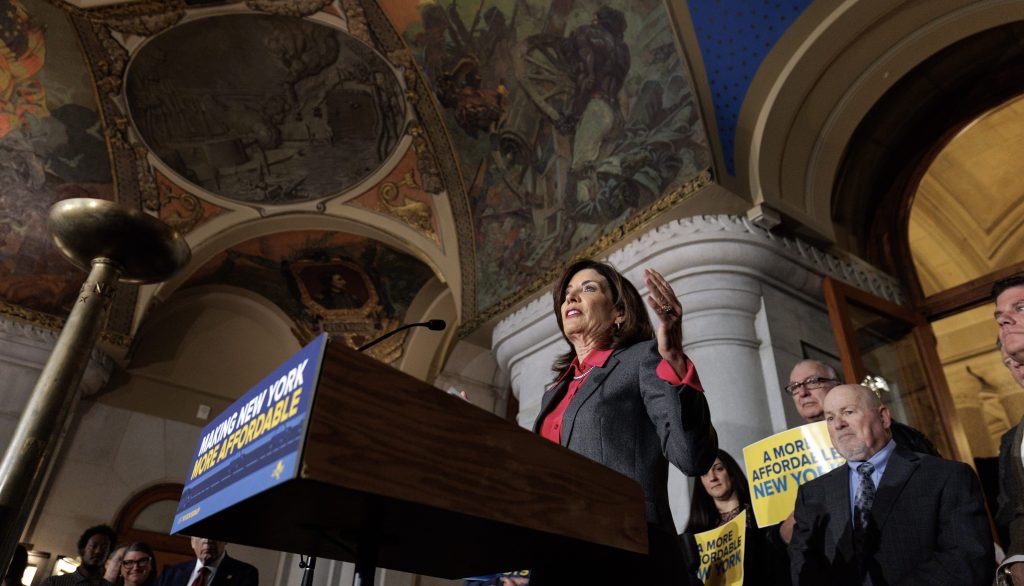
New Yorkers injured in traffic crashes slammed Gov. Hochul’s controversial push to erode victims’ rights to sue for damages, warning that the governor’s car-first campaign could be “financially crippling.”
The governor’s proposals, lobbied for by Big Tech companies like Uber, will slash compensation that people wounded by drivers desperately need to pay for their extensive medical care, said a Brooklyn nurse and midwife, who was doored while cycling to work a decade ago.
“When I hear what she’s talking about, my reaction is, ‘How do you do that to people,'” said Nina Sabghir.
Sabghir suffered a badly broken femur and other injuries that required several surgeries and two-and-a-half years of physical therapy, both of which maxed out the two insurances she had.
Victims of traffic violence said the governor’s focus on insurance premiums was misguided, and that she should instead address the daily carnage on the roads.
“The best and only way to reduce litigation from crash victims is to reduce the number of crash victims,” said Devan Sipher, a writer and journalist who was nearly killed after a tour bus driver mowed him down in the West Village in 2015. “The citizens aren’t experiencing fake crashes every day, they’re experiencing mortal fear crossing the street in New York City.”
Sipher shared with Streetsblog full horror of his injuries: “I had broken bones including ribs, clavicle and right leg. I was bleeding out on the street from a severed femoral artery and vein in my left leg, and nerves were also sliced through resulting in partial paralysis. My clavicle was sticking out of my body, but the many broken bones were actually the easy part. Then I had multiple complications in the hospital from large open wounds and many surgeries.”
The state’s chief executive has not directly addressed the horror of road violence in her push. Instead, she has pushed the claim of rampant fraud, like staged crashes, and that she is standing up to “special interests,” particularly the powerful trial lawyers lobby.
But Streetsblog has found that the state’s insurance regulator secures very few actual convictions for fraud, and that fake collisions are vanishingly rare, and that Uber-backed groups like Citizens for Affordable Rates are far outspending attorney lobbyists and using hired actors for propaganda videos.
It’s also worth reiterating that crashes are the leading cause of injury-related deaths in the state, with an average of 1,098 fatalities, 12,093 hospitalizations and 136,913 emergency department visits each year — or one emergency visit every four minutes — according to the state Department of Health. These are official statistics, not exaggeration or fraud.
Deadly and serious traffic crashes cost the state $135.4 billion in medical care, lost productivity, legal and court costs, travel delay, pollution, and property damage in one year alone, according to 2023 estimates – or roughly $6,770 per New Yorker, regardless of whether they drive or not.
What is a ‘serious injury’
Hochul’s slate of changes will narrow the definition of “serious injury,” which currently entitles people to more damages than the minimum $50,000 covered by no-fault insurance that victims get without having to go to court.
She also proposed completely eliminating damages for anyone whom a jury finds to be more than 50 percent at fault in a crash, along with a $100,000 cap if the victim was driving impaired, without insurance, or while committing a felony.
As the name suggests, no-fault insurance covers the first $50,000 in expenses, regardless who’s at fault. But for any additional compensation, injured New Yorkers have to go to court.
Hochul wants to change the state’s “serious injury” threshold by disqualifying people who suffer non-permanent injuries, even if the wounds or trauma keeps them out of work for months. (Fractures, loss of limbs or organs would still qualify, however.)
Sabghir noted that medical care is rarely straightforward. Her injuries required further treatment in the years after the collision.
The health care professional, who also advocates with the group Families for Safe Streets, has treated patients hit by drivers whose wounds could become ineligible for what the state defines as “serious injuries,” she feared.
“Her supposition that, ‘There’s a lot of fraud and people are faking these injuries in order to get million-dollar payouts’ is preposterous,” said Sabghir. “Knowing what you have to document medically to show that there’s been a serious injury, there’s a lot of documentation.”
‘Crippling’ costs
The second proposal would eliminate damages for people found by a jury to be more than 50 percent at fault in a crash — but those jury verdicts can be subjective, said people who actually went through that process.
Sabghir said that a jury could have easily put most of the blame on her, potentially disqualifying her for more payments, under changes Hochul is proposing.
Another Brooklyn woman, who was struck by a trucker while cycling a block from her work at Fort Hamilton Army Base in 2018, said that if the jury had decided she was to blame, the medical costs for her treatment would have spelled financial ruin.
“I would be left with over $100,000 of medical costs,” said Rivkah Weissberger. “It would have been financially crippling.”
Similarly, a woman who was struck by a driver in the suburbs last year said that she had to fight back against insurers and the motorist who were trying to put blame on her.
“If you have that blame game it’s always going to be fuzzy,” said Julie Trelstad, a book publishing consultant in White Plains. “It’s just your word against theirs.”
The driver in her case lied to police, according to Trelstad, saying that she walked outside of a crosswalk and on an adjacent, more busy street.
‘Victim is always to blame’
Even near-deadly injuries are still a battle, said Sipher.
After the tourist bus ran him over, doctors did not expect him to live and he spent three months in intensive care, followed by multiple surgeries after that.
Insurers tried to claim that he crossed the middle of the street without having the light, and he had to pay for his expenses for nearly four years until surveillance footage proved that he had crossed the street legally.
“I had around $200,000 of medical expenses by the time I was able to bring a lawsuit to get anything reimbursed,” Sipher said. “The idea that we’re going to trust insurance companies about who is seriously injured, about who is to blame — as far as they’re concerned, the victim is always to blame.
“They were more than happy — including in legal filings — to continue lying and say that I ran across the street in the middle of the street with a red light,” he added.
If there is fraud, law enforcement should go after bad actors, rather than the governor’s efforts to undermine rights to recover damages, crash victims said.
“Why aren’t they prosecuting, why aren’t they investigating these supposed fake crashes? Or is because my crash is a ‘fake crash’ … unless a person is fortunate enough to have evidence?” Sipher asked. “I’m lucky that I’m here to express on behalf of the people that are not able to say these things.”
A spokesperson for Hochul maintained that crash victims like these will still be able to sue and receive damages under her plans.
“Our proposal to bring down auto insurance costs ensures full protections for pedestrians and cyclists involved in crashes,” Sean Butler said in a statement. “Gov. Hochul has fought for life-saving street safety policies that take on super speeders and punish dangerous drivers, and by fixing a broken system where drunk drivers and speeders can cause a crash and still get jackpot insurance payouts, these reforms will make streets safer for all.”

Read More:
Streetsblog has migrated to a new comment system. New commenters can register directly in the comments section of any article. Returning commenters: your previous comments and display name have been preserved, but you'll need to reclaim your account by clicking "Forgot your password?" on the sign-in form, entering your email, and following the verification link to set a new password — this is required because passwords could not be carried over during the migration. For questions, contact tips@streetsblog.org.