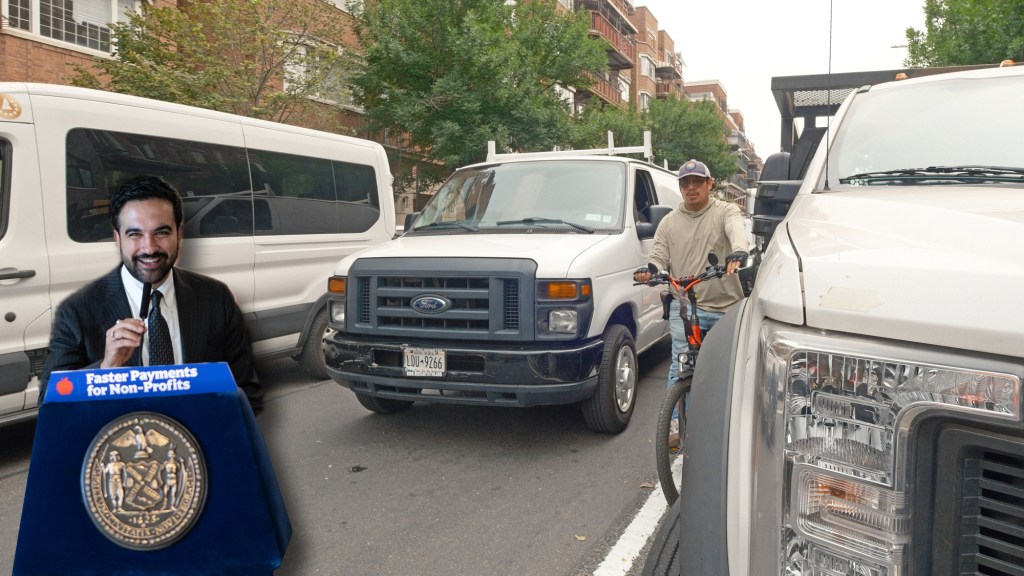
Mamdani Earmarks $96M for New Greenways as Current Paths Crumble
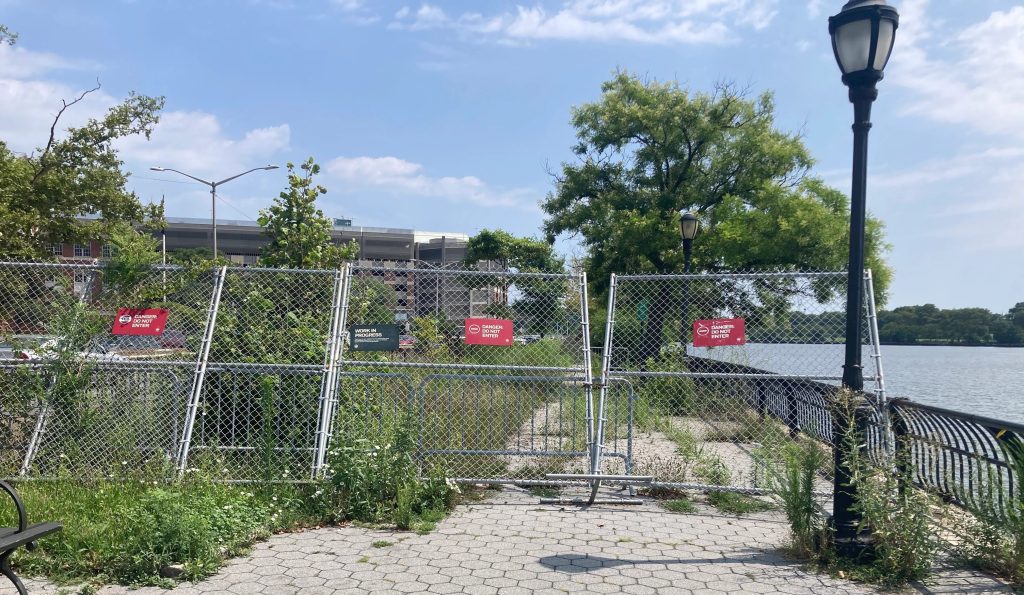
Mayor Mamdani’s executive budget added $95.9 million in new money to build out pedestrian and bike greenways over the next five years — an infusion welcomed by advocates who nevertheless cautioned that the funds are not enough to fulfill New York’s growing need for car-free paths.
The city routinely takes more than a decade to roll out new greenways, which serve both as recreational spaces and key transportation corridors. When those greenways finally open, however, the city often allows them to slowly deteriorate by delaying or entirely foregoing basic maintenance, such as fixing sinkholes and repairing cracks.
“Projects that were funded many, many years ago, it takes such a long time to actually implement them,” said Hunter Armstrong, executive director of the Brooklyn Greenway Initiative. “We just cut the ribbon on a project a couple of weeks ago that was years in the works,” he added, referring to a project on Sunset Park’s waterfront.
Significantly, the new money for the Department of Transportation will pay for capital construction of greenways, which refers to projects that involve hardened infrastructure — not the usual paint and flimsy plastic bollards. The transportation-focused mayor also gave the agency some $200 million over the next four years to quickly build out bus and bike lanes and public realm upgrades as part of the Streets Master Plan.
Cycle of disrepair
Past mayors treated greenways as an afterthought and let crumbling sections languish, from the country’s first bicycle path on Ocean Parkway to the nation’s busiest one on the Hudson River Greenway.
This cycle of disrepair forces city leaders to spend costly political capital to fund overdue renovations, whose costs rise as conditions worsen over time. During those renovations, the Parks Department and DOT have repeatedly refused to repurpose excess car lanes for safe passage, and instead directed cyclists onto unsafe detours for months on end. New sections of greenway still require years to install.
For example, the city recently wrapped up a stretch of two-way bike paths along one mile of Brooklyn’s Third Avenue that took 14 years to finish – as long as it took to construct the Brooklyn Bridge in the 19th century. Another proposal has already broken that record: a two-way raised bike path on three blocks of Commercial Street in Greenpoint will finally break ground sometime in 2028 – 16 years after city officials identified the route for upgrades in 2012.
These projects, like a $217-million esplanade stretching for eight blocks along the East Midtown waterfront, carry sky-high price tags. “Unfortunately the cost of these projects does add up, so ideally there will be ways to efficiently and wisely spend this money,” said Armstrong.
The greenway bucks come as a $7.25 million federal grant for greenways is set to run out next year. Under Mayor Eric Adams, the city spent that grant on planning new routes across the five boroughs but never provided a timeline or funding for the proposals, which included paths along the Bronx’s Harlem River and the western Queens waterfront.
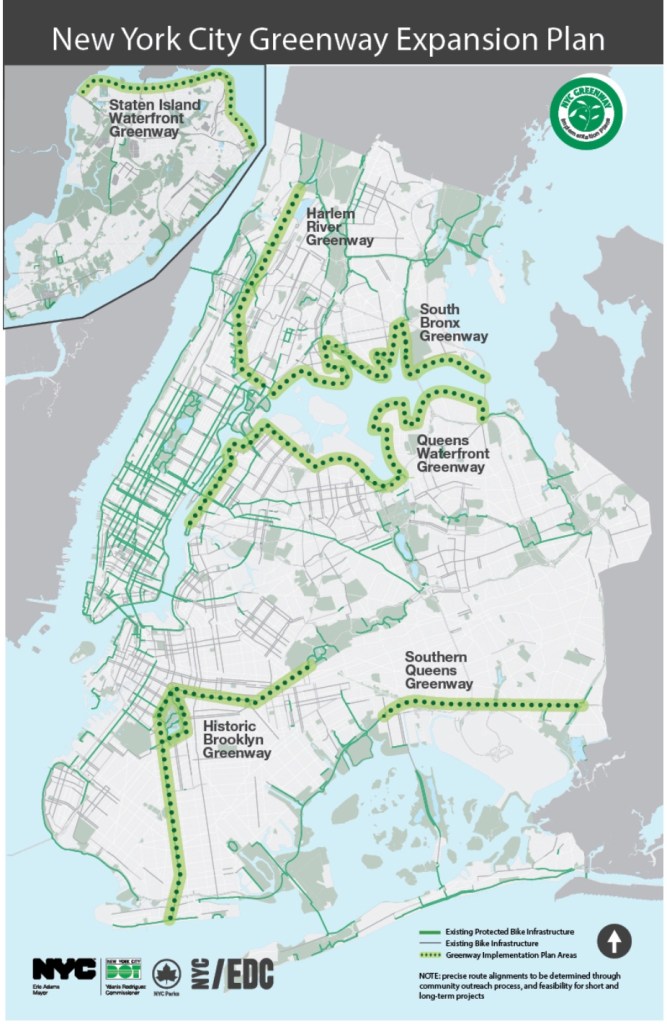
DOT said the new cash will help turn those proposals into reality. “This historic investment gives NYC DOT the largest budget in its history, including the biggest-ever funding pool for bus and bike projects,” agency spokesperson Vin Barone told Streetsblog. “That means more staff and additional capacity to deliver for all New Yorkers for years to come.”
Mamdani’s executive budget labels the new funds as “Bike Network Development 2030.” The money is dedicated to greenways now, but City Hall spokesperson Jeremy Edwards said the mayor could repurpose it for non-greenway bike lanes that are more immediately, pressing.
Still, the funding amounts to a small drop in the city’s $124.7 billion annual fiscal spending plan. The NYPD, by contrast, plans to spend nearly the same amount on overtime this summer alone, as Commissioner Jessica Tisch deploy cops on 12-hour shifts to patrol events like the upcoming FIFA World Cup and the celebrations around the United States’s 250th anniversary.
Capital woes
The Parks Department controls the majority of greenways and has its own $674-million pot of money for some longstanding greenway-related projects and spanning to mid-2034, according to agency rep Chris Clark.
But the agency does not have the staff and resources to realize its projects at a faster pace, according to the city’s greenspace advocates. Amid continuous budget cuts recent years, the agency hemorrhaged dozens of project managers, landscape architects and engineers.
“[These are] the very people who would be facilitating, if not spearheading, the capital projects that people want to see happen,” said Adam Ganser, executive director of New Yorkers for Parks. “The agency has been somewhat notorious in their ability to do capital projects, but it’s hardly their fault when they don’t have the staffing to do them.”
For example, the East River Esplanade alone has a $358.4 million budget for its renovation, but it has been crumbling into the water for years. “The funding has been there for a long time, but the project just continues to languish with no leadership or urgency,” Ganser said. “They’re in a tough spot because they don’t have the resources to push forward the literally hundreds of millions of dollars that have been advocated.”
Like other city agencies that perform capital work, Parks must submit new projects to an extensive design, procurement and construction process. This inevitably requires Parks to correspond and collaborate with other entities — such as DOT, ConEd and National Grid — whose infrastructural assets overlap with their own.
But most bureaucratic friction actually arises in the intermediate stage where Parks solicits and chooses third-party contractors to construct projects. This stage is layered with city and state regulations, whose architects originally designed them to prevent city leaders from corruptly favoring their cronies. In practice, these rules slow down routine work, a former senior Parks official argued.
“Procurement sucks. So much of it is out of the agency’s hands. It’s really hard to reform procurement on a simple agency level,” said Sam Biederman, who was the agency’s chief of staff during the late de Blasio administration and now runs a communications consultancy. “I get the point of not wanting this thing to be corrupt – I’m from Chicago – but the effect of all these decades and decades of laws … is to catastrophically slow down the procurement process.”
Former Mayor Eric Adams convened a task force to improve the capital process, and the new administration should look into reforms, and fund planning staff at Parks to be able to advance projects, according to Ganser.
“It is fixable and it would require both that the agency just decide that this is going to be their top priority… and then having the mayor and the administration focus on the procurement and capital process citywide,” he said.
Parks’s greenway repairs heavily rely on the goodwill of local elected officials to allocate their own discretionary funds for projects. In 2019, the agency finally began renovating a mile of the historic Ocean Parkway malls. That project cost more than $4 million over five years, after officials secured funds from then-Council Member Mark Treyger and Eric Adams, who was still Brooklyn’s borough president at the time.
The agency lacks the budget to maintain its vast portfolio of greenways, playgrounds, pools, boardwalks and miscellaneous greenery in a state of good repair, so officials have relied on lengthy and expensive capital projects rather than routine maintenance.
“Because the agency doesn’t have the money to maintain, it almost becomes part of a strategy,” Ganser said. “The only way they get these things repaired is if they become capital projects. It’s the most expensive way to do this. It doesn’t make any sense.”
The circumferential loops of Central Park and Prospect Park offer two vivid counterexamples. These drives are relatively well-maintained because they fall under the jurisdiction of DOT and its robust road resurfacing program — a legacy of those paths allowing car traffic until 2018, when former mayor Bill de Blasio banned motor vehicles from both.
Consequently, advocates have repeatedly urged the city to reassign greenway maintenance to DOT. Conversely, some advocates have argued for Parks to take over trimming greenery along DOT’s greenways, a task with which the latter agency has struggled.
The missing one percent
On the campaign trail, Mamdani vowed to increase Parks’s budget to one percent of the city’s overall spending plan, but he has allocated only around 0.55 percent, or $685.4 million, in his annual budget.
“I am going to take the mayor at his word that he is going to get to one percent in his first term,” said Ganser. “It’s a difficult budget year. At the same time, the Parks Department budget is a tiny fraction over the overall city budget, so there’s no reason we can’t make significant progress.”
The city should select a few projects to show how they can speed up implementation, said Jon Orcutt, a safe streets advocate and former DOT policy director under the Bloomberg and de Blasio administrations. “Pick a couple of projects already in the pipeline… and try to make them models for speeding them up,” he said.
The city should finally link three existing greenways in southern Brooklyn, Ocean Parkway, Shore Parkway, and the Jamaica Bay Greenway, by installing a bikeway on overly-wide Neptune Avenue and the Cropsey Avenue bridge.
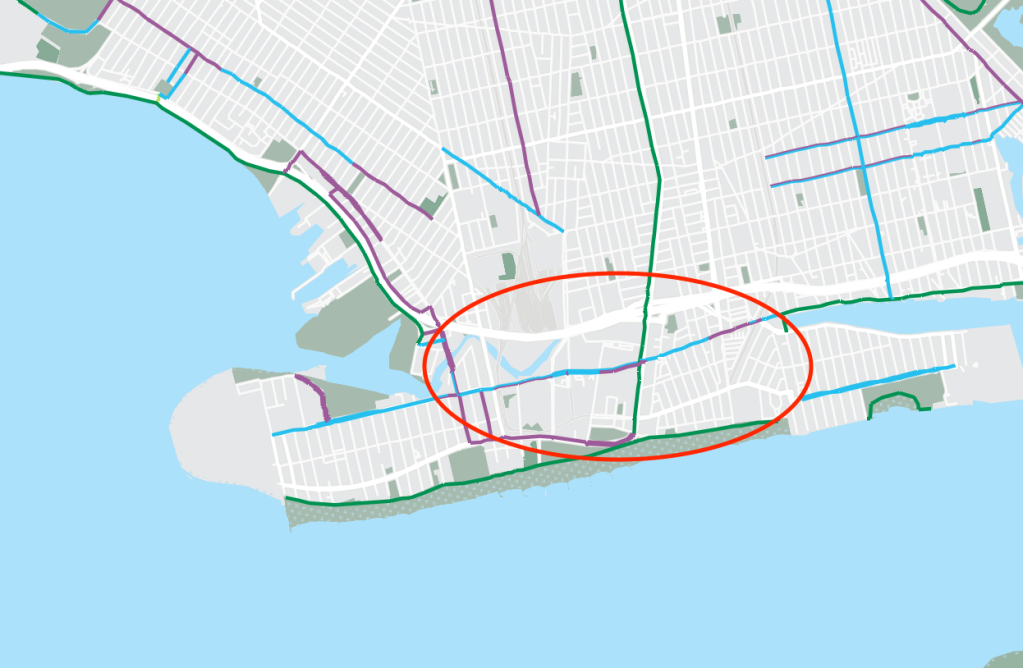
“Let’s use some of the Mamdani political capital honeymoon period to finally connect these three routes that have sat there with this big gap in the middle since the time of Robert Moses,” Orcutt said.

Streetsblog has migrated to a new comment system. New commenters can register directly in the comments section of any article. Returning commenters: your previous comments and display name have been preserved, but you'll need to reclaim your account by clicking "Forgot your password?" on the sign-in form, entering your email, and following the verification link to set a new password — this is required because passwords could not be carried over during the migration. For questions, contact tips@streetsblog.org.