Streetsblog provides high-quality journalism and analysis for free — which is something to be celebrated in an era of paywalls. Once a year, we ask for your tax-deductible donations to support our reporters and editors as they advance the movement to end car dependency in our communities.
If you already support our work, thank you! If not, can we ask for your help?This year’s fundraiser includes a special gift for our biggest supporters. Don’t miss out.
Together, we can create a more livable, walkable, bikeable, equitable and enjoyable city for all. Happy holidays from the Streetsblog team!
ALBANY — If Albany doesn’t disappoint you, were you ever really even there? A capital zone impervious to ethics, reason and good vibes in the most general sense is usually a good bet to kill the optimism of even the sunniest person.
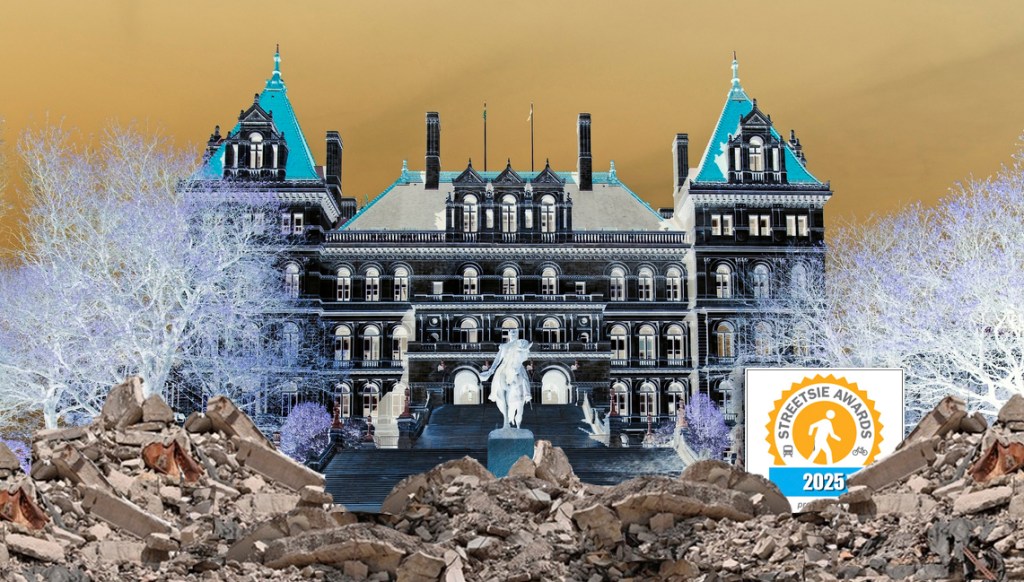
In 2025, we saw flip-flops on major transportation policy, egregious bill passings and vetoes and putrid street designs come out of state government. But don’t worry, we kept track, even with the stomach turning insight that some things don’t change.
And the nominees for worst things to come out of Albany and state government in 2025 are …
Hochul vetoes ‘Grieving Families Act’
The Grieving Families Act (S4423/A6063), sponsored by state Sen. Brad Hoylman-Sigal and Assembly Member Jen Lunsford, is the best marker that a new legislative session is around the corner. Like clockwork, the bill, which would modernize the state’s wrongful death statute, was vetoed on the grounds that it would increase costs for insurance and healthcare companies.
Also, a regular feature of life in New York: cyclists and pedestrians are killed by reckless drivers, and their loved ones don’t always have a legal recourse to seek damages. The bill would give claimants three years, not two, to seek damages and allow lawsuits for emotional suffering. It would also broaden the people in a victim’s life beyond just immediate family and financial dependents.
The insurance and healthcare industries are hardly at the height of their popularity. Meanwhile, new families need to adjust to losing a loved one to an avoidable road death on a regular basis. It’s unclear who the governor is attempting to please.
The OPTO bill
Both houses of the state Legislature passed a bill (A4873/S4091) sponsored by state Sen. Kevin Parker and Assembly Member Monique Chandler-Waterman that would mandate two-person crews on MTA trains with more than two cars.
Though backed by the Transit Workers Union Local 100, many advocacy organizations, like Reinvent Albany, cautioned that the bill would decrease efficiency and cost more money to operate out of step with international mass transit standards in this manner. Does a plan that makes it harder for the MTA to operate multiple train lines make sense?
For many, the answer is no.
Legal bus stop parking in Co-op City
If a bad bill is vetoed and no one notices, was it still a bad bill? Yes. Proposed legislation from state Sen. Jamaal Bailey and Assembly Member Michael Benedetto would have exempted motorists in Co-op City from automated bus stop parking violations. The bill passed both houses, but was ultimately vetoed by Hochul in December.
It’s good that the governor bowed to reason, but why were dozens of state lawmakers under the impression that it made sense to give one neighborhood a different set of rules than the rest of New York City? If a program that was making it more efficient not to use cars was working, why hamstring the mechanisms that are working to preserve it?
Affordability concerns are a real force in New York politics. If only we could say the same about equity.
Kensington Expressway mishegoss
In Buffalo, state DOT officials were forced back to the drawing board after their initial plan to rework the Kensington Expressway, a six-lane highway running through east Buffalo, was struck down in court for failing to conduct an environmental review.
The state’s plan was to cap a portion of the expressway to create a tunnel and park in the hope of undoing some of the effects of one of New York’s poorly conceived urban renewal projects that split up communities of color.
The only issue was that state DOT tried to skip the environmental assessment by using a workaround meant for small projects with minimal impact on communities. The courts decided in February that such a massive public works project needs review. Advocates were already concerned that the project wouldn’t go far enough to restore the communities in east Buffalo that were disrupted decades ago by the roadway’s creation and they took DOT back to court in July.
That folks, is what half assing a $1.5-billion project looks like.
Super speeders watered down and killed
State Sen. Andrew Gounardes and Assembly Member Emily Gallagher sponsored the “Stop Super Speeders” bill (S4045/A2299) that would have installed speed capping devices in the vehicles of motorists with six or more speeding and or red-light camera tickets each year. It’s a no-brainer, given that it only affects drivers with the heaviest of lead feet — and spares the entire nation from their recklessness.
Then Albany happened.
The state Senate, did pass the bill — but only after watering it down so much that it barely could serve its purpose. The revised bill required 16 violations — speed-camera only this time — before the speed-limiting device would be required.
But in the Assembly, even the diluted legislation never made it to the floor because of legal concerns around due process for motorists.
So consider this, New Yorkers — drivers can still get an unlimited number of camera-issued tickets for speeding through school zones, and our state lawmakers don’t want to do anything about it.
And remember, all our end-of-year Streetsies coverage is archived here.
Before becoming Albany Bureau Chief in late 2025, Austin C. Jefferson was a state politics reporter for City & State NY, covering state government, elections and major legislative debates. His reporting has also appeared in the Daily Freeman, Chronogram Magazine and The Legislative Gazette. Having grown up in the Hudson Valley, he's always happy to argue about where Upstate New York truly begins.
Streetsblog has migrated to a new comment system. New commenters can register directly in the comments section of any article. Returning commenters: your previous comments and display name have been preserved, but you'll need to reclaim your account by clicking "Forgot your password?" on the sign-in form, entering your email, and following the verification link to set a new password — this is required because passwords could not be carried over during the migration. For questions, contact tips@streetsblog.org.
In their latest video, the current and former NYC public school students of the Joint Transit Association have some concerns about Mayor Mamdani's plan to rebuild the BQE.