Streetsblog provides high-quality journalism and analysis for free — which is something to be celebrated in an era of paywalls. Once a year, we ask for your tax-deductible donations to support our reporters and editors as they advance the movement to end car dependency in our communities.
If you already support our work, thank you! If not, can we ask for your help?This year’s fundraiser includes a special gift for our biggest supporters. Don’t miss out.
Together, we can create a more livable, walkable, bikeable, equitable and enjoyable city for all. Happy holidays from the Streetsblog team!
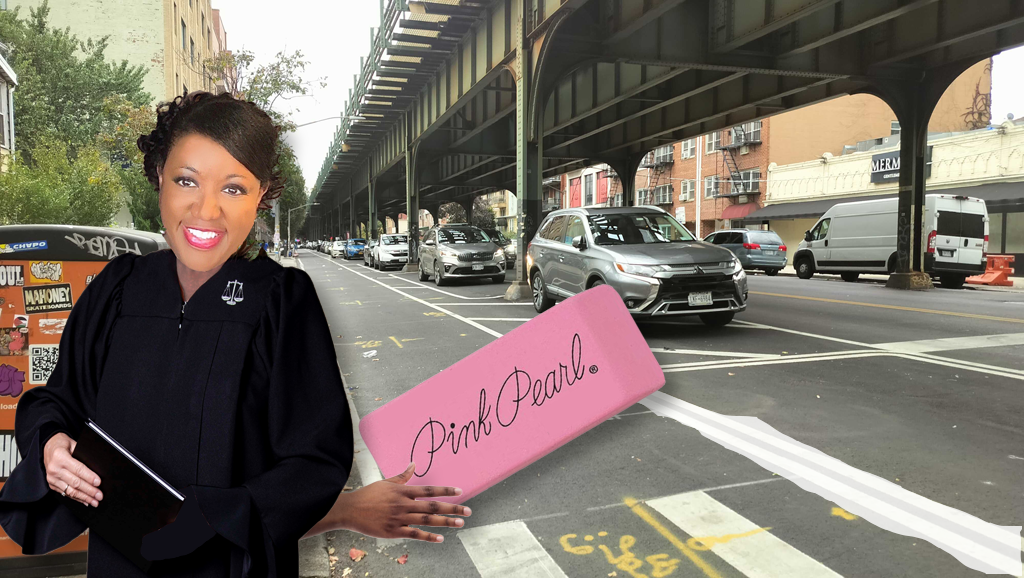
A Queens judge’s decision on Friday ordering the city to rip up Astoria’s 31st Street protected bike lane blatantly overstepped her jurisdiction — and ought to be thrown out on appeal, experts told Streetsblog.
Judge Cheree Buggs privileged her own sympathy for criticism of the project over the Department of Transportation’s long-established power to redesign streets as it sees fit, ignoring the law, and subsequent court findings, allowing DOT broad discretion so long as it demonstrates a “rational basis” for its decision-making.
“This is a circumstance where the judge is substituting her judgment for the DOT’s, and she does so while citing case law that makes it clear [she’s] not allowed to do that,” said attorney Peter Beadle, who is not involved in this case, but was on the opposite end of DOT’s broad statutory authority this summer when a judge in Brooklyn ruledin favor of the agency’s authority (in that case to rip up three blocks of protected bike lanes on Bedford Avenue).
Buggs’s ruling threw out Astoria’s protected bike lane project on the basis that DOT had not checked specific regulatory boxes required for “major transportation projects.” The DOT had undertaken the required consultation with FDNY and other city agencies, but because the agency had not provided to the court the actual signed certification of said consultation, Buggs killed the project entirely.
“While DOT’s efforts may demonstrate engagement in a colloquial sense, it does not satisfy the plain language of [the law], which was enacted to ensure formal, documented, cross-agency review and to build a record of that review before major projects affecting emergency response and vulnerable populations are implemented,” Buggs wrote.
But rather than ordering DOT to simply provide the certification, Buggs essentially conducted her own analysis of the project — deciding that concerns voiced by the FDNY and bike lane opponents convinced her that the redesign “lacks a rational basis.”
“Respect for DOT’s administrative expertise in traffic and street design does not require the court to discount FDNY’s expertise in fireground operations,” the judge wrote.
Except that city law does not require FDNY approval of street redesigns nor does the Fire Department’s concerns override DOT’s authority. The law merely requires FDNY be consulted, and DOT did exactly that. FDNY officials did a demo with the local firehouse and warned the new bike lane could affect ladder access to buildings on the street, so DOT adjusted the bike lane width so fire trucks could use the bike lane during emergencies and not have to deal with the previous problem of parked cars along the curb.
“The thrust of the Bedford Avenue decision was to reinforce that DOT has the presumptive discretion to do as it decides provided that its decisions have a rational basis,” Beadle told Streetsblog. “The way she gets to ‘no rational basis’ is by doing this other analysis in which she peremptorily issues her own judgment to this equation. She is now determining whether it’s a good enough basis, and that’s not what the law says. It just has to be ‘rational.'”
Former DOT official Jon Orcutt, now the advocacy director at Bike New York, acknowledged that DOT “could have dotted a few i’s better” — but he questioned why the judge seemed to insist that DOT had an obligation to adhere to the feedback received from its consultation with other agencies.
“She says the law just requires consultation, but in some places she seems to want consensus,” he said. “This is supposed to be a matter of law not a referendum.”
Beadle suggested Buggs overstepped her role because the City Charter clearly gives the DOT the authority to “establish, determine, control, install and maintain the design, type, size and location of any and all signs, signals, marking, and similar devices … for guiding, directing or otherwise regulating and controlling vehicular and pedestrian traffic.”
Buggs paid lip service to DOT’s expertise, but set an unprecedentedly high bar for the agency to prove the “rational basis” for its decision making — dismissing stats showing the safety benefits of protected bike lanes as not applicable to specific context of 31st Street.
Further complicating DOT’s case, Buggs said Mayor Adams’s and DOT’s justifications for scrapping three blocks of the Bedford Avenue bike lane project in response to child safety concerns were applicable on 31st Street.
But that’s simply not her call to make, according to Beadle.
“If there’s a technical flaw here, then the proper remedy should be that the judge orders the DOT to issue the proper certifications in the records,” he said. “Have DOT go back, fix the formal record with the appropriate certification: ‘Perform that statutory responsibility and then you can proceed.'”
DOT may not even have to go through all that, though. The law requiring inter-agency consultation on “major transportation projects” has a big gaping loophole: The agency can side-step the notification rules entirely so long as a project requires “immediate implementation to preserve safety.”
On Friday, the city said it is “reviewing the decision and evaluating next steps.” Officials have until Jan. 4 to appeal Buggs’s decision — by which time Zohran Mamdani will have assumed control over city policymaking. Mamdani, who represents the project area in the state Assembly, supported the redesign over the summer:
"I stopped biking on 31st Street and I started biking on 35th Street because of the fact that I did not want to jeopardize my life each and every day," said Mamdani. pic.twitter.com/5tms9cJixD
The debate over the 31st Street protected line has drawn clear lines between the Astoria public and some of the businesses that serve it. Plaintiffs who sued to stop the project include King Souvlaki and Parisi Bakery.
Bike lane opponents associated with the businesses opposed to project parodied themselves when DOT presented the project to Community Board 1 in June — repeatedly interrupting and shouting down bike lane supporters. One community board leader admonished bike lane opponents for “embarrassing” themselves and the board while behaving “like children.”
Every elected official who represents the district supports the redesign, including Mamdani and Council Member Tiffany Caban.
“I bike to work and the protected bike lane would have made me feel a lot safer. I think it was a bad idea for them to not follow through with it,” one Astorian, who declined to give their name, told Streetsblog on 31st Street on Monday. “A lot of people bike here, and no one really has any problems with the bikes. Also, I see a lot of kids biking here, and I think that the community would rather the kids be safe.”
But you wouldn’t know there’s a groundswell of support for the bike lane from reading the ruling, in which Buggs paints opponents as representative of “community sentiment,” taking at face value business owners’ petition against the project yet failing to mention a competing petition in favor of the project, or bike lane opponents “rude” behavior at the CB 1 meeting.
It’s not clear why the city did not include the pro-bike lane petition or affidavits from the elected officials in its court papers. Reps for DOT and the city Law Department declined to respond to several questions from Streetsblog.
“We deserve streets that protect us — not rulings that put our lives at risk,” Caban said in a statement. “Almost 200 people have been injured on 31st Street in five years. Slashing proven safety measures in the face of this danger is unacceptable. This project will save lives.”
David was Streetsblog's do-it-all New York City beat reporter from 2015 to 2019. He returned as an editor in 2023 after a three-year stint at the New York Post and is now Managing Editor.
Streetsblog has migrated to a new comment system. New commenters can register directly in the comments section of any article. Returning commenters: your previous comments and display name have been preserved, but you'll need to reclaim your account by clicking "Forgot your password?" on the sign-in form, entering your email, and following the verification link to set a new password — this is required because passwords could not be carried over during the migration. For questions, contact tips@streetsblog.org.
In their latest video, the current and former NYC public school students of the Joint Transit Association have some concerns about Mayor Mamdani's plan to rebuild the BQE.