Double-Parking Forever! Court St. Merchants Want Unprotected Bike Lane For ‘Maneuverability’
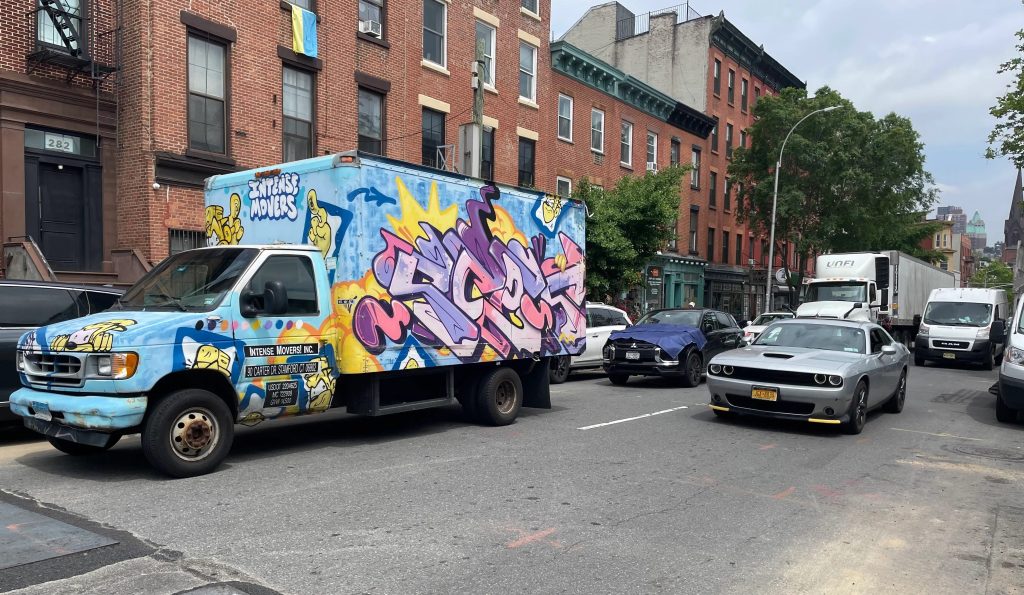
Court Street merchants suing the city over the new protected bike lane on the Brooklyn thoroughfare want it turned into an unprotected lane so that drivers will have better “maneuverability,” meaning they want to restore the double-parking that long plagued the area and made it unsafe before the overhaul, lawyers said in Brooklyn Supreme Court on Monday.
If the city had instead installed an unprotected bike lane, “it still would have left some maneuverability,” the Court Street Merchants Association lawyer Hartley Bernstein told Justice Inga O’Neale.
“This has been a plan solely to satisfy cyclists,” the attorney added, claiming that the changes have had “disastrous and negative implications that can already be seen.”
City officials quickly warned that an unprotected bike lane would jeopardize safety and allow unfettered double-parking, which was rampant before the overhaul and caused congestion and unsafe conditions for all road users.
Just take a look at the last time the city undid a protected path on Bedford Avenue. The Adams administration ripped out that protected bike lane on three blocks over the summer to appease the Hasidic community, which votes as a bloc, and the path immediately degraded to a second parking lane, as Streetsblog has documented.
Almost any unprotected bike path in the city routinely devolves into extra parking for drivers, just take a look here, here or here.
Court’s bad old days
Before the redesign, commercial drivers would double-park up and down the corridor, forcing everyone else to swerve around them. The busy corridor had a rate of side-swipe crashes that was double the borough-wide average, according to DOT stats.
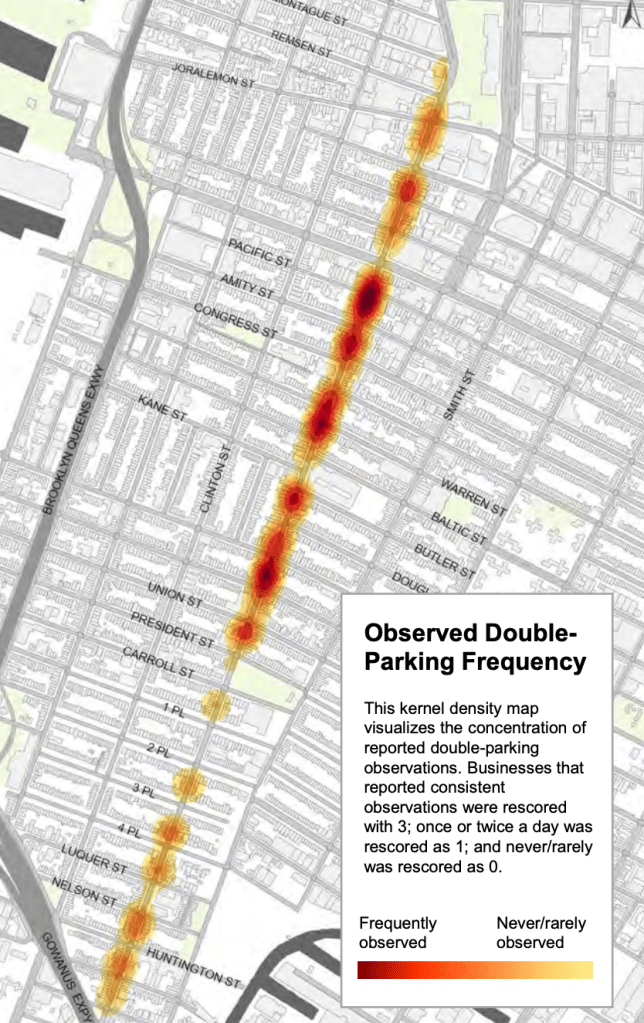
The problem was especially pronounced between Atlantic Avenue and President Street, according to a heat map the agency published in court filings.
The street was already popular among cyclists before the redesign, with DOT counting upwards of 1,000 people on two wheels there, Assistant Corporation Counsel Kevin Rizzo told the court. More people rode bikes to get to Court Street than traveled there by car, people told the agency during a street survey last year.
The two wide and chaotic lanes posed a danger to those riders, because both ends are truck routes, and the heavy haulers have large blind spots that puts more vulnerable road users at risk, Rizzo added.
“Every time cyclists and trucks interact, there’s a disproportionate risk for cyclists,” the city lawyer said.
That’s blatantly clear in the crash hot spots, at both ends of the project corridor, including the two fatalities over five years that happened at Atlantic Avenue and at Hamilton Avenue. Those are on top of a whopping 155 injuries during that time, including 11 of them severe.
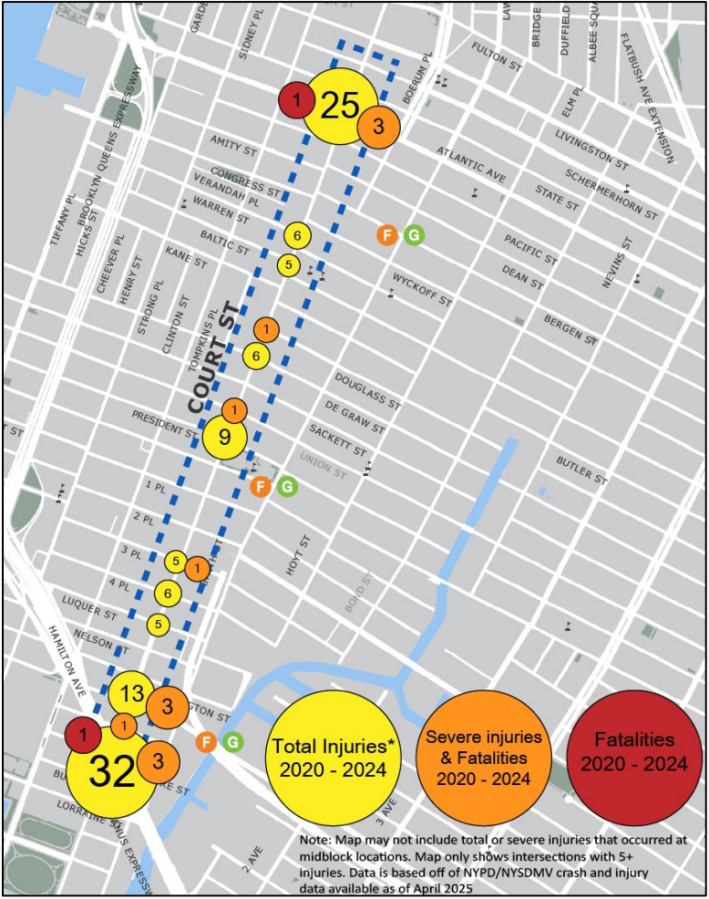
Bernstein – who also represents opponents trying to undo an unfinished protected bike lane in Astoria – dismissed the stats as “incomplete, misleading and even on its face inconsequential.”
The DOT project on Court Street removed one southbound travel lane, between Schermerhorn Street and Hamilton Avenue, to install a curbside protected bike lane, along with safety upgrades at intersections for better visibility, like parking bans, and pedestrian islands for shorter crossing distances.
The changes are a standard design officials have rolled out across the city, and they improve safety for all modes of transportation, according to DOT data, while discouraging drivers from leaving their cars in the middle of the street.
“There’s a strong discourager of double-parking,” Rizzo told the court. “[An unprotected bike lane] wouldn’t satisfy the concerns that DOT had.”
O’Neale, who previously claimed to be impartial despite regularly driving down Court Street, asked Rizzo if he had driven on the road in question.
Rizzo responded that he hadn’t because he doesn’t own a car, but added that he had walked on it.
It’s unclear how the transportation choices of a single Law Department official pertain to whether the DOT acted lawfully in implementing the street redesign. O’Neale did not ask the same of Bernstein, but he told her anyway that he walked on Court Street and did “attempt to drive it.”
Anonymous petition
Bernstein tried to make the case that there had not been enough notice for the project, bringing some 100 petition signatures from people in the “business community” against the plan, but he asked to keep the list anonymous in court records for fear of “boycotts” by the “cycling community.”
“These folks are going to see their names on social media,” Bernstein said, adding that they’re mostly small businesses.
“Most of them have survived Covid, they’re trying to survive this as well,” said Bernstein.
Rizzo objected, saying a list in the public record should not be censored, and that it was the First Amendment right of people to boycott businesses.
O’Neale did not say whether she would allow keeping the petitioners secret, but told Bernstein that if she needed the list, she would ask him for it.
She has said she plans to make a verdict before the end of the year.

Read More:
Streetsblog has migrated to a new comment system. New commenters can register directly in the comments section of any article. Returning commenters: your previous comments and display name have been preserved, but you'll need to reclaim your account by clicking "Forgot your password?" on the sign-in form, entering your email, and following the verification link to set a new password — this is required because passwords could not be carried over during the migration. For questions, contact tips@streetsblog.org.