Wednesday’s Headlines: Delay Tactics Edition
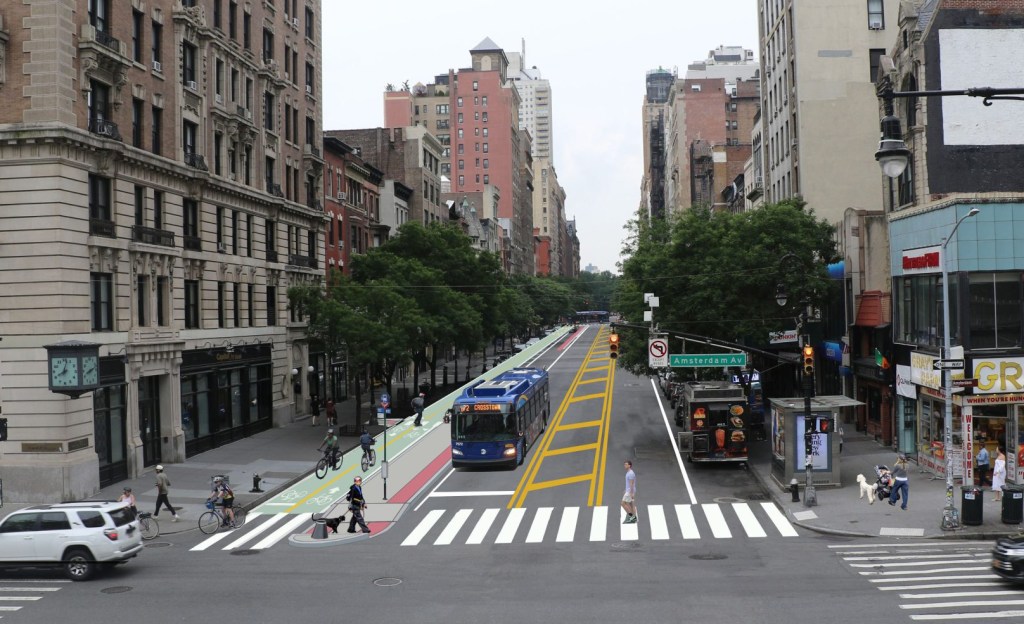
Psychiatrist Elisabeth Kübler-Ross got the five stages of grief wrong, at least when it comes to opponents of street safety redesigns or bus lanes. It’s not denial, anger, bargaining, depression, and acceptance; it’s denial, anger, bargaining, more anger, and lawsuits.
We’ve come to that last stage with the Department of Transportation’s road diet on W. 72nd Street, as opponents, led by revanchist lawyer Hartley Bernstein, have sued on the grounds that the safety plan, similar to redesigns that have been successfully undertaken all over the city for more than 20 years, would somehow make this roadway less safe for that neighborhood’s seniors.
On Tuesday, legal news came fast and furious. First, the West Side Rag covered last week’s legal filing, but just as we were scrambling to make sense of its allegations and exhibits, we learned that Judge Dakota Ramseur had ordered the DOT to not start the project until a court hearing next month.
We’ll have a lot more on the specious lawsuit later this week (including Judge Ramseur’s 2012 campaign contribution to elect Eric Adams Brooklyn Borough President), but suffice it to say lawsuits against the DOT’s power to design the streets as it sees fit are like happy families: they are all alike (that’s a Tolstoy reference!).
Legally, opponents of street redesigns throw everything into their court papers — that there wasn’t enough community outreach, that the city is violating some obscure planning rule, that ambulance response times will increase, that bike lanes are unsafe, that bus lanes cause congestion — but these lawsuits always fail because judges are always rule that the city does, indeed, have the power to design roads as long as it’s not done arbitrarily or capriciously.
And given how long the DOT spends doing these designs, planning these designs, explaining these designs to community members and elected officials, tweaking these designs and, finally, revisiting designs after implementation, the agency’s actions could hardly be called arbitrary.
Such lawsuits have failed on 14th Street, on Central Park West, on Morris Park Avenue, on Fresh Pond Road, on Court Street, on Review Avenue, on Prospect Park West, and in so many other locations. True, judges do sometimes issue temporary restraining orders, but virtually every time, the jurist ends up ruling like all other judges have previously ruled: The city has the power to make streets safer.
And on W. 72nd Street, the plan is a no-brainer: The city wants to reduce the four-lane road — where rampant double-parking makes the roadway unsafe and delays buses — to two lanes in each direction, with a turning bay and a two-way protected bike lane. Such designs have a proven safety record. Bernstein’s contention that the bike lane will prevent seniors from getting into taxis is absurd; currently, there’s a line of parked cars against the curb, making it impossible to enter these supposed taxis (which would be double-parking, by the way).
Transportation Alternatives, which is named in the suit, fired back, pointing out disabled people don’t need additional car lanes since New Yorkers with a disability make 32 percent fewer trips by car than New Yorkers without a disability.
In fact, they make significantly more trips by bus — so speeding up buses supports disabled New Yorkers. Plus, the DOT project calls for pedestrian islands, which will further narrow crossing distances, another proven safety measure.
“Prioritizing safety in no way bars or impairs anyone from using 72nd Street — quite the opposite, it turns a dangerous street into a better one for seniors, children, and disabled New Yorkers,” said the group’s Executive Director Ben Furnas. “After the redesign is finished, cars, trucks, and buses will all still be able to access, park on, and drive through 72nd Street [but[ it’ll be even easier for ambulances to drive through or pick up on 72nd, just like it’s become easier after similar projects finished across the city.”
We’ll keep you posted.
In other news from yesterday:
- Big truck, big problem. (Brooklyn Daily Eagle)
- Gothamist is continuing its driver-protection strategy, one that is divorced from reality, but is sure to maintain the outlet’s relationship with Brian Lehrer.
- Speaking of parking, NY1 followed our coverage of how congestion pricing did not reduce the availability of spaces to store cars.
- Road rage in Queens. (QNS)
- Someone at amNY is continuing to willfully misunderstand the widely misunderstood emergency room study about micro-mobility. It is not a fact that 50 percent of trauma cases in Bellevue Hospital’s emergency room was caused by e-mobility users because the study did not include trauma cases caused by car drivers. It only studied micro-mobility crashes, not all crashes, as we pointed out earlier this summer.
- The bill to ban horse carriages in Central Park will be heard on Wednesday morning at City Hall, but we are sending a murder of reporters on the likelihood that the carriages are likely only a Trojan horse at the hearing and it’ll end up being another bike bitch fest. (NYDN, NY Times)

Read More:
Streetsblog has migrated to a new comment system. New commenters can register directly in the comments section of any article. Returning commenters: your previous comments and display name have been preserved, but you'll need to reclaim your account by clicking "Forgot your password?" on the sign-in form, entering your email, and following the verification link to set a new password — this is required because passwords could not be carried over during the migration. For questions, contact tips@streetsblog.org.