That Widely Misrepresented E-Mobility Study Actually Reveals Need For Safer Streets, Not Hysteria
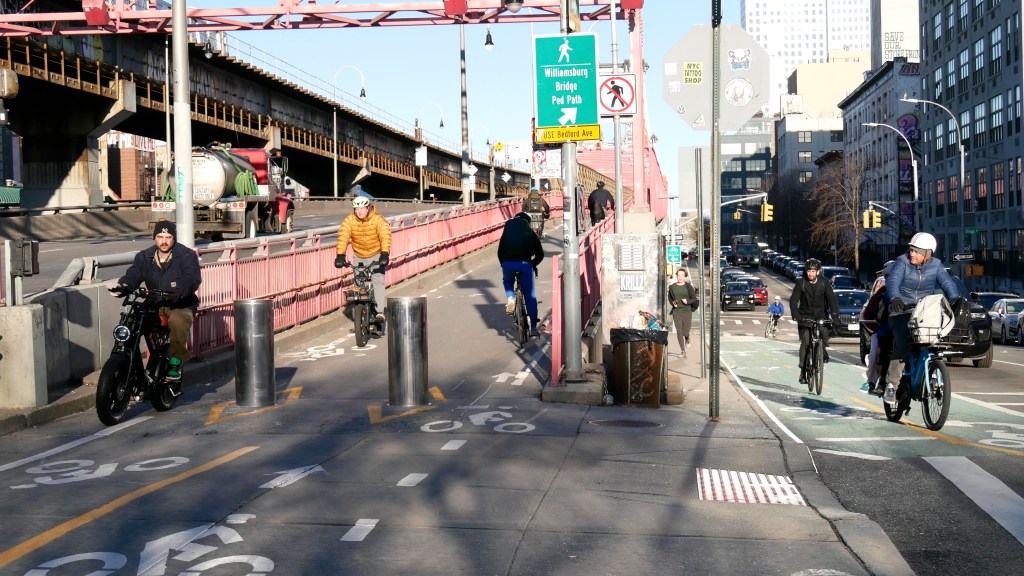
Safer street design is the best way to mitigate rising-but-still-rare injuries stemming from the increase in biking and electric micromobility use, according to a new analysis of emergency room data that is being widely misrepresented by multiple media outlets as part of an anti-e-mobility, pro-driving agenda.
Researchers looked only at the roughly 900 who were brought to the Bellevue Hospital emergency room from 2018 to 2023 with injuries resulting from being an e-mobility user or a pedestrian struck by one. The study, which covers the rise in post-pandemic electric micromobility in the Big Apple, shows that ER visits involving electric bikes and scooters rose between 2018 and 2022 before dropping.
But its conclusion is not, as many anti-bike groups have claimed, that the city must create new laws to restrict e-bikes, but rather that street design must be improved because it would offer the “most immediate” opportunity to reduce the burden that emergency rooms face.
“Nearly half of injuries in our cohort resulted from motor vehicle collisions, underscoring critical infrastructure deficiencies,” the study says. “Only 3 percent of Manhattan’s bike lanes are protected, and in 2023, 94 percent of cycling fatalities occurred on roads without protected bike lanes. Infrastructure redesign — including separated lanes and intersection protections — may offer the most immediate opportunity to reduce neurosurgical trauma burden.”
The authors conceived the study amid anecdotal evidence that more people were showing up at Bellevue from crashes involving bikes, both electric and mechanical, after the pandemic when the use of electric micromobility exploded.
E-bikes became legal in 2020, and in 2025, roughly 32 million Citi Bike rides were on electric bikes, or close to 90,000 e-bike rides per day. The rise in food and grocery delivery has also put tens of thousands more e-bikes on the streets.
That rapid rise in bike miles traveled came without sufficient street safety improvements and education, the study argues, resulting in a rise in emergency room visits. This mimics national trends and demonstrates the need for cities to do more to accommodate the popularity of cycling and micromobility.
The roughly 900 emergency room visits are just a small percentage of the total carnage taking place on city streets. In 2023, the last year of the study, 103 pedestrians were killed in traffic crashes — all but two by car or truck drivers.
In that same year, 94 percent of reported pedestrian and cyclist injuries involved a car or truck vehicle, according to the city Department of Transportation, while, e-bike, e-scooter and moped riders caused just 2.4 percent of all reported pedestrian injuries.
Emergency room data can provided better evidence because, of course, some injuries don’t get reported to cops, but lead someone to a clinic anyway — another point of the study.
“This is a really good first effort to shed light on the fact that the number of injuries on micromobility devices, specifically electric devices, have been increasing,” said Kathryn Burford, a post-doctoral researcher at Columbia University who is working on a similar study on emergency room data that will break down incidents by type of e-bike, which is not commonly done currently.
Burford said that infrastructure and education are the best ways to combat this problem.
“I am very much focused on built-environment policy because that has the most impact on this issue. Protected, not just sharrows, getting rid of parking, focusing on intersections and signage and bike lights, all of that, we need more,” she said.
Of the 914 emergency room visits in the six-year study period, the largest cohort of patients (50 percent) were people who had been struck by a car driver. Another 34 percent of cases were the result of someone falling off his own electric mobility device, harming no one but himself.
Another 7 percent of cases were collisions between micromobility users, and 7.5 percent were pedestrians hit by riders of e-bikes, bikes, scooters and other two-wheeled micromobility.
Beyond the need for street redesigns and car-reduction as a society-wide imperative, the study makes it clear that individuals should wear helmets and lay off the booze: 37 percent of riders without helmets had a brain injury, but only 23 percent of helmeted riders had such injuries. (Commercial cyclists, such as delivery workers, are required to wear helmets, as are the riders of Class 3 e-bikes. In the study, only 32 percent of micromobility riders were wearing one.)
Of the 814 patients tested for alcohol, around 20 percent were deemed “intoxicated.”
The bike-lash
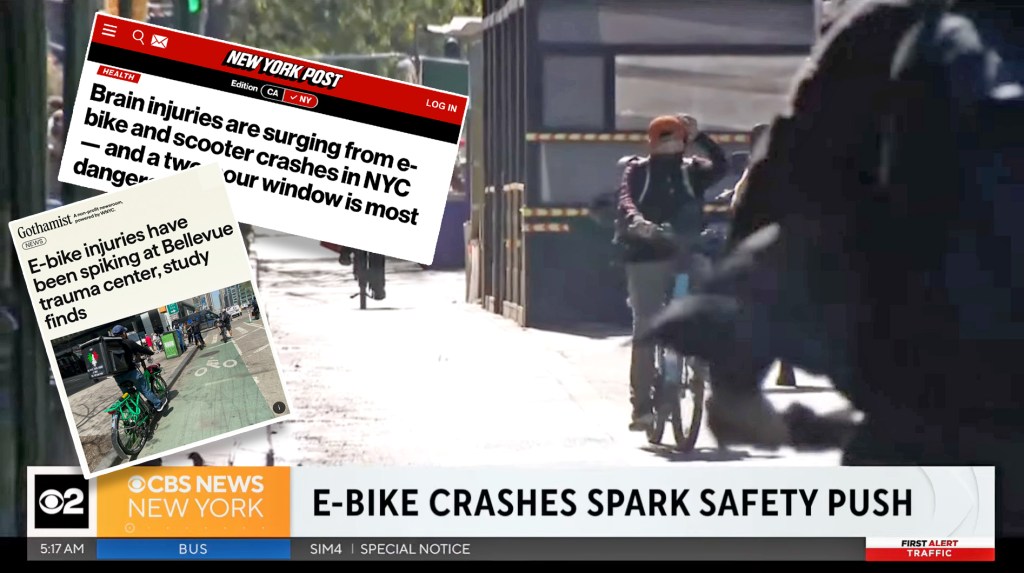
Since its release the study has been co-opted by anti-bike activists to try to make a case for e-bike licensing or to promote general hysteria around e-bikes. A CBS News article claims “e-bike crashes are on the rise,” and that there was a “41-percent jump in New York City last year alone.” But the study only goes through 2023 and it’s unclear where the outlet is getting 41 percent from. As the study itself says, total ER visits involving bikes and e-micromobility went down from 2022 to 2023.
Gothamist also took an anti-e-bike stance, headlining its piece, “E-bike injuries have been spiking at Bellevue trauma center,” even though e-bike riders were not the largest share of injuries seen at the trauma center and that fully half were hit by car drivers. The outlet didn’t bother to address the study’s conclusion that better infrastructure would be the most effective way to address these issues. Instead, Gothamist confused crashes where e-bikers were hit by car drivers and ended up in the ER with crashes where an e-bike rider hit a pedestrian, which paints a confusing picture of the issue. Only 7 percent of the ER visits in the study involved pedestrians.
“Actually, I am surprised that people are using the data to try to support that viewpoint,” said Paul Huang, one of the study’s co-authors and the chief of Neurosurgery at Bellevue Hospital. “The findings of the paper are quite nuanced [but] the media being what it is, people just want a headline that catches attention.”
What doesn’t get as much attention from the mainstream press is the value of e-bikes in the overall effort to make streets safer by reducing car use.
“E-bikes give a much wider range of people the ability to move around,” said Huang. “The e-bike rider tends to be older … and a lot of people who maybe would have difficulty now find that this is a great way to get around the city,” Huang said. “Is it worth restricting that freedom? Licensing is this extra hurdle and I don’t know that there is a benefit to people’s behavior.”
Huang pointed out that study reiterates the danger to pedestrians posed by unsafe streets — though the study has a huge blind spot: pedestrians who went to the ER after being struck by a car driver were not included. The much smaller group of pedestrians who were struck by the rider of an e-bike were more likely to suffer a severe injury than those who were hit by the rider of a manual bike.
“The pedestrian is ultimately unprotected,” said Huang. “Our data suggests that pedestrians get the worst of all the various groups that we look at.”
Better infrastructure helps vulnerable pedestrians, too. On streets with protected bike lanes there is a 39-percent decrease in crashes that cause death and serious injury for seniors, and that drop is 24 percent for non-senior adults, according to DOT.
“Having the infrastructure built out to designate where the groups should be on the street is very helpful,” said Huang.
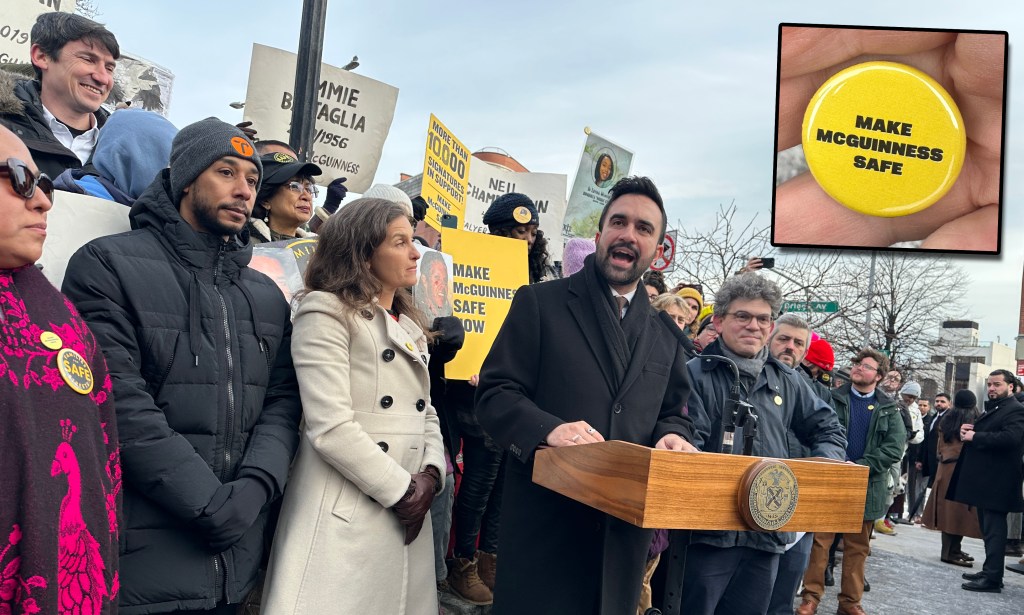
The Mamdani administration has already made street safety a big focus, announcing plans to free street safety projects, like the McGuinness Boulevard road diet, from Eric Adams-induced purgatory, and announcing new projects like a protected bike lane on 72nd Street to create more, safe crosstown connection in Manhattan. The Department of Transportation said the study’s results align with the research they have been doing into emergency room data, and that they are working to build a safer city.
“We applaud Bellevue Hospital for this important study, which … reinforces the importance of our Vision Zero work and building safe streets,” said DOT spokesperson Vin Barone.

Read More:
Streetsblog has migrated to a new comment system. New commenters can register directly in the comments section of any article. Returning commenters: your previous comments and display name have been preserved, but you'll need to reclaim your account by clicking "Forgot your password?" on the sign-in form, entering your email, and following the verification link to set a new password — this is required because passwords could not be carried over during the migration. For questions, contact tips@streetsblog.org.