City Council Leaders Call on State to Emulate New Jersey’s Flawed E-Bike Law
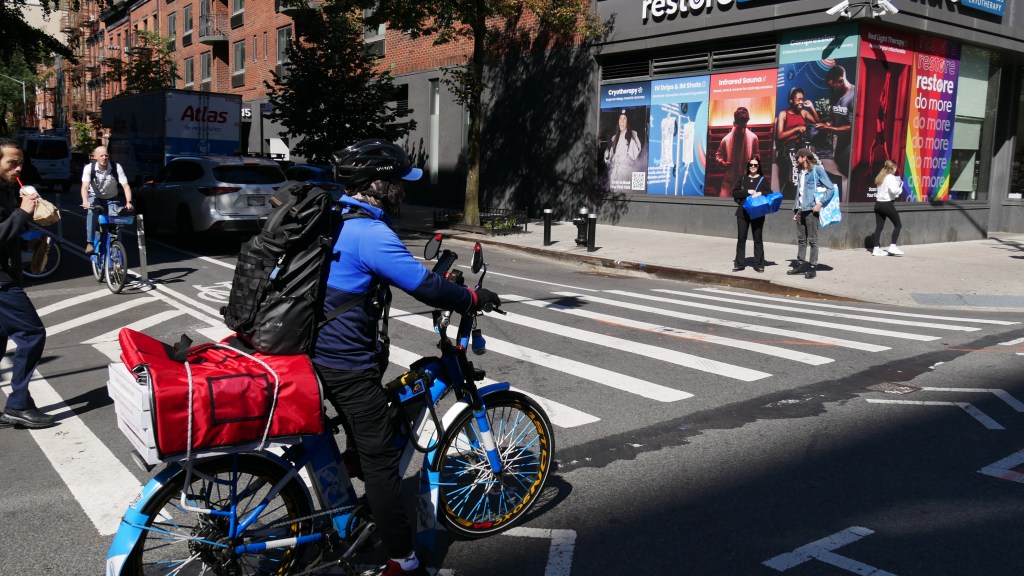
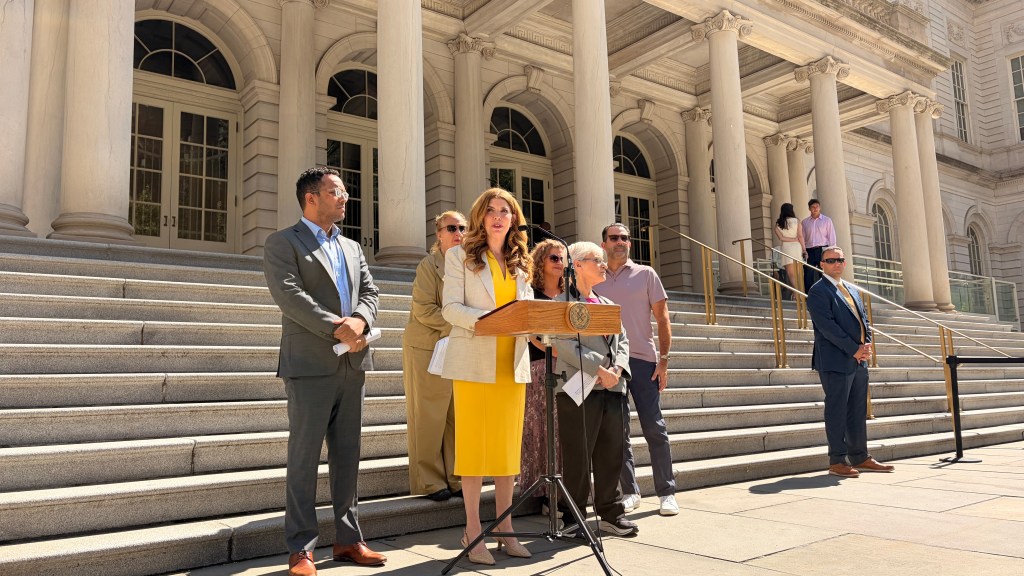
City Council Speaker Julie Menin (D-Upper East Side) called on Albany to pass its own version of New Jersey’s flawed e-bike registration law on Tuesday as she unveiled plans to hold a Sept. 30 mega-hearing to consider no less than 17 possible responses to the e-micromobility boom.
New Jersey began requiring licenses, registration and insurance for all e-bike riders last month. At a “major transportation announcement” outside City Hall on Tuesday, Menin endorsed a forthcoming resolution by Council Member Gale Brewer (D-Upper West Side) that will apparently cite the controversial law. The speaker also emphasized that only state legislators, not city lawmakers, can regulate e-bikes.
“[Brewer’s resolution] calls for the state to do that law,” Menin told reporters as she announced plans to hold the September mega-hearing. “Just like New Jersey did. New Jersey passed it. It’s a state issue.”
Menin did not explicitly endorse most of those 17 bills, which run the gamut from requiring delivery app companies like DoorDash and UberEats to be licensed by the city Department of Consumer and Worker Protection, to prohibiting the sale and rental of 25 mile-per-hour throttled-powered “Class 3” e-bikes.
New Jersey’s new e-bike laws added significant bureaucratic hurdles for anyone who wants to ride an e-bike in the Garden State, regardless of the speed of that bike. Riders with disabilities have expressed concerns about needing to pass the state licensing test, while e-bike owners have struggled to find insurance companies that offer e-bike policies. The Bergen Record recently ran an editorial that called on New Jersey lawmakers to revisit and revise the “rushed” legislation.
Menin spokesman Henry Robins insisted the speaker does not support “anything on the city level that puts the onus on the individual,” but did not clarify whether she wants the state to copy New Jersey’s “toughest in the nation” law word-for-word.
In her comments, the speaker cited an existing resolution introduced by Brewer that only called for state licensing of commercial e-bikes. Robins later clarified that Brewer planned to introduce another resolution for the Sept. 30 hearing. That new resolution will call for licensing of all e-bikes — raising the total number of bills on the day’s docket to 18 (and counting).
Brewer, who also claimed inspiration from New Jersey on Tuesday, balked when Streetsblog asked her whether she wanted New York to pass the same law as the Garden State. She told reporters she would not support any bill opposed by delivery worker Los Deliveristas Unidos — even though LDU has opposed universal licensing requirements.
“I’m open to ideas,” Brewer told Streetsblog after the press conference. “I am always worried about the process.”
Absent from the press conference, however, was any mention of the road violence caused by car drivers — who accounted for the vast majority of the e-bike injuries cited by Menin and her colleagues.
Many cycling advocates oppose e-bike licensing and registration bills, which they argue discourage cycling without actually ensuring safety. After all, drivers must be licensed and have their cars registered, yet continue to wreak havoc on city streets.
The press conference followed two recent deadly crashes involving illegal electric micromobility devices. On July 29, a teenager who was riding an illegal Deepower e-moto died in a collision with an SUV driver near City Hall. And two men, including one on an illegal e-scooter, died in a head-on collision on the Queensboro Bridge in May.
“The worst tragedies are caused by devices that are not legal to operate on our streets,” said Council Majority Leader Shaun Abreu, who chairs the body’s Committee on Transportation. “We cannot keep burying New Yorkers because a company decided profit was worth more than safety,”
Abreu told Streetsblog he supports including Brewer’s resolution in the Sept. 30 mega-hearing, but hedged on what type of regulatory action the state should take.
“Personally, I don’t think licensing and registering is going to make a difference at the local level for the reasons that have been mentioned,” he told Streetsblog. “To the extent that [e-bike licensing] should happen, it should be done at the state level. But my support is for the hearing only.”
Illegal e-motos and e-scooters are typically manufactured with cheap parts like manual brakes. They can easily switch into “off-road modes” that reach speeds of 30 to 60 mph and are simple to buy online and assemble at home.
New York Attorney General Letitia James recently issued a consumer alert to warn New Yorkers about the proliferation of these falsely-marketed vehicles and remind sellers of the law. Abreu said the Council would explore new methods of enforcement against these illegal devices, like dynamometers, which are used by European cities with strict laws around e-bikes and scooters to test a vehicle’s maximum speed and power.
“A lot of folks who buy these devices think that they’re actually legal,” he said. “We’re working to strengthen consumer protection laws to inform the buyers literally on the bikes themselves that they’re buying an illegal device, and we’re hoping that that awareness will make a big difference.”
Asked at an unrelated event to respond to Menin’s “comprehensive legislative review,” Mamdani said his focus is on getting illegal e-motos off the street.
“My first focus, frankly, is that which is already illegal, how to ensure that no consumer is duped into believing that that is an appropriate way to be moving around the city, because it is hard for New Yorkers to keep up with what is legal or illegal if they’re able to buy it online,” the mayor told reporters. “Our work is how to insure that each of those New Yorker knows this is something that’s permitted, this is not, and the reason it’s not is because it’s not safe.”

Read More:
Streetsblog has migrated to a new comment system. New commenters can register directly in the comments section of any article. Returning commenters: your previous comments and display name have been preserved, but you'll need to reclaim your account by clicking "Forgot your password?" on the sign-in form, entering your email, and following the verification link to set a new password — this is required because passwords could not be carried over during the migration. For questions, contact tips@streetsblog.org.