Mayor Mamdani Must Rein in Illegal E-Motos After Queensboro Bridge Tragedy: Experts
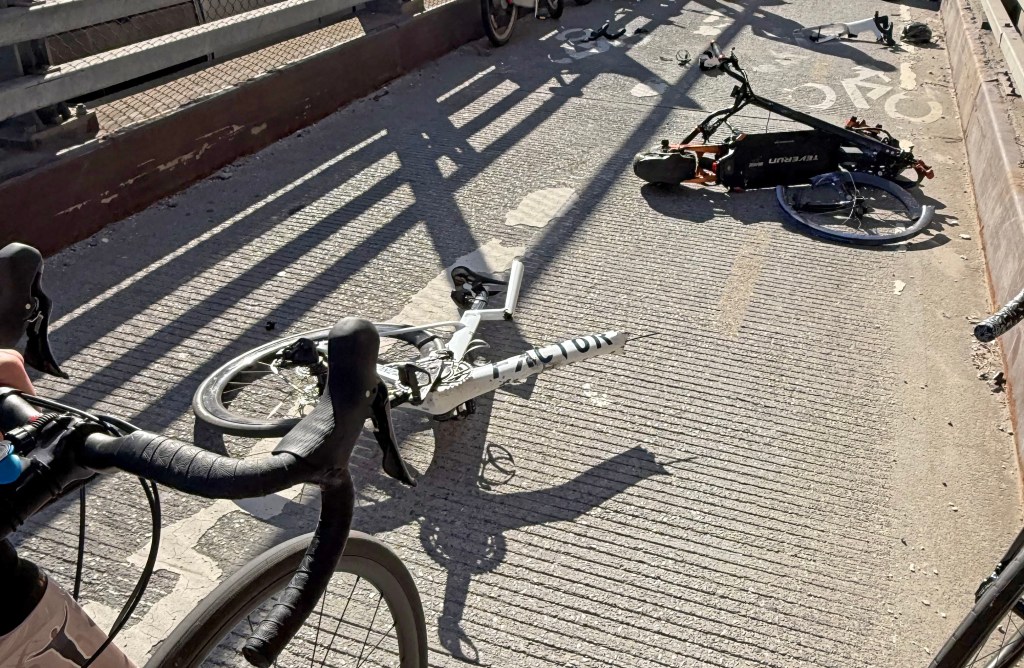
Mayor Mamdani must crack down on illegal stand-up electric scooters and other devices, safe streets watchdogs said on Thursday after a man riding on one of the illicit vehicles collided head-on with a cyclist on the Queensboro Bridge, killing them both.
Francis Delvalle, 39, was headed west up the bridge’s bike path on an illegal e-scooter with a top speed of 50 miles per hour when he struck cyclist Dmytro Stechenko, 35, as he rode downhill towards Queens. Neither man survived.
The horrific incident called attention to the city’s failure — over multiple mayoralties — to rein in the widespread use of high-speed electric vehicles that are legal to purchase even though they are illegal to ride on city streets.
But, according to experts, the city is not powerless to stop the vehicles, which many people call “e-bikes” even though they are very different than legal electric bicycles. For starters, the mayor can increase street-level enforcement and rider education, and take steps to ban the sale of illegal e-motos in the five boroughs.
Step 1: Enforce existing law
Stand-up electric scooters capable of going over 20 mph and e-bikes capable of going over 25 mph are illegal to ride on New York City streets. Neither vehicle is permitted to exceed 15 mph.
The most important thing Mayor Mamdani can do today? Direct NYPD to confiscate those illegal vehicles, said Jon Orcutt, a former DOT official and longtime city cycling advocate. (Currently, the NYPD effort has focused on electric mobility devices that have been used in crimes as well as legal mopeds that owners have failed to register.)
“If someone is riding an illegal vehicle in one of the city’s most crowded bike paths, it’s a safety issue like we’ve seen today,” Orcutt said. “Put a stop to it.”
The NYPD declined to say how many illegal e-motos its officers have seized in the past year. Cops already struggle to distinguish between e-bikes and a mopeds, let alone between illegal and legal stand-up scooters, but technology exists to help them: European cities with strict laws around e-bikes and scooters have turned to devices called dynamometers, or “dynos,” to test a vehicle’s max speed.
“They take the two wheeler, e-bike or scooter, they put it on the machine and they rev the throttle and the machine tells them. It’s idiot proof,” said Steve Vaccaro, another longtime cycling advocate and attorney based in Manhattan. “Instead of relying on police to figure out what to call them, buy the machines that exist. Invest in the tech.”
A Reddit post shows the technology in action:
Step 2: Regulate illegal e-moto sales
Vehicles like the Blade GT II scooter involved in Thursday’s crash are illegal to ride, but they are not illegal to purchase or sell. Mayor Mamdani and the City Council could fix that, according to advocates.
Theoretically, New Yorkers can purchase these devices for use on a closed course, but any ride over any city bridge reveals that these commuters are not limiting their use of these devices to private roads. Besides, no such closed courses exist in the city.
But Mamdani can still pass point-of-sale regulations to prevent New York City residents from buying two-wheeled vehicles that don’t meet certain standards. Yes, online sellers can find ways around such regulations, but the regs allow governments to enforce against retailers rather than relying on post-facto enforcement after the vehicles are already on the streets.
Amazon recently agreed to stop selling “e-bikes” that exceed state speed limits in California, after the Golden State’s Attorney General Rob Bonta warned companies that the sale of such vehicles violated state law.
And the scooter in Thursday’s crash is illegal almost everywhere, another expert pointed out.
“Forty-two out of 50 states clearly would not allow this scooter to be operated beyond 25 mph,” said Peter Beadle, another New York City-based bike attorney. “This scooter should not be able to be delivered to an address in New York City. If you’re looking for something to do, stop that today.”
Step 3: Take on dangerous marketing
Teverun, the maker of the Blade GT II, advertises the product on its website as “built for sustained high-speed dominance,” “built to match the freeway” and “born from racing instinct.” The website claims the Blade GT II goes from “zero to 53 in 3.9 seconds.”
Nowhere does the site point to the potential dangers of riding a scooter at top speed, or the prohibitions on these types of scooters around the country. The company “shares some responsibility for this and other crashes we see,” Beadle said in a post on Instagram.
“You know you’re building a scooter that goes twice as fast as any jurisdiction allows, you’re allowing it to be sold and shipped … and you’re taking absolutely no responsibility. In fact, you’re telling people it’s ‘unstoppable, built to rule the streets, has super speed,'” he told Streetsblog. “It’s the same toxic messaging used to sell guns and cars. On TV we have rules against cigarette, liquor and gun sales. Why don’t we have more rules that prevent this marketing?
“There have been lawsuits, against tobacco, firearms, product liability lawsuits based on the fact that you have false advertising and you’re committing a kind of fraud on the public based on that you’re marketing it in an irresponsible way,” Beadle added.
Step 4: Educate New Yorkers
Part of the solution is to educate New Yorkers about what they are buying — and the fact that they are illegal to use on Big Apple streets.
“Education is telling people, ‘Just because you can buy it and you use it doesn’t mean it’s lawful and that it’s safe and appropriate,'” said Vaccaro. “We need really clear language to talk about these things so people know it when they see it.”
Thursday’s crash rattled advocates who spent years fighting for separate bike and pedestrian paths on the Queensboro Bridge. The city finally opened a separate pedestrian path last year, but illegal, high-speed vehicles like the Blade GT II continue to use the safe infrastructure that advocates fought for.
A rep for Mayor Mamdani said the mayor is committed to getting high-speed e-motos off city streets.
“This terrible tragedy is a grim reminder that illegal, high-speed micro-mobility devices, like the stand-up e-scooter involved in this incident, are dangerous and have no place on our roadways or bike paths,” City Hall spokesman Jeremy Edwards said in a statement.
“Every New Yorker deserves to feel safe, and the Mamdani Administration will continue working to remove these illegal devices from our streets and bring accountability to micromobility use.”
Step 5: Take more space away from cars
It may seem counter-intuitive to once again call for roadway space to be repurposed from car drivers in the wake of a crash that did not involve any cars, but, in fact, car culture and its carnage is certainly implicated.
Indeed, illegal scooter operator Francis Delvalle and racing cyclist Dmytro Stechenko were occupying the same space on the Queensboro Bridge bike path simply because cyclists in both directions are still forced to share a single car-width lane of the span, while drivers in both directions are given eight lanes.
“Engineering” is one of the three “E”s of Vision Zero, as some people posted on social media yesterday.
Steven Lucy posted that the Queensboro Bridge bike path is just not built to accommodate the kind of traffic it gets:
When challenged, Lucy doubled down: “11 feet wide is not sufficient for a bidirectional path with this much traffic,” he posted.
Indeed, Lucy was pointing out the elephant in the room of New York City bike lane design: For the most part, they are too narrow.
“Two-way bike lanes should be at least 13 feet wide to accommodate all types of bicycles, side-by-side riding, platooning, and passing,” according to the NACTO bike lane design guide, an industry standard. “Motor vehicle lanes should be narrowed to support the widest feasible bike lanes.”
Correction: The original version of this story misstated the legal speed capacities for electric bikes and electric scooters in New York City. The former is limited to 25 mph and the latter is limited to 20 mph. Legal speed capacities are distinct from speed limits. Electric bikes and electric scooters must obey a 15 mph speed limit.

Read More:

Streetsblog has migrated to a new comment system. New commenters can register directly in the comments section of any article. Returning commenters: your previous comments and display name have been preserved, but you'll need to reclaim your account by clicking "Forgot your password?" on the sign-in form, entering your email, and following the verification link to set a new password — this is required because passwords could not be carried over during the migration. For questions, contact tips@streetsblog.org.