Friday’s Headlines: Canal St. Redesign Delayed Edition
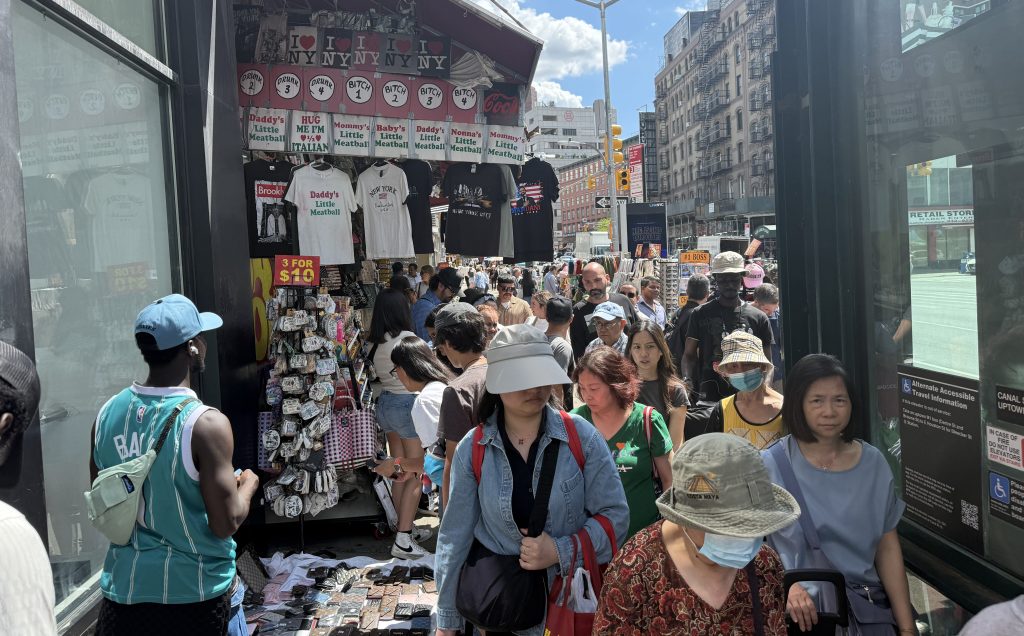
The Mamdani administration will push back a years-in-the-works redesign of Canal Street after complaints from car-focused opponents of the safety plan, Streetsblog has learned.
The Department of Transportation was supposed to start expanding the corridor’s overflowing sidewalks and install a new two-way crosstown bike lane in the area this summer. But officials are now “extending” that timeline to take in a “vast amount of feedback,” according to the head of Community Board 3, who said the civic panel would also push back its advisory vote on the plan.
“The Canal Street redesign was originally scheduled for a [community board] vote in June, however, DOT is taking time to consider the vast amount of feedback and will be extending the timeline,” CB 3 District Manager Susan Stetzer told the full board at its meeting on Tuesday.
It’s unclear what the vast feedback consists of, but DOT spokesman Vin Barone told Streetsblog that the delay will be short.
“We remain committed to comprehensive safety upgrades for Canal Street in 2026,” Barone said. “We’ve asked boards for slightly more time to return with presentations because we’ve heard important feedback that we want to incorporate into our designs before we start installation this year.”
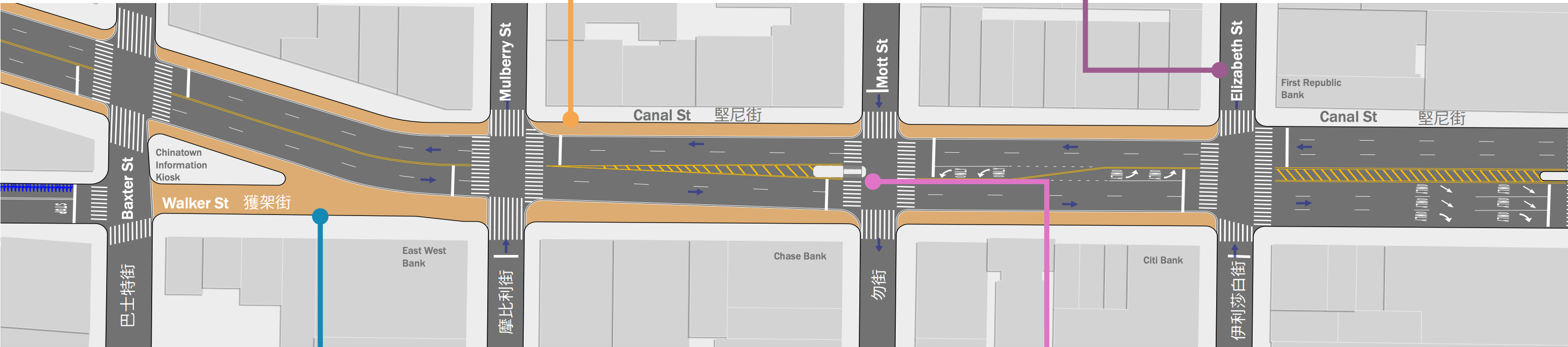
DOT planned to redesign Canal between the Manhattan Bridge opening at the Bowery and the Hudson River at West Street [PDF], adding more pedestrian space along the clogged sidewalks east of Broadway and turning the the current eastbound bike lane on Grand Street two-way, closing a major crosstown gap in the Lower Manhattan bike network, as Streetsblog reported in September.
The changes aimed to curb the rampant traffic violence along the notorious car sewer and give more room to pedestrians with so-called “Super Sidewalks” – curb lanes with painted foot path expansions. That would have removed a rush hour traffic lane in each direction and moved commercial loading to the side streets, but motor vehicles would still have kept the majority of the road bed with four travel lanes. DOT also planned to pedestrianize a slip lane on Walker Street east of Baxter Street.
Pedestrians make up nearly two-thirds of all people on Canal but have to squeeze into as little as 10 percent of the public right-of-way because the city prioritizes the movement and storage of cars and trucks, according to DOT data. The shorter crossing distances would have helped Chinatown’s residents, who tend to be older and have fewer cars than Manhattan and New York City as a whole. A mere 14 percent of households have access to a motor vehicle, compared to 23 percent in the borough and 45 percent citywide.
Motorists have killed or injured a whopping 220 people on the eastern portion of the project over six years, between Broadway and Bowery, and another 175 people between Broadway and West Street, an “unacceptably high number,” Amy Howden-Chapman, DOT’s project manager for public realm, told the community board in December. That includes two fatalities right at the Manhattan Bridge entrance, where drivers often come flying off the span’s excess car lanes at high speeds.
One local advocate, who has long pushed for a safer Canal Street, was incensed about the city’s slow-walking of the life-saving design.
“We are always waiting for Godot on Canal Street, and it seems we will continue to wait,” Chinatown resident Joseph Tedeschi told Streetsblog. “What should be a showpiece of urban planning and quality of life is an absolute disgrace.”
The delay comes after some residents and business owners aired the usual anti-street-safety grievances about congestion and lost parking at a two-hour-plus joint meeting of community boards 1, 2 and 3 late last year, with physician Thomas Chan claiming, without evidence, that the revamp would snarl car traffic and block his patients from being dropped off.
In addition to its pedestrian majority, Canal Street is a major mass transit hub, with 13 subway lines stopping at the thoroughfare, and the idea that reclaiming space for people from cars drives down business has been debunked again and again.
There has been backlash against unpermitted street vendors along Canal Street, and the head of the Chinatown Core Block Association, Jan Lee, added at the heated meeting last winter that the city was ignoring the “illegality, the crime, the violence, and everything that causes sidewalks to be impassable.”
Other locals, however, said the agency should go even further to make Canal Street a safe and pleasant boulevard.
“I would encourage only to step further into it, to become bolder with the idea of making Canal Street a place, not just a conduit for traffic and for the kinds of safety hazards we’ve seen,” said Kevin Watts at the December meeting.
DOT had originally planned to return to the three community boards in the spring with a revised proposal incorporating ideas from the public, and start implementation in July, continuing into spring 2027.
It marks yet another setback for a project that began more than three years ago when the agency began studying Canal Street, and its staff already conducted multiple surveys, which showed 80 percent support, according to a digital survey of more than 600 people officials presented in December.
But the effort dates back even further.
Former Mayor Bill de Blasio pledged a “comprehensive” study of Canal (and another look at Broadway) as part of the 2021 rezoning of SoHo and NoHo. The New York Metropolitan Transportation Council, a regional planning body, examined the corridor for nearly a decade from 2002-2010, and its Canal Area Transportation Study, or CATS, recommended the city expand space for pedestrians, ban left turns, and set up smarter parking regulation.
— Kevin Duggan
In other news:
- The big story yesterday was the horrific morning crash between a cyclist on a traditional pedal bike and the user of an illegal high-speed stand-up scooter. Most outlets had it, but the Times and Streetsblog offered the most insightful breaking coverage.
- We added a second-day story still on the first day in hopes of helping policymakers figure out how to rid the city of illegal high-speed vehicles.
- Queens County Supreme Court Justice Chereé Buggs refused to issue a temporary restraining order against the Department of Transportation, which would have halted the agency’s ongoing installation of a protected bike lane on 31st Street in Astoria. Instead, she scheduled a hearing for July 6 at 10am. In December, Buggs paused DOT’s original and much smaller version of the same project. (NY Courts)
- Buggs’s decision came one day after a group of Astorians held a small rally in a church parking lot near 31st and Ditmars Boulevard. QNS and PIX11 attended the gathering, as did neighborhood activist Alex “Miser” Duncan, who filmed an anti-bike-lane protestor shouting “Death to transplants … death to hipsters … “
- Reporter Adlan Jackson rode the limited-run Domino Park-to-Prospect Park shuttle bus, sponsored by skincare brand The Ordinary, and lived to tell the tale. (Hell Gate)
- News12 spoke with Jamie Torres-Springer, the MTA’s president of construction and development, about the embattled Penn Station Access project, which will bring four new MetroNorth stations to the East Bronx. (News12)
- A car drove onto the Queensboro Bridge’s bike lane. (@jmramrez on TikTok)
- Subway surfers are obtaining keys to the back doors of trainsets by stealing them or buying them online. (Gothamist)
- If you missed Manhattanhenge last night, catch the next one tonight — which will be even better. (NY Post)
- People aren’t rushing to buy new cars, which tend to be bigger and heavier than their older counterparts. (WSJ)
- The World Cup match between France and Senegal is likely to coincide with Game 6 of the NBA Finals on June 16, setting up a potential transit mess — but NJ Transit is telling attendees not to worry. (ABC7)
- After testing e-cargo bikes in New York City, Amazon is expanding the pilot to Washington, DC. (FreightWaves)
- Mayor Mamdani is boycotting the annual Israel Day parade on Fifth Avenue on May 31. However his police commissioner, Jessica Tisch, will serve as the event’s grand marshal. (Times of Israel, PIX11)
- The percolating drama around the privately owned public space at 780 Third Avenue in Turtle Bay now involves sprinklers. (Instagram)
- The Port Authority Bus Terminal: a hidden gem? (Gothamist)

Read More:
Streetsblog has migrated to a new comment system. New commenters can register directly in the comments section of any article. Returning commenters: your previous comments and display name have been preserved, but you'll need to reclaim your account by clicking "Forgot your password?" on the sign-in form, entering your email, and following the verification link to set a new password — this is required because passwords could not be carried over during the migration. For questions, contact tips@streetsblog.org.