Opinion: On Canal Street, I Just Dream Of Having A Sidewalk
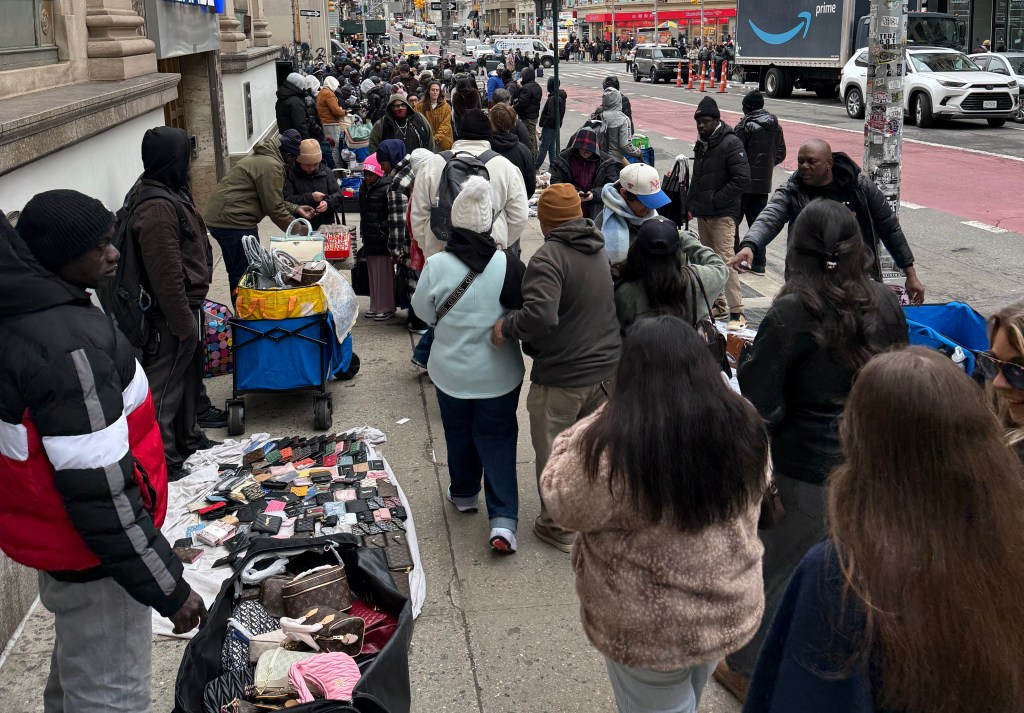
This is every day on Broadway just south of Canal Street: police sirens cut through the normal chaos and people run chaotically across the street and through the intersections, dragging large laundry bins overflowing with handbags, tee-shirts and jewelry.
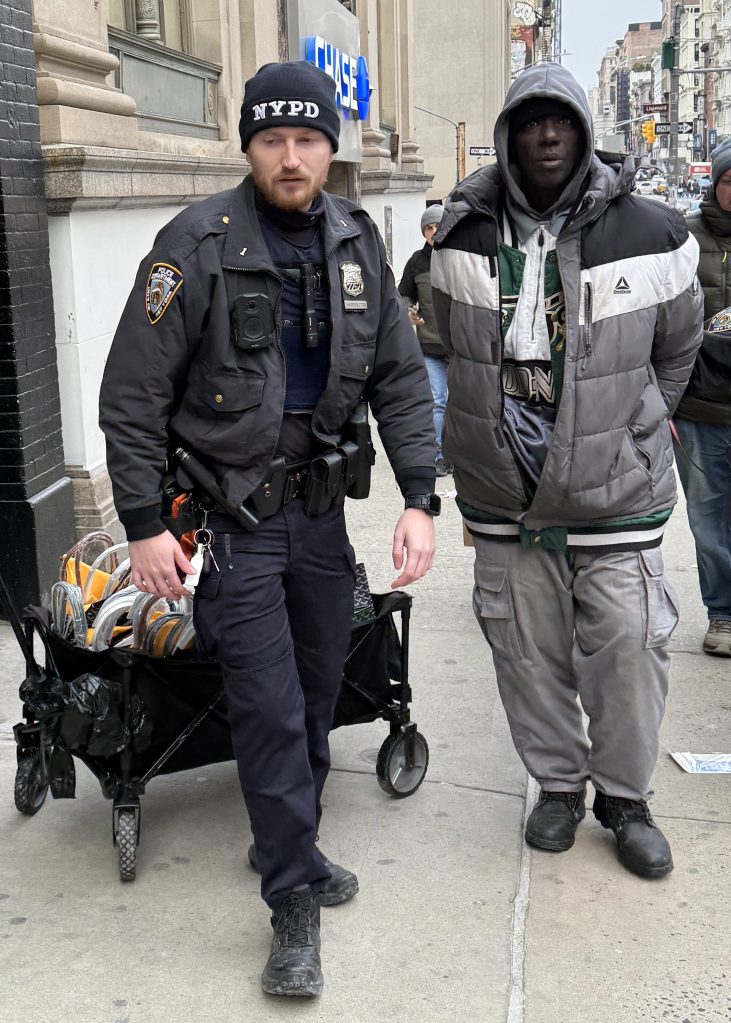
On my most-recent visit, I watched two cops arrest a single street vendor. I asked one of the officers — name tag, Benedetto — why this man was being arrested when vendors on the other side of the street were not.
“There’s only two of us,” he said, looking around, “and a lot of them.”
He and his partner left with their collar. Within moments, the sidewalk reset. Selling resumed. Business as usual.
The sidewalks don’t function
In a two-block radius around the Broadway and Canal intersection, sidewalks are routinely blocked by blankets covered in merchandise — handbags, t-shirts, watches — laid edge to edge. Vendors move goods in a coordinated system: vans and SUVs pull up, carts are loaded, inventory is distributed in waves. It is organized, constant, and massive.
Some vendors are open about it. Others operate more discreetly, quietly showing prospective buyers glossy, high-color catalogues displaying handbags, sneakers and watches bearing the logos of luxury brands. When a customer agrees to buy, a runner disappears down the block and returns moments later carrying the item from a nearby van or truck. The parking lot at the corner of Lispenard and Broadway (and the abandoned building on the southwest corner of Broadway and Canal, which also benefits from the cover of scaffolding) appears to serve as a kind of informal warehouse and dispatch center, with vehicles constantly arriving, unloading merchandise and redistributing inventory back onto the street.
Canal Street no longer feels like a collection of isolated vendors. It feels like a fully functioning informal economy — a parallel retail infrastructure operating just beneath the surface of the formal city.
The scale is astonishing: thousands of items moving through a sidewalk ecosystem that seems at once improvised and highly coordinated. Watching it, one is left with the strange feeling that nobody but the vendors and the people who supply the illegal merchandise — not residents, not police, not City Hall — fully understands how this machine actually works.
New York has always contained informal economies — think pushcarts, gray-market electronics stores, or unlicensed food vendors — but the counterfeit corridor on Canal has evolved into something unusually concentrated, visible and spatially dominant: not merely commerce occurring on sidewalks, but commerce overwhelming them.
What could be one of the great pedestrian corridors of New York is instead a daily obstacle course.
This is public space
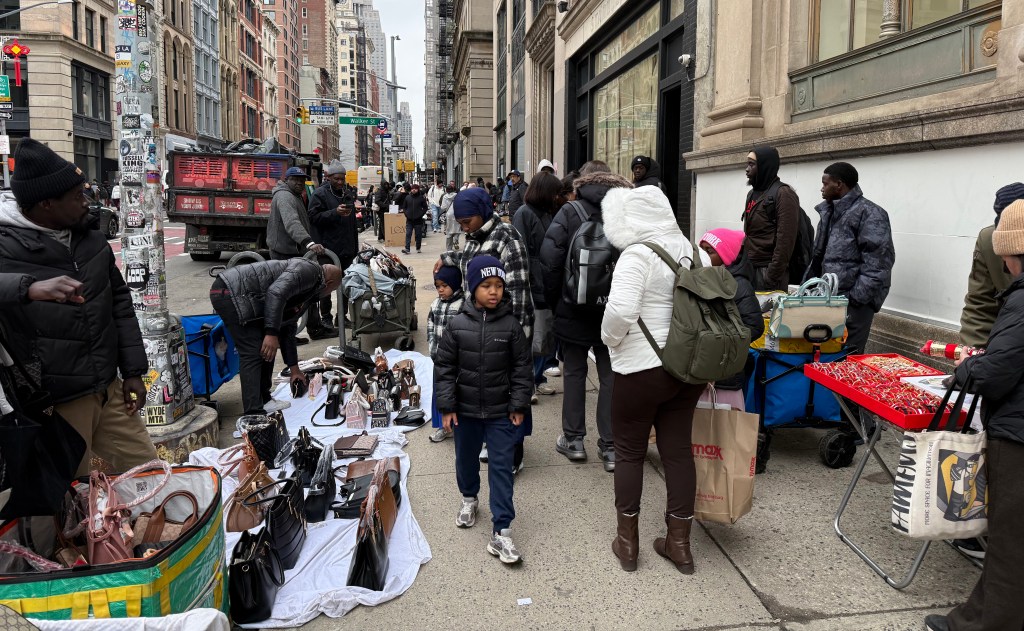
It would be one thing if the current situation at least worked for one group of people, but it currently works for no one: Residents, workers, customers of local businesses, commuters, the elderly, parents with strollers, people with disabilities all must navigate an unwalkable sidewalk.
The vendors themselves are forced to operate in a constant cycle of confiscation, dispersal, and return. Cops certainly can’t love the fact that they perform the same futile folie-de-deux day after day. And let’s not forget the customers seeking these counterfeit baubles. We may not like them, but their desire to buy cheap luxury knock-offs is the foundation of this entire crazy system.
The failure of three consecutive mayors to balance these competing interests practically invites in an interventionist federal government; indeed, federal immigration authorities raided Canal Street late last year, adding a layer of fear and volatility — which was probably the point, but didn’t solve the problem either (which may have also been the point).
So what is to be done?
To figure out a path forward, we first must understand: Why is this happening on Canal? There are busy, tourist-rich commercial streets all over the city — West Broadway in Soho, Broadway between Times and Union squares, Main Street in DUMBO and in Flushing, the Hub in the Bronx — that have not similarly been commandeered by unlicensed vendors.
Unlike those other areas, this is not only a political or enforcement issue, but a human and civic one, as well. So it’s worth asking: Why not create a safe, regulated, temporary space for vendors to sell while a broader plan for Canal Street is developed and implemented?
Advocacy groups and scholars have long pointed out that many of the people selling counterfeit goods on Canal are migrants operating in an economy that offers them few viable alternatives. As one recent essay in the Fordham Political Review observed, the debate around Canal is often burdened with racial and class assumptions that flatten the human dimension of the situation. It is easy to speak abstractly about “illegal vendors” or “counterfeit markets.” It’s harder to confront the reality that many of the people caught in this cycle are simply trying to survive in one of the most-expensive cities in the world.
On the plus side, there are discussions happening inside the Mamdani City Hall, the Department of Transportation, the MTA and the NYPD — as they have been happening for years. And DOT has shared a vision for a dramatic “re-imagining” of Canal Street that includes widened sidewalks, reduced pedestrian crowding, expanded public space and other pedestrian-first improvements.
Some locals fear that vision: unless the city simultaneously addresses the underlying vending ecosystem, wider sidewalks may simply become a larger stage for the same dysfunction. More space alone can act as a kind of induced demand — a siren song drawing even more vendors, more congestion and more pressure onto public space that is already failing to function as a sidewalk at all.
So, clearly, this is not an easy problem. It involves enforcement, economic reality, coordination across agencies, and some the ability to consider the human toll of an exploited, mostly immigrant workforce just trying to make a buck.
But “complicated” cannot be an excuse for inaction.
What exists now is a failure of basic public space.
Is a simple sidewalk too much to ask?

Read More:
Streetsblog has migrated to a new comment system. New commenters can register directly in the comments section of any article. Returning commenters: your previous comments and display name have been preserved, but you'll need to reclaim your account by clicking "Forgot your password?" on the sign-in form, entering your email, and following the verification link to set a new password — this is required because passwords could not be carried over during the migration. For questions, contact tips@streetsblog.org.