AG Tish James Issues Promised Consumer Alert on Illegal E-Motos
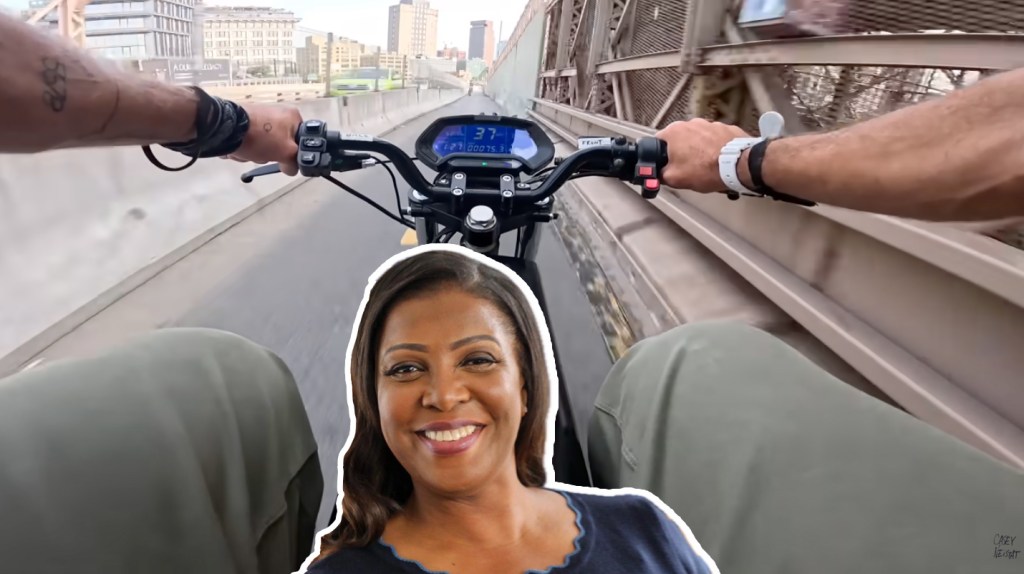
State Attorney General Letitia James has made good on her promise, reported earlier this week by Streetsblog, to issue a statewide consumer alert to remind would-be purchasers, but also sellers, that many motorbikes that are marketed as e-bikes are, in fact, illegal — a move that many believe will reduce the sale of the devices to unsuspecting consumers.
Citing two recent deaths involving illegal electric micromobility devices, James’s office issued the alert on Friday to make clear that marketing and selling vehicles as “e-bikes” or “e-scooters” is illegal if the devices “exceed state speed or power limits for those vehicles.”
“Our laws set limits on e-bikes and e-scooters to help keep New Yorkers safe, and the riders and companies who ignore them are putting everyone on our streets in danger,” James said in a statement. “I urge businesses and consumers throughout our state to follow the law and keep unlicensed and unregistered motor vehicles off our streets. No one should have to fear for their lives when crossing the street, and I encourage New Yorkers to follow the law and report those selling illegal e-bikes and e-scooters to my office.”
The statement comes weeks after a group of state legislators called on the state’s second-highest-ranking official to issue the consumer alert, which follows a similar effort by James’s California counterpart, which led online retailers to stop shipping illegal devices to addresses in the Golden State.
James’s alert comes after Wednesday’s crash on Centre Street that caused the death of a teenager who was riding an illegal Deepower e-moto and after the deadly May 28 head-on collision on the Queensboro Bridge between a cyclist and a man on an illegal e-scooter.
As such, safety advocates hailed the alert.
“No one should ever have to bury their child,” Fabiola Mendieta-Cuapio, executive committee co-chair of Families for Safe Streets New York, said in a statement. “Wednesday’s deadly crash was a terrible reminder that our state must do much more to protect the youngest New Yorkers. This high-school student was riding an illegal high speed device that should never have been available for purchase. My heart aches for his family, friends, and school community. We must close these loopholes so this tragedy never happens again.” (Mendieta-Cuapio’s son was 5-years old when he was killed by a driver.)
Under New York law, e-bikes must have an electric motor of less than 750 watts, and fall into one of three classes:
- Class 1, also known as low-speed pedal-assisted e-bikes, provide electric assistance only while being pedaled and only at speeds under 20 miles per hour.
- Class 2, also known as low-speed throttle-assisted e-bikes, provide electric assistance up to 20 miles per hour but have a throttle that allows the rider to use the motor without pedaling.
- Class 3, also known as speed throttle-assisted electric bicycles, are similar to Class 2 e-bikes, but the electric motor assistance must stop when the bicycle reaches 25 miles per hour. (These bikes are only legal, for now, in New York City. There is a Council bill that would ban them.)
Bicycles that go faster than 25 miles per hour with electric assistance in New York City, or faster than 20 miles per hour with electric assistance outside New York City, are not e-bikes under New York law, and are instead e-motos, mopeds, or motorcycles that may be subject to additional registration, licensing, and insurance requirements through the Department of Motor Vehicles, James’s statement also pointed out.
The main problem is that consumers don’t know much of the above, and parents often by e-motos for their adult children without realizing they are purchasing an illegal conveyance. In the case of the Deepower rider Gabriel Nacato, an uncle had recently bought the illegal device so that the student could get from home to his job and school in Manhattan.
There is considerable urgency behind James’s alert, given how much misinformation exists in the marketplace. And the sellers of these devices are not helping; indeed, hours after Nacato’s death, Deepower altered its website to suggest that its illegal two-wheeler was, in fact, legal.
James urged New Yorkers to report businesses that they believe are violating the law by submitting a complaint online or by calling (800) 771-7755.


Read More:
Streetsblog has migrated to a new comment system. New commenters can register directly in the comments section of any article. Returning commenters: your previous comments and display name have been preserved, but you'll need to reclaim your account by clicking "Forgot your password?" on the sign-in form, entering your email, and following the verification link to set a new password — this is required because passwords could not be carried over during the migration. For questions, contact tips@streetsblog.org.