Revealed! Trump’s Penn Station Contract Would Have Handcuffed MTA On Lease — And Let Duffy Say Whatever He Wants
It was as bad as they said it was.
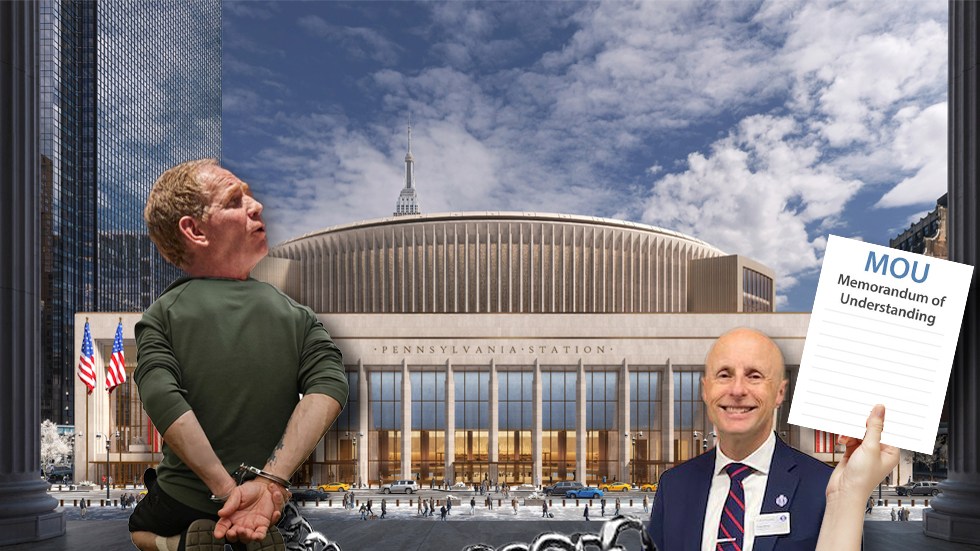
Turns out MTA officials were right when they described Amtrak’s heretofore unreleased Penn Station contract as a bad deal for the agency because it would bind it to Amtrak’s quest for money from New York State for the station’s costly renovation and would potentially change the terms of the MTA’s existing lease for its space inside the station, according to a document released on Friday.
The contract, a collaboration agreement that was previously only described in broad strokes by MTA leadership, was obtained and made public by Reinvent Albany. The document asks the MTA to submit to a series of disadvantageous demands, including:
- Supporting Amtrak as it lobbied for money from New York State and the federal government to pay for the project.
- Agreeing to renegotiate the agency’s current lease to operate out of Penn Station, which is prepaid for 160 more years.
- Allow U.S. Transportation Secretary Sean Duffy to make public statements about the Penn renovation project without the MTA’s consent.
- Barring MTA from reviewing or approving designs that affect areas under MTA’s exclusive control.
The MTA’s refusal to sign the document has been a point of contention between the MTA Chairman and CEO Janno Lieber and Amtrak Special Advisor Andrew Byford, who’s been helming the project since Duffy took over the renovation from New York State in a fit of pique over congestion pricing.
Good government advocates say that the contents of the agreement, which was sent to the MTA in November 2025, show the MTA was correct in declining to sign it.
“This is Trump’s project, it’s Amtrak’s project, and the MTA is right to be skeptical and use whatever leverage they have to protect New York, because this is not a balanced arrangement,” said Reinvent Albany Senior Policy Advisor Rachael Fauss.
Byford has spent much of 2026 cajoling the MTA into signing the document, starting in January when he publicly revealed that New Jersey Transit had signed its “memorandum of agreement” with the federally managed railroad. That document did give the cash-strapped NJ Transit some say over which master developer’s design was chosen for the Penn redesign in exchange for a financial contribution to the project.
The collaboration agreement sent to the MTA contains a clause that states that the agency “shall cooperate and support Amtrak with respect to Amtrak’s efforts to obtain state and federal funding.”
That clause made the entire deal more or less dead on arrival, given that ever since Duffy took over the project to create a grand Trumpian train hall, Gov. Hochul has insisted that New York State will not pay a dime.
The clause demanding the MTA support Amtrak’s funding efforts would also lock the state agency into supporting Amtrak’s push for land-use control of the neighborhood around Penn Station. Amtrak has supported a clause in the pending federal surface transportation reauthorization bill that would allow it to override local land-use laws and redirect city property taxes towards the train hall’s reconstruction. Amtrak pitched that as “value capture,” but it could hobble the city budget for years and allow Amtrak to simply hand over the area to Manhattan landlord Vornado with no city review.
In January, Byford said that by signing the MOA, New Jersey had gained “full voting rights” over the future of the project. But there’s a big gap between “voting” and “rights”: the contract says that the project developer would be selected by a Technical Evaluation Committee — and three of the four voting members of that committee are appointed by Amtrak. Only one was appointed by NJTransit.
The makeup of the evaluation committee was not made public until Amtrak quietly revealed the setup at a July briefing to government officials and local residents who get occasional updates on the project.
Janno Lieber has been open in public about his lack of interest in signing the document that was offered to the MTA, frequently telling reporters that the agency has rights as an existing Penn Station tenant with a long prepaid lease.
“I’m declining to be the first person in New York real estate history to say I want to enter into a real estate deal with Donald Trump with no lease and no protections,” he told reporters in June.
The motive for Lieber’s posture is clearer now that the public can see the contract and its specific clause that allowed the existing MTA lease to be altered during the pre-development agreement phase of the project, which is currently ongoing to advance the design and settle on a final cost of the renovation.
A section of the document that acknowledged the MTA’s lease goes on to state “in conjunction with the prosecution of the [Pre-Development Agreement] Work, the Parties agree to engage in good faith discussions regarding potential modifications to the LIRR Lease and the [NJTransit] Lease reasonably necessary to facilitate the implementation of the Project.”
If the MTA had signed the deal, all of these rights would have been waived before Amtrak even chose a developer for the project, which ended up being a consortium headed by international developer Halmar working from a design by architect Vishaan Chakrabarti.
The collaboration agreement — again, which the MTA would have had to sign before the developer was chosen — specifically cut the MTA out of reviewing the design, and would also have kept the MTA from final approval of designs for station areas that were supposed to be explicitly controlled by the MTA.
Two clauses in the contract highlight the difference between the rights given to NJ Transit and rights given to the MTA (emphasis ours):
As a Funding Partner, NJ TRANSIT shall be invited by Amtrak to participate in all design sessions with the Master Developer, including “over-the-shoulder” reviews of design documents prepared by the Master Developer as part of the PDA Work. Amtrak shall consider, and shall cause the Master Developer to consider, in good faith, comments provided by NJ TRANSIT; provided that NJ TRANSIT comments are provided within fourteen (14) calendar days to enable consideration and potential incorporation thereof. Notwithstanding anything to the contrary set forth herein, the Master Developer’s design shall be subject to final approval by Amtrak; provided further that Amtrak’s final approval of the Master Developer’s design shall be subject to NJ TRANSIT’s approval of those portions of the Master Developer’s design comprising areas that will be for the exclusive use of NJ TRANSIT in the future, such as NJ TRANSIT back-of-house operational areas …
As a Coordinating Partner, MTA shall be invited by Amtrak to review and comment on the Master Developer’s design documents as design milestones are achieved; provided that MTA comments are provided within fourteen (14) calendar days to enable consideration and potential incorporation thereof. Notwithstanding anything to the contrary set forth herein, the Master Developer’s design shall be subject to final approval by Amtrak.
Even the seemingly innocuous clause allowing Duffy to make public statements without the MTA’s approval has a knife’s edge that could harm the MTA or the project. After all, Duffy was wrong when he told the Senate that the federal government was going to give $8 billion to the project, a comment that Fauss said bolster’s the MTA’s reason to be wary of giving away its rights to communicate about the project. (In addition, the Trump administration has already been mired in market manipulation and prediction market chicanery, suggesting that it is not immune to self-dealing on this project either.)
“We know who’s been making the most public statements about this. It seems to be accounting for the fact that they can’t control their own boss. There should be discipline on messaging and coordination, and public statements can mean a lot in terms of the financial markets, in terms of public opinion, and it’s not nothing,” said Fauss.
The MTA’s refusal to sign the document touched off a war of letters between Byford and Lieber earlier this year over who was doing the most to stand up for riders who use Penn Station, with Amtrak giving reporters both Byford’s letter he said he sent to Lieber as a good-faith bargaining move and Lieber’s sarcastic rejoinder to a letter reporters got before he did.
Since then, the temperature seems to have cooled somewhat between the parties, but misunderstandings remain. At a Crain’s breakfast last week, Byford suggested that the MTA was ready to sign a less-onerous document, but, the MTA disputed that idea. And at a press conference last week, Lieber said he was standing firm on his demand to see whatever Amtrak’s plans for the station are before the MTA signs off on them.
“Up to now the feds have not been willing to share those ideas with us. We are looking forward to them actually showing us the plans. We’re concerned with protecting the riders because when you start talking about pulling out a ton of structures and columns, it impacts on platforms; it may take platforms and tracks out of service,” he said. “We have to know whether this is going to hurt Long Island Rail Road and subway riders. There was never any discussion of us approving the project; it was just a discussion of can we get access to the drawings, can we see what they’re doing, so we can evaluate with our lease rights, which are absolute, whether it will be compatible with the first class operation of this facility we’ve accomplished.”
A spokesperson for Amtrak, the same railroad that attempted to get the MTA to sign the agreement by working the agency through the press just three months ago, called efforts to report on the $8 billion project in the heart of Manhattan “ill-informed,” “wasted speculation” and “unnecessary.”
“This is an outdated document and is not relevant to the current project or negotiations,” said Amtrak spokesperson Jason Abrams. “Any ill-informed opinion about it is wasted speculation. This type of unnecessary back-and-forth is one of many reasons why this project has failed to get off the ground in the past.”

Read More:
Streetsblog has migrated to a new comment system. New commenters can register directly in the comments section of any article. Returning commenters: your previous comments and display name have been preserved, but you'll need to reclaim your account by clicking "Forgot your password?" on the sign-in form, entering your email, and following the verification link to set a new password — this is required because passwords could not be carried over during the migration. For questions, contact tips@streetsblog.org.