Open Streets are Business Incubators, Yet Another Report Shows
Want jobs? Keep out the cars.
Yet another report — this time from state Comptroller Tom DiNapoli — reveals that job growth is more robust on most of the city’s open streets, with more than 74 percent of the non-school locations adding retail and restaurant jobs.
And at those 200 or so locations, more than 67,200 jobs were created — with nearly a majority of those slots (46 percent) created at the 62 locations that had an open street for all five years between 2020 and 2024. Almost 98 percent of those were created in Manhattan and Brooklyn, but that’s because those boroughs are more likely to have had open streets from the start of the pandemic through 2024.
“The Open Streets program … continues to encourage foot traffic to support shopping, dining and other activities in many parts of the city,” DiNapoli said in a statement.
The new data won’t surprise New Yorkers who have been paying attention to the business-friendly quality of car-free streets. In 2022, the Department of Transportation reported that restaurants and bars on open streets increased their sales by 19 percent above their pre-pandemic baseline while sales dropped by 29 percent at establishments that weren’t on car-free corridors.
Two years later, the Department of City Planning reported that open streets have a 12-percent lower vacancy rate than the citywide average.
But the new report adds a few new wrinkles.
For instance, open streets in Manhattan added significantly more retail and restaurant jobs than the rest of the borough, with Brooklyn and the Bronx adding slightly more and Queens on Staten Island open streets actually adding fewer jobs than compared to the rest of those boroughs.
The failure of Queens and Staten Island might simply be because of those boroughs’ lower participation numbers across the entire study period, from the dawn of the pandemic to the end of 2024. There were only 62 such locations — “and those were concentrated in Manhattan and Brooklyn,” the report stated.
Advocates for reducing the deleterious effect of cars on our city were certainly pleased by the findings.
“This new report validates what we have known for years – –that open streets are an engine for boosting economic vitality, jobs, and community connections,” said Sara Lind, co-executive director of Open Plans. “We encourage lawmakers to take heed from these findings and allocate funds from the city and state budgets to increase and provide support for open streets across New York.”
And a spokesperson for DOT also joined in the fun.
“As [the] report shows, when we design people-centric streets and utilize strategies like open streets, it benefits local businesses and all New Yorkers,” said DOT spokesman Scott Gastel.
Of course, it’s not all peaches and cream.
DiNapoli said that the city should do more to mitigate concerns of the volunteer groups or business improvement districts that operate the open streets for the city. Many organizers have complained, for instance, of limited public funding and the failure of NYPD to enforce traffic and parking rules.
Crunching 311 data, DiNapoli’s office discovered that illegal parking was a major concern, with complaints rising by 178 percent on open streets between 2020 and 2024.
On the plus side, complaints from neighbors about residential noise dropped 20 percent on open streets during the same period (on non-open streets, such complaints dropped by only 8.4 percent). And as the pandemic receded, complaints about commercial noise rose at a lower rate than citywide.
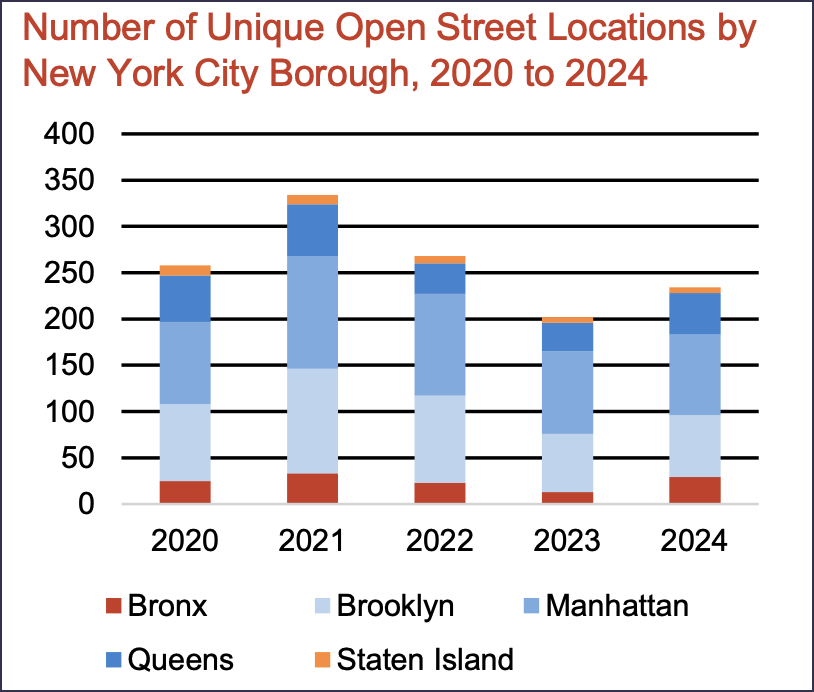
Also good news: In 2024, the number of open streets rose for the first time since the height of the pandemic. DiNapoli attributed the rise to a 2023 program established by DOT that helped fund operations and management of public spaces through November 2026.
Can open streets do everything? Of course not. The pandemic decimated the New York City job market. By the end of 2020, foot traffic in key retail corridors in Manhattan was 50 percent below its 2019 level — and the open streets program certainly didn’t erase all of that impact, as the chart below shows.

Read More:
Streetsblog has migrated to a new comment system. New commenters can register directly in the comments section of any article. Returning commenters: your previous comments and display name have been preserved, but you'll need to reclaim your account by clicking "Forgot your password?" on the sign-in form, entering your email, and following the verification link to set a new password — this is required because passwords could not be carried over during the migration. For questions, contact tips@streetsblog.org.