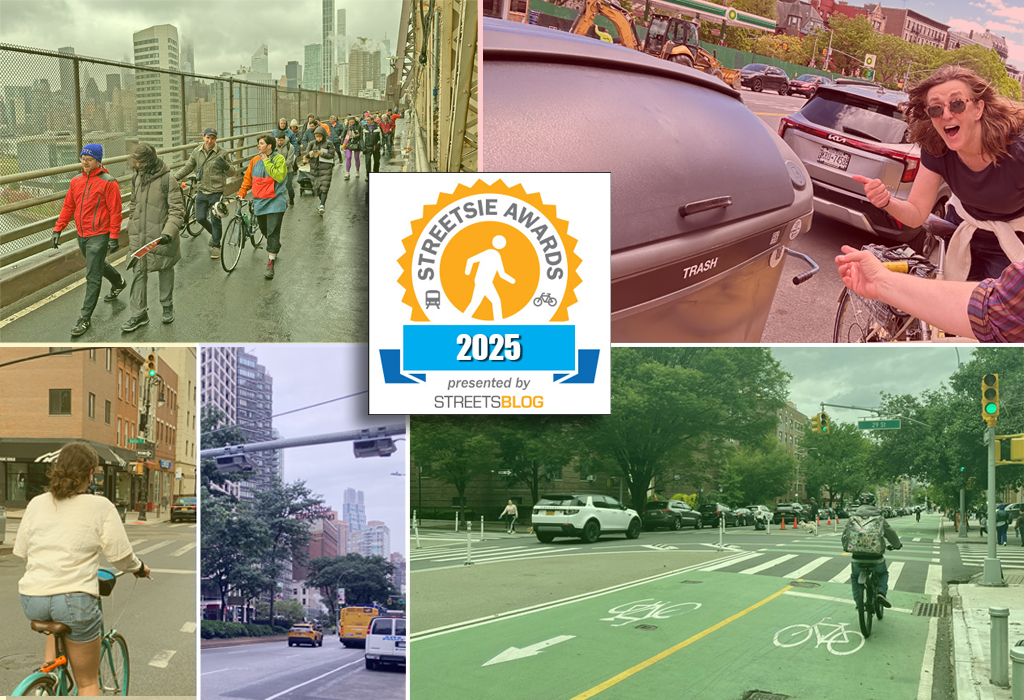
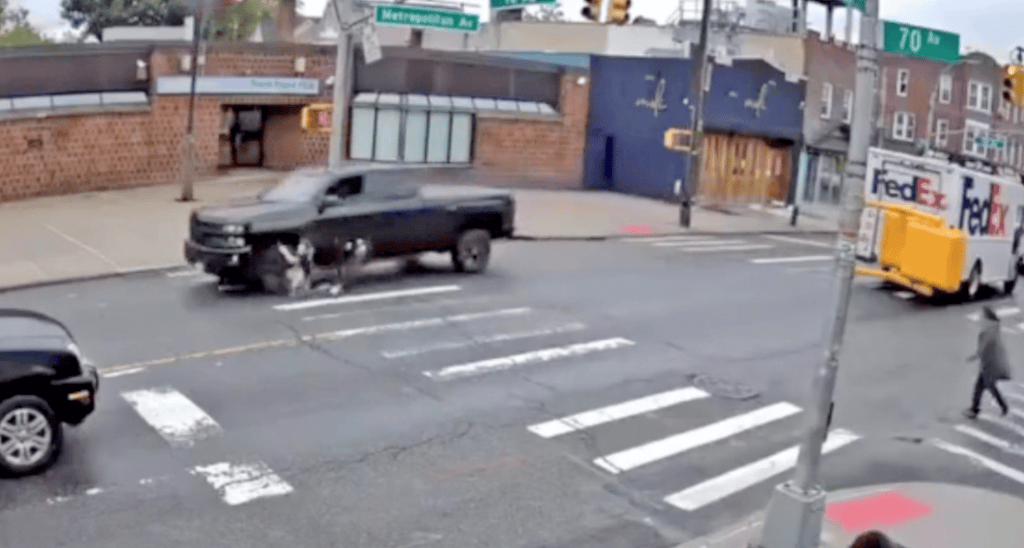
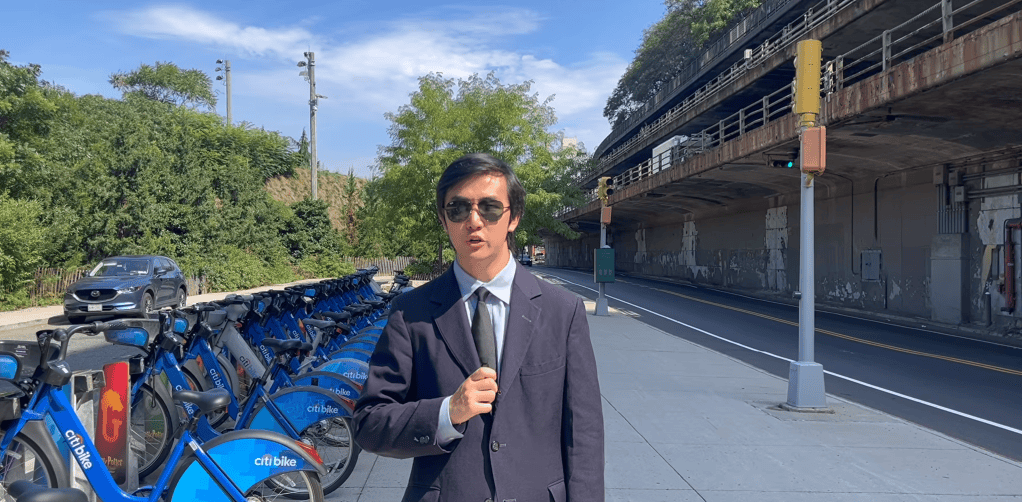
And the nominees for best project of the year are (clockwise from top left): More pedestrian space on the Queensboro Bridge, the successful deployment of Empire Bins, the 31st Avenue bike boulevard, congestion pricing and more "green wave" timing.
Streetsblog provides high-quality journalism and analysis for free — which is something to be celebrated in an era of paywalls. Once a year, we ask for your tax-deductible donations to support our reporters and editors as they advance the movement to end car dependency in our communities.
If you already support our work, thank you! If not, can we ask for your help?This year’s fundraiser includes a special gift for our biggest supporters. Don’t miss out.
Together, we can create a more livable, walkable, bikeable, equitable and enjoyable city for all. Happy holidays from the Streetsblog team!
The final year of the Adams administration has largely been marked by a mayor who didn’t care about livable streets policy or actively worked to roll back a decade’s worth of Vision Zero work.
But there were still some highlights this year: The city finally got congestion pricing, avoided a highway expansion in the South Bronx, and European-style trash containerization took off uptown. And that’s not all!
So meet this year’s nominees for “Best Project” of the year … and remember to vote at the bottom. Polls are open until Dec. 27 at 11:59 p.m. And remember, all our end-of-year Streetsies coverage is archived here.
Congestion — priced
It finally happened.
The nation’s first congestion pricing program launched early this year, charging drivers a $9 peak toll to enter Manhattan’s Central Business District below 60th Street. The progressive transportation policy arrived after decades of failed efforts and last-minute political battles to enact the proven measure to cut car trips and fund mass transit.
On the eve of Jan. 5, Metropolitan Transportation Authority leaders uncovered the signs at the congestion relief zone’s border in Midtown as fans and advocates cheered the first drivers paying the toll.
Is that MTA Chairman Janno Lieber getting lifted into the air to unveil the “CONGESTION RELIEF ZONE” sign on Broadway and 61st?
The agency plans to cover most of the city’s mid and large-size buildings by 2032, and it will remain up to future mayors to maintain the backbone to repurpose parking giveaways for drivers into civilized garbage collection.
‘More space QBB’
The city finally gave pedestrians and cyclists their own lanes on the Queensboro Bridge after years of delays thanks to a DOT focused on motorists, who got nine of the 1909 span’s lanes.
The agency returned the bridge’s south outer roadway from car traffic to pedestrians, who for decades had to squeeze into the dangerously tight north outer path with some 8,500 daily cyclists and micromobility riders.
The proposal dated back to the de Blasio administration, but DOT held off on making it a reality for fear of adding a little more traffic amid otherwise unrelated upper deck repairs – prioritizing driver convenience over safety for cyclists and pedestrians.
The redesign dated back to the de Blasio administration, but under Mayor Adams, the Department of Transportation kept postponing the work to avoid a little more cars backing up during bridge construction closures as officials repaired the 1909 span’s upper deck.
And even when DOT was ready to finally proceed this spring, Mayor Adams again intervened in the 11th hour to halt the redesign mid-work. Eventually the southern path became car free in May, even as Transportation Secretary Duffy complained about it – but don’t listen to the noise, it’s great!
Green wave revival
DOT brought back a de Blasio-era tool to calm traffic and encourage bike trips: tweaking traffic signals so people driving or riding at 15 miles per hour get consecutive green lights, also known as “green wave” signal timing.
The agency previously rolled out the bike-friendly signals on Hoyt and Bond streets in Downtown Brooklyn in 2019, and here’s hoping this will be the start of more green waves all over the city.
The bike boulevard
Transportation watchers know that Queens has been the borough to watch for innovative street redesigns in recent years, and the super-wide two-way bike lanes on 31st Avenue are the latest example.
The 16-foot-wide paths are part of a mile-long bike boulevard that gives back the majority of the street scape to pedestrians and cyclists, while flipping traffic direction every few blocks to drastically reduce pass-through trips by drivers.
The revamp came after Astorians organized heavily – including resident and incoming Mayor Zohran Mamdani – for better street safety infrastructure in their neighborhood, where the few protected bike lanes used to be limited to the edges.
Kevin Duggan joined Streetsblog in October, 2022, after covering transportation for amNY. Duggan has been reporting on New York since 2018, starting at Vince DiMiceli’s Brooklyn Paper, where he covered southern Brooklyn neighborhoods and, later, Brownstone Brooklyn. He is on Bluesky at @kevinduggan.bsky.social and his email address is kevin@streetsblog.org.
Streetsblog has migrated to a new comment system. New commenters can register directly in the comments section of any article. Returning commenters: your previous comments and display name have been preserved, but you'll need to reclaim your account by clicking "Forgot your password?" on the sign-in form, entering your email, and following the verification link to set a new password — this is required because passwords could not be carried over during the migration. For questions, contact tips@streetsblog.org.
In their latest video, the current and former NYC public school students of the Joint Transit Association have some concerns about Mayor Mamdani's plan to rebuild the BQE.