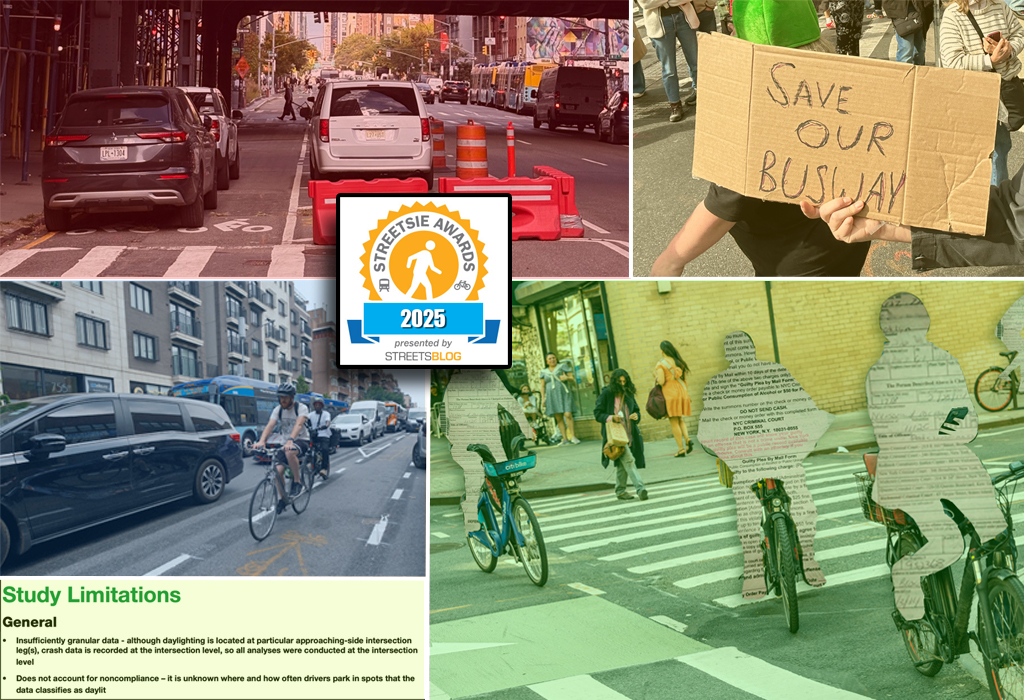
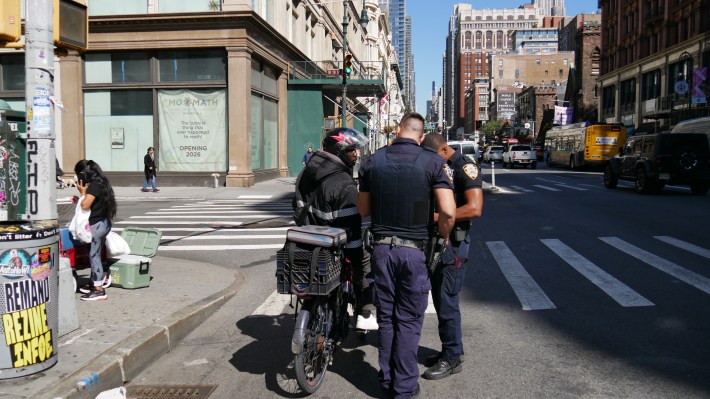
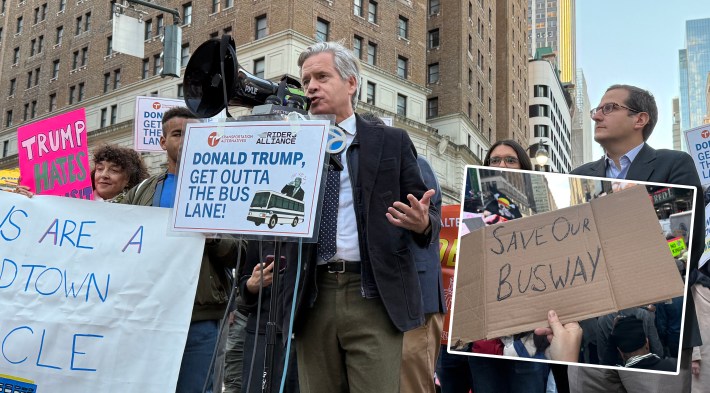
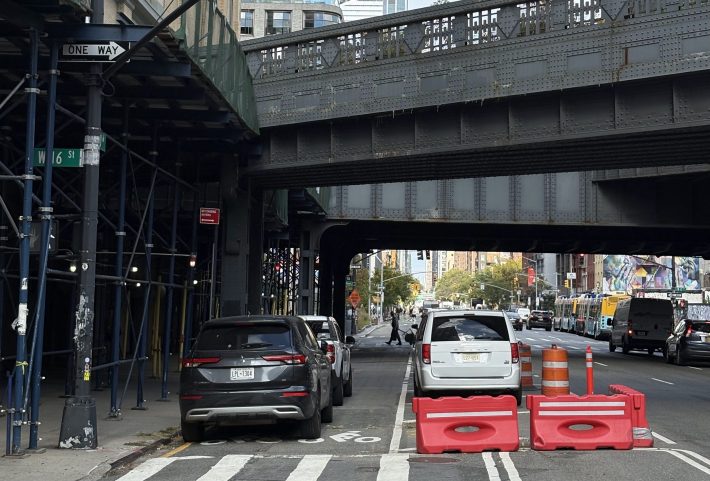
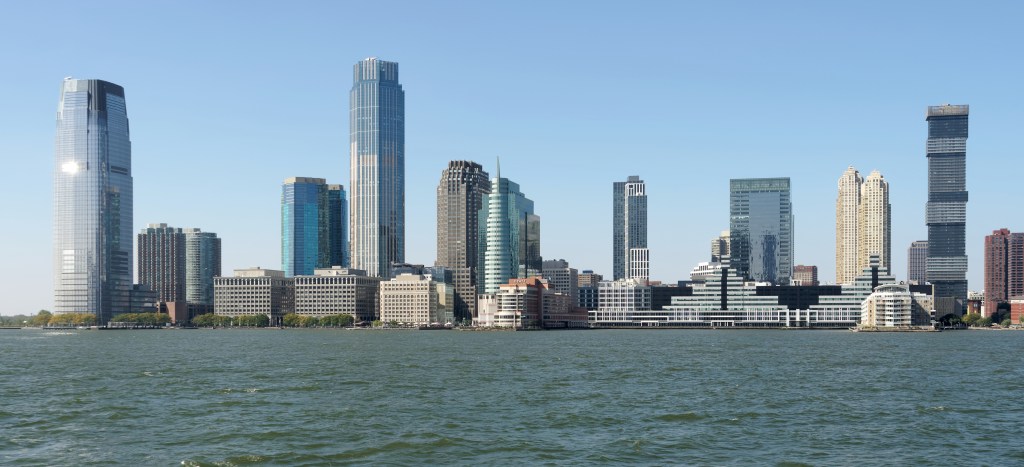
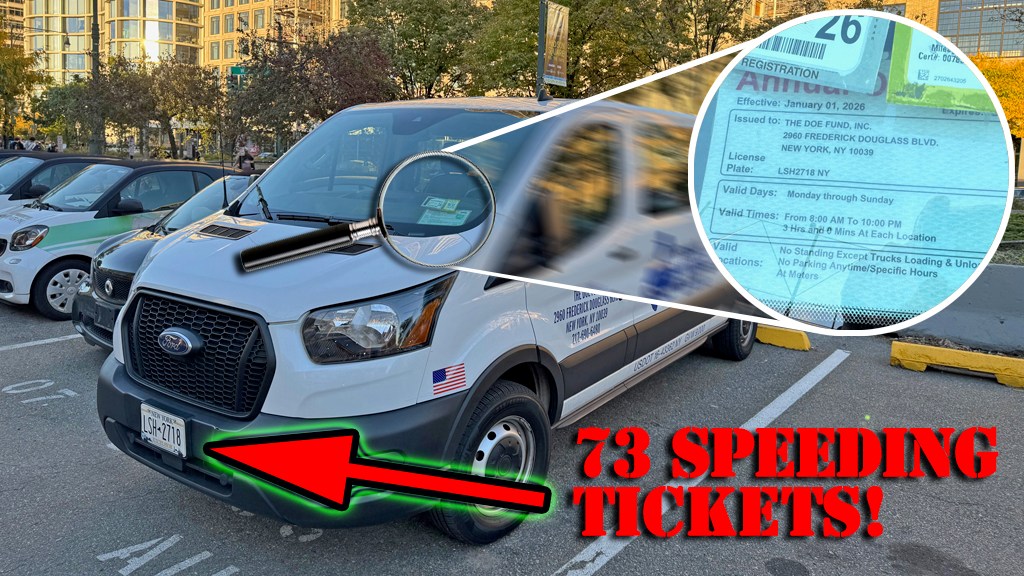
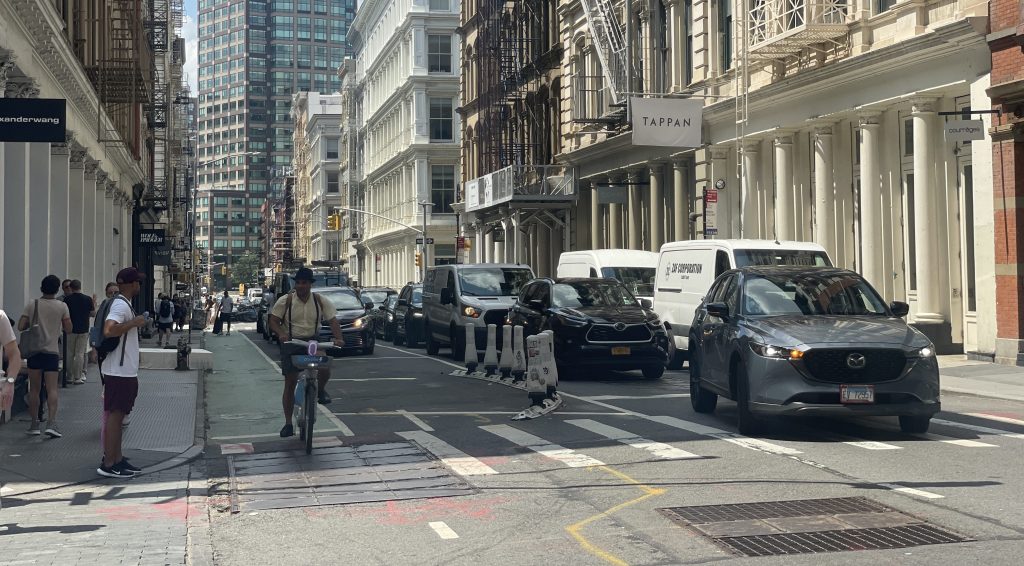
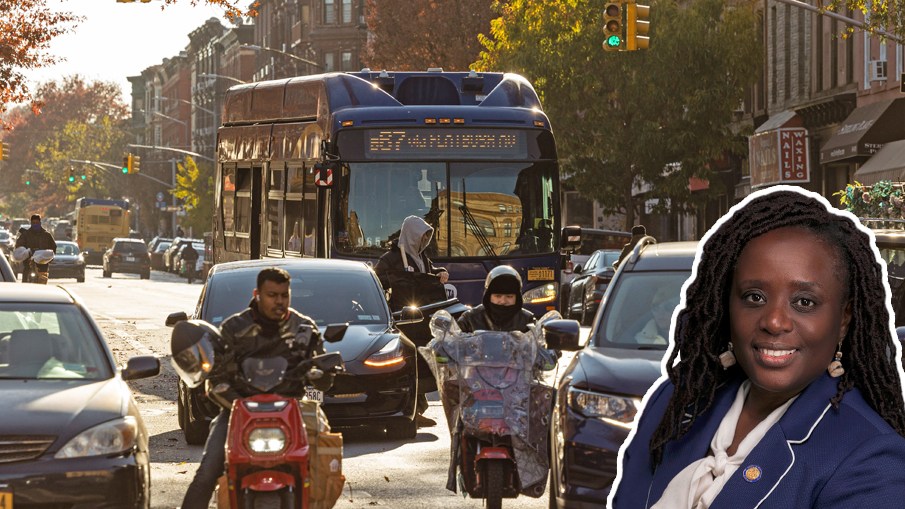
The failures of the year include (clockwise from top left) the federal government seizing a bike lane, the demise of the 34th Street busway, the criminalization of cycling, DOT's flawed war on daylighting and the removal of part of the Bedford Avenue busway.
Streetsblog provides high-quality journalism and analysis for free — which is something to be celebrated in an era of paywalls. Once a year, we ask for your tax-deductible donations to support our reporters and editors as they advance the movement to end car dependency in our communities.
If you already support our work, thank you! If not, can we ask for your help?This year’s fundraiser includes a special gift for our biggest supporters. Don’t miss out.
Together, we can create a more livable, walkable, bikeable, equitable and enjoyable city for all. Happy holidays from the Streetsblog team!
Twenty-twenty-five was like watching a slow-motion traffic crash.
Little by little the corruption of the Adams administration came to light and in the mayor’s desperate – but successful – attempt to get out of trouble with the feds we watched New York City’s top Democrat capitulate to Donald Trump.
As the Adams administration crashed and burned, it was New Yorkers on bikes who took the heat. The Department of Transportation delayed life-saving safety projects in favor of business interests, the mayor curried favor with a voting bloc by ripping out an already-installed protected bike lane, and the administration began treating cyclists like criminals, especially the immigrant workforce that relies on e-bikes.
Let’s just hope incoming Mayor Zohran Mamdani doesn’t repeat history. After all, Eric Adams also rode a bike on the campaign trail, made promises to bus riders, and “talked the talk” on livable streets.
Here are the nominees for Epic Failure of the Year (and remember, you get to vote at the end!). Plus also remember: all our end-of-year Streetsies coverage is archived here.
DOT arguing against its own designs in court
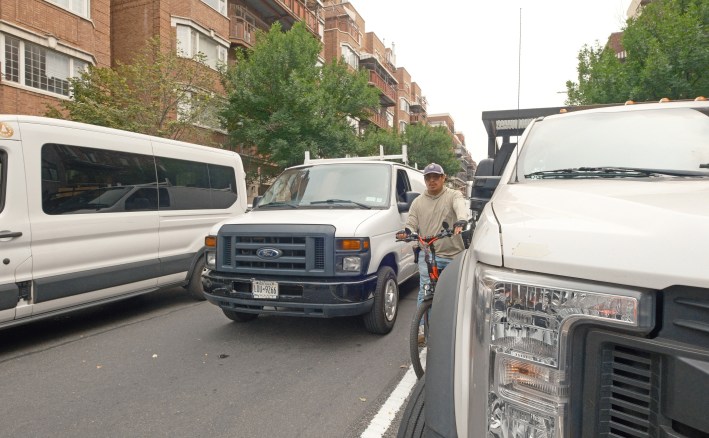
We really thought it couldn’t get any worse when Brooklyn Judge Carolyn Walker-Diallo ruled to allow the Department of Transportation to rip out three blocks of the just-installed Bedford Avenue protected bike lane in July. But, just in time to be included in the 2025 biggest fails list, another judge, Cheree Buggs, halted the construction of a protected bike lane on 31st Avenue in Astoria.
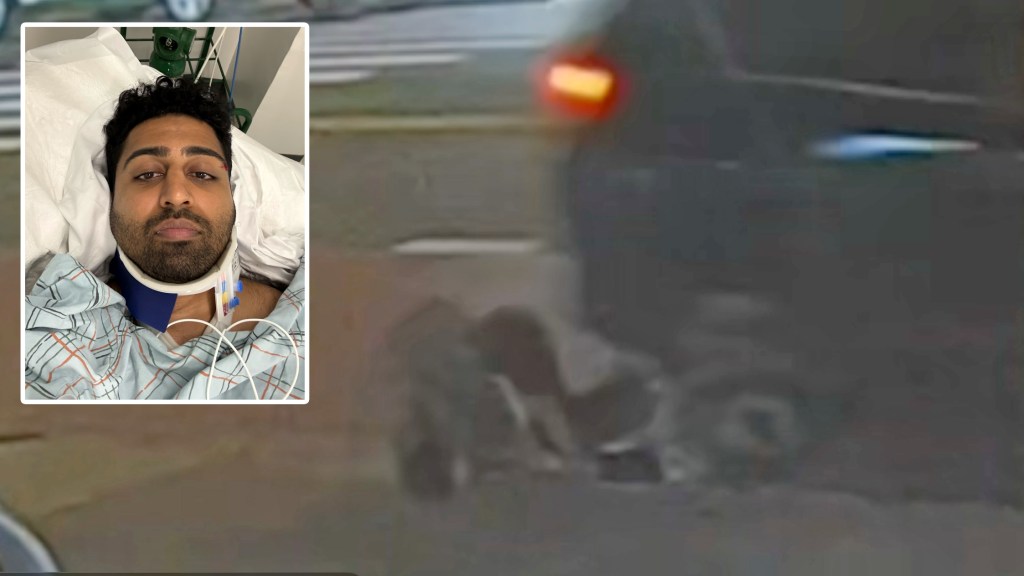
This cyclist was almost crushed to death by traffic on the newly unsafe portion of the Bedford Avenue bike lane. Photo: Yoshi Omi-Jarrett
Here’s why that’s an epic fail for DOT.
The agency has long argued that protected bike lanes make roadways safer for all users. But on Bedford Avenue, the agency wanted to rip up the protected bike lane. Then, after teen cyclist Rafe Herzfeld sued, DOT Deputy Commissioner for Transportation Planning and Management Eric Beaton testified in an affidavit that a protected bike lane is not meaningfully different than an unprotected lane … and the agency can use whichever design it wants.
So the DOT removed the bike lane on behalf of Hasidic parents who argued, wrongly, that their kids were less safe. But when Astoria parents made the same false safety argument about the protected bike lane on 31st Street, the agency did not make the same call to remove the bike lane — prompting the Queens judge to call foul.
So in this colossal failure by DOT, the city is down two protected bike lanes, which are proven to improve safety for cyclists, pedestrians, and drivers.
DOT’s flawed daylighting study
The Bedford Avenue situation is not the only time that the Department of Transportation made confusing arguments against proven safety measures. This year, advocates and concerned Council members made it their mission to pass a bill mandating universal “daylighting,” so that the city would no longer exempt itself from a state law banning parking within 20 feet of an intersection. Daylighting is common practice in cities all over the world.
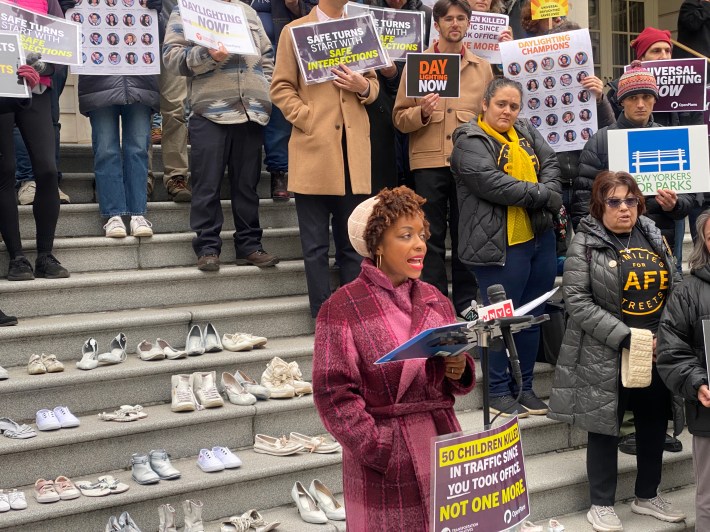
Council Member Selvena Brooks-Powers rallys for universal daylighting. Photo: Kevin Duggan
But the Department of Transportation was not on board with the bill, despite also being on record of supporting improved visibility at intersections. As part of its counter-offensive against the bill, DOT put out a study claiming that daylighting was not safe — a report that was repeatedly slammed by experts, citing DOT’s flawed methodology. But the damage was done: the study convinced at least one Council member to come off the bill and may have played a role in convincing Speaker Adrienne Adams to kill it outright, despite the bill having the support of 29 out of 51 Council members.
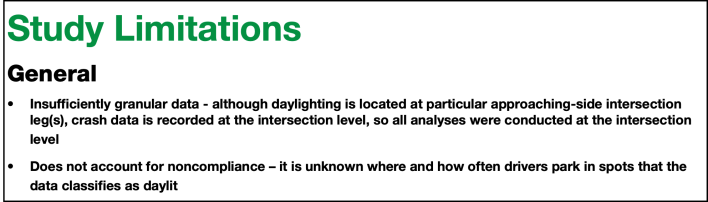
The DOT admitted its report on daylighting is fatally flawed. Graphic: DOT
Since the DOT report was issued, drivers have killed or seriously maimed nearly 1,800 New Yorkers – or about five a day – at intersections, according to an analysis by Transportation Alternatives.
The NYPD’s criminal crackdown on cycling
In April, Mayor Adams and his then-new Police Commissioner Jessica Tisch turned cycling into a crime. Instead of giving traffic tickets to cyclists who break traffic laws – like the kind drivers get – the NYPD directed its officers to give out criminal court summonses for such offenses as running a red light or riding the wrong way.
Tisch claimed the initiative was “data driven” and would only be used to enforce e-bike violations, but once the criminal crackdown began, Streetsblog documented all kinds of cyclists being caught in the dragnet and being forced to miss a day of work to answer in court for “riding recklessly” on a regular bike, having headphones in both ears, or not yielding to a pedestrian … when the pedestrian was a cop jumping into the bike lane to give a cyclist a ticket.
NYPD officers stop a delivery worker. Photo: Sophia Lebowitz
Meanwhile, immigrant delivery workers, many of whom are using temporary work permits and going through the asylum process, were terrified that something as simple as a traffic violation-cum-criminal charge could jeopardize their chances of staying in the country.
Later, Tisch admitted that her so-called “data-driven approach” was not borne out by hard data, but by hysteria voiced at community board meetings, town halls, and community council meetings: literally forums designed for complaining.
The crackdown culminated in the mayor enacting an “e-bike speed limit” of 15-miles per hour, yet not taking advantage of state-granted power to, as we always say at Streetsblog, “NOW DO CARS!“
Busway graveyards: 34th Street and Tremont Avenue
The city has been embarrassingly behind on installing bus lanes for the entirety of the Adams administration. It didn’t help that Mayor Adams unexpectedly paused a proposed busway for 34th Street in July, though he later unpaused it as part of a zoning deal. What really killed the busway was the federal government stepping in on the false premise that truckers would not be able to access the crosstown corridor — and the Adams administration not doing anything about it.
State Sen. Brad Holyman-Sigel vented about President Trump’s demand that the DOT kill the busway. (Inset) A protester lets his feelings be heard at the No Kings rally a day later. Main photo: Dave Colon
At a rally to protest the Trump Administration’s meddling, DOT boss Ydanis Rodriguez showed up in support of the bus lane. But DOT doesn’t give bus riders any reason to believe that the department has their best interest in mind, considering it also pulled the plug on another long-promised busway on Tremont Avenue in August.
A source within DOT told Streetsblog that all the prep work — community engagement, planning, and creating a brochure to explain the new traffic patterns on the busway — was done and everything was ready to go.
Those two failures capped a three-yearstreak ofnot coming close to fulfilling the Streets Master Plan requirements to install 30 miles of bus lanes in the city each year.
High maintenance: DEA seizes the 10th Ave. bike lane
Speaking of the feds, 10th Avenue between 16th and 17th streets is a Drug Enforcement Administration autonomous zone. Where once was a gold-standard extra-wide protected bike lane, DEA agents have created a parking lot for their personal cars — and DOT wont do anything about it or answer any questions we’ve raised about this egregious theft of public space that we started covering in September.
Someone moved one of the DEA’s barriers, allowing cyclists to at least squeeze through safely in the 10th Avenue bike lane between 16th and 17th streets.
Oh, but our coverage wasn’t strictly accountability journalism! Streetsblog Editor in Chief Gersh Kuntzman ramped up the coverage with videos of him smoking weed, snorting drugs, and even doing ayahuasca to get the attention of the DEA’s drug-fighting agents.
But as feds and the local authorities have largely ignored the problem, cyclists are left to fend for themselves in and out of traffic on busy 10th Avenue.
Failing to plan, and planning to fail: E-bike charging infrastructure
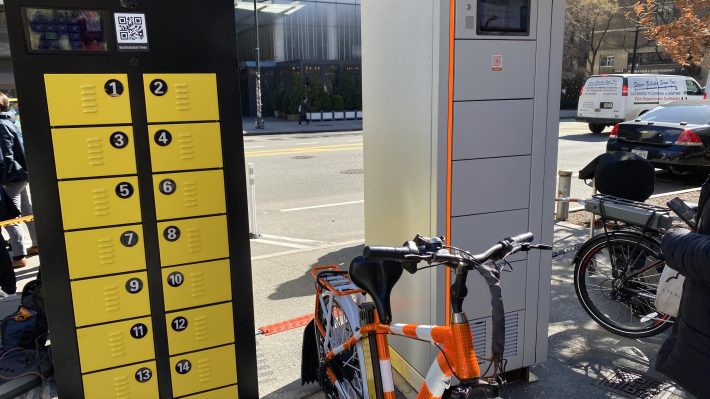
City officials have long hyped outdoor e-bike charging cabinets, both part of a private and public network, as a way to combat the ongoing e-bike battery fire crisis. But for the companies that build this lifesaving infrastructure, 2025 has been a failure.
In February, the Fire Department changed how it approves new charging cabinets, and, as a result, the companies say they are in a holding pattern because they can’t get necessary approvals to build anything new.
These two charging lockers by Popwheels and Swobbee allow swapping out an empty battery with a fully-loaded power pack. Photo: Kevin Duggan
Because of the new regulation — in combination with a lack of agency coordination, pricey applications and pervasive confusion — nothing is being built, even though the administration said outdoor e-bike charging infrastructure would be a major part of solving the e-bike battery fire crisis.
New Yorkers will have to wait at least two more years, until 2027, for public e-bike charging infrastructure, according to a recent DOT press release that was really a victory lap over nothing. In other words, if current trends in conflagrations continue, there’ll be roughly 400 more fires caused by these batteries before the safe infrastructure is installed.
Meanwhile, ConEd recently pulled the plug on a ready-to-go e-bike-charging pilot program for NYCHA campuses. Given that lithium-ion battery fires have been raging since 2020 — and calls for public charging started shortly thereafter — it’s fair to ask why public charging has been so slow to be built.
Streetsblog has migrated to a new comment system. New commenters can register directly in the comments section of any article. Returning commenters: your previous comments and display name have been preserved, but you'll need to reclaim your account by clicking "Forgot your password?" on the sign-in form, entering your email, and following the verification link to set a new password — this is required because passwords could not be carried over during the migration. For questions, contact tips@streetsblog.org.
A first full fleet inventory led to 70 fewer vehicles, fewer take-home cars and new accountability for crashes. Experts say New York’s deficit-ridden cities should audit their own.
He was struck and badly injured by a car driver. But his injuries weren't sufficient to trigger a real police investigation. And therein lies the problem.