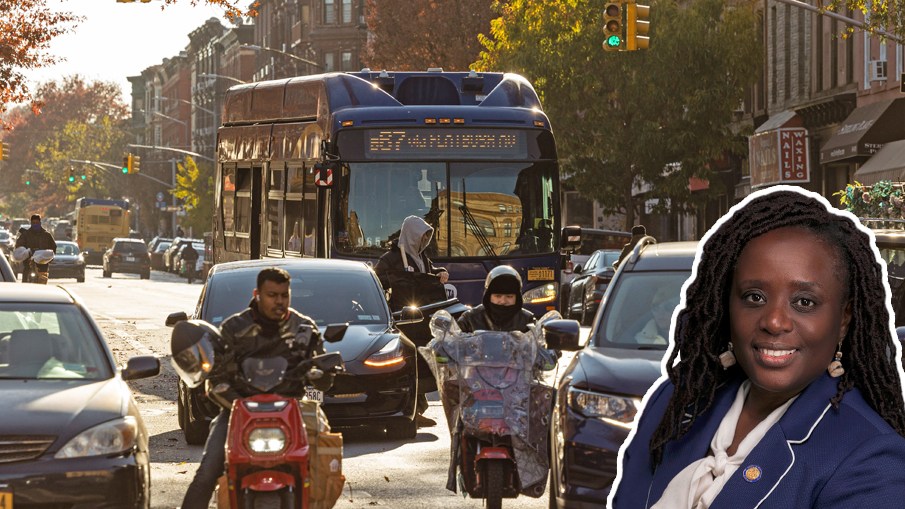
Claire Valdez: In Congress, I Will Fight For Transit and Bike Lanes
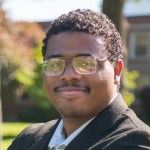
Editor’s note: We received an op-ed from Assembly Member Claire Valdez, who is running to succeed retiring Rep. Nydia Velazquez in Congress. We offered equal time to her opponents, Brooklyn Borough President Antonio Reynoso and Council Member Julie Won, and will print their op-eds when they are delivered.
For more than half a century, federal transportation policy has been written by and for auto industry CEOs. Working-class New Yorkers got the bill: poisoned air, gutted neighborhoods, and a mass transit system starved of funding. The highway system was a political choice that channeled public dollars toward private gain.
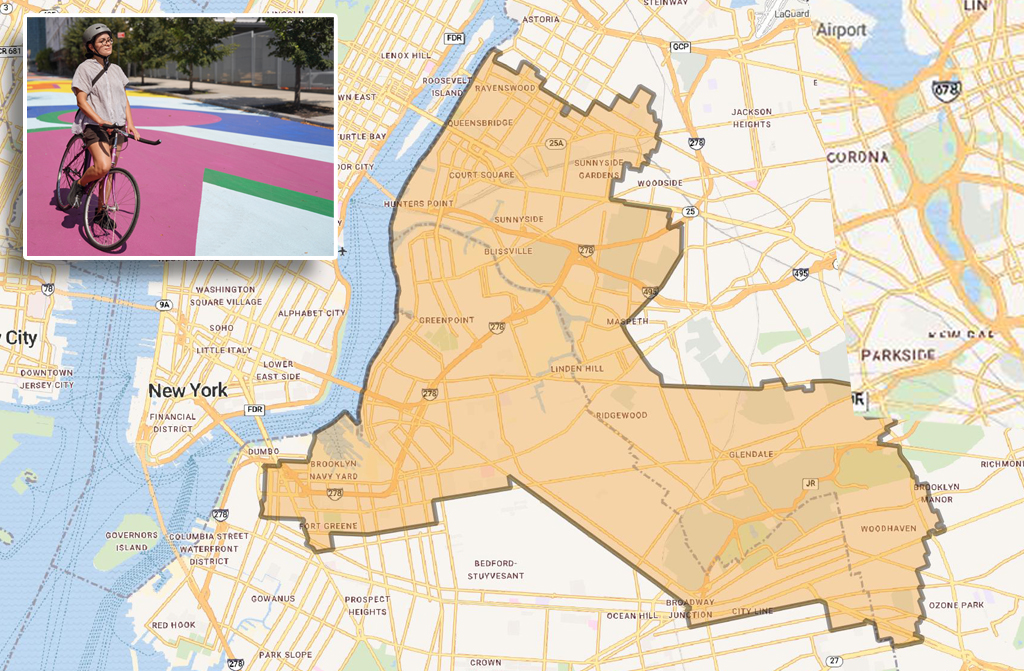
In the Seventh District, approximately 79 percent of commuters get to work using public transportation, walking, or biking, with an overwhelming majority (66 percent) relying on transit alone. That’s true for a majority of the working-class across New York City. But federal transportation dollars still flow overwhelmingly to highways and roads, funding a car-centered system that most people in this district don’t use or can’t afford.
Car culture didn’t just reshape our roads. It reshaped our neighborhoods. The postwar push to move Americans into cars and suburbs was also undermining shared spaces — the sidewalks, the subways, the stoops — where urban, working-class, multiracial solidarity was built. The highway didn’t just bring noise and pollution to North Brooklyn and western Queens. It was designed to divide. The BQE bulldozed thriving commercial corridors. The Federal Highway Act funded the expansion that tears through Sunnyside and Maspeth today. These weren’t engineering decisions. They were political ones, made by people who were afraid of what dense, connected, diverse cities might become.
Most Americans say they would prefer more connected, less car-centric transportation systems. A 2024 Ipsos poll found that 76 percent of respondents agreed that their community would be a better place to live if bicycling were safer and more comfortable, and polling conducted by Data for Progress found that 77 percent of voters agreed that the United States would benefit from improved public transit. The public is already there. The obstacle is a federal policy apparatus that prioritizes the highway lobby over the public good.
My vision
Transportation is a public good — and it should be funded and run like one. The question isn’t whether government should be involved in how people move; it always has been. The question is whose interests that investment serves.
For too long, the answer has been: highway contractors, car manufacturers, and the developers who made American sprawl their business model. My vision starts from a different premise: that working people deserve a public system that gets them where they need to go, cheaply and reliably, without depending on a private vehicle they may not be able to afford or want.
That means significant and unapologetic public investment — in transit, in safe streets, in electrification without leaving workers behind, in reconnecting communities that highway policy deliberately cut apart. It means fighting to redirect federal dollars away from road expansion and toward the infrastructure of shared public life. And it means naming clearly what’s at stake: not just climate or congestion, but whether our cities are organized around private wealth or the common good.
As a member of Congress representing NY-7, I will:
- Fight for the reallocation of federal transportation dollars to reconnect communities and reverse the proliferation of surface highways like McGuinness Boulevard.
- Increase the amount of federal transportation spending dedicated to public transportation projects and support local efforts to increase transit options and availability.
- Invest in new technology both to support union jobs and to reduce carbon emissions when driving is necessary, working toward a goal of net-zero emissions.
Reverse the harms of arterial roads, promote active transit
The proliferation of surface highways and arterial roads didn’t just reshape our streets. It fractured neighborhoods, poisoned the air, and stripped away the public spaces where community life happens. We know how to reverse this damage. What’s been missing is federal funding and the political will to spend it differently: on active transportation, on freeing cities from outdated design mandates, and on getting dollars directly to the communities that need them most.
Right now, the Reconnecting Communities Pilot Program, meant to support communities repairing the damage caused by urban highways, has extremely constrained applications and limited funding. At the same time, Congressional Republicans and President Trump are gutting federal programs that fund active transportation infrastructure. By significantly expanding federal funding for the Reconnecting Communities Pilot and creating more opportunities for grants that promote active transportation, we can reverse past damage and bring tangible and impactful infrastructure improvements to NY-7.
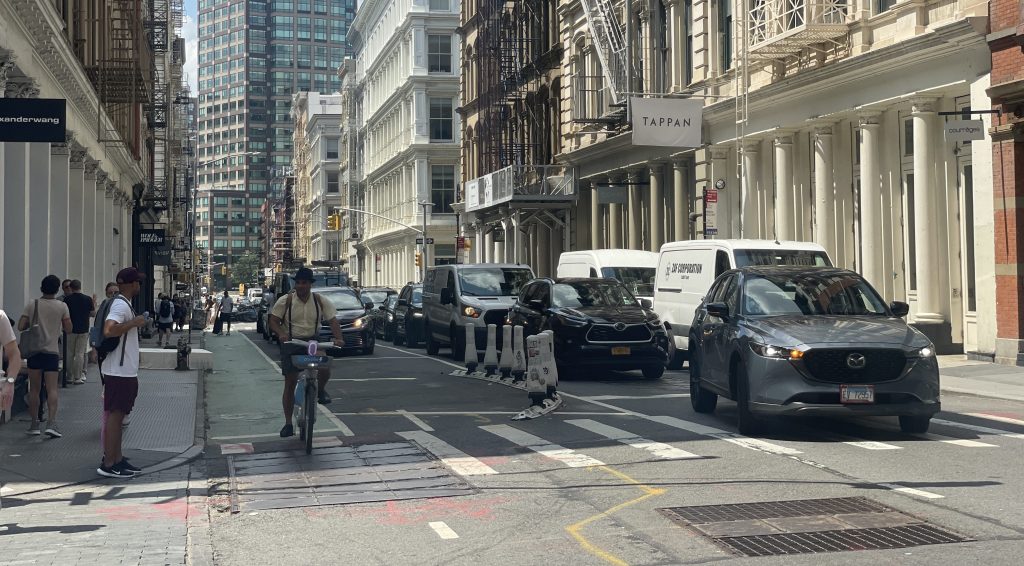
- We must provide greater funding earmarked specifically for cycling, pedestrian, and public space-focused projects. Current federal funding for non-car focused projects is approximately $20 billion for the entire country per year, compared to the total budget of $117.4 billion. This allocation does not match the needs of our district, where car ownership is extremely low, or the desires of the public at-large, which overwhelmingly supports expanding public and active transportation options.
- We must significantly expand the Reconnecting Communities Pilot Program to make additional federal funds available to state and local governments fighting to repair the damage caused by urban highways. This expansion must also broaden the scope of how these funds can be applied. In its current form, Reconnecting Communities only provides grants for specific capital projects and community planning, which too often leads to multi-million dollar studies and no action.
- Right now, federal standards for state and local street designs are arduous and extremely constraining. Local projects cannot be implemented with federal funds unless they meet the extremely rigid guidelines of the federal Manual on Uniform Traffic Control Devices. To change this, we must introduce and pass legislation to end the requirement for state and local governments to adhere to the MUTCD in order to receive federal funds for local projects.
- Currently, the Federal Highway Administration directs funding to the State Department of Transportation, which allocates funds to the city. We will push for FHWA to directly fund big cities, which would allow for greater control of how funding is allocated, greater emphasis on safe streets and pedestrian priorities, and faster funding allocation.
Building more, better public transportation
Public transit is the circulatory system of a working city. It’s how nurses get to hospitals, how cooks and bartenders get home after a late shift, how students get to school. The MTA carries 43 percent of the nation’s mass transit riders and receives only 17 percent of federal transit formula funding. New York’s working class has been subsidizing the rest of the country’s transportation system while ours deteriorates. I will fight to change that.
New York City needs federal funding that matches our ridership and supports the need for expanded access. Projects like the Interboro Express, G train expansion, and realizing Mayor Mamdani’s vision for fast and free buses require steady, reliable streams of funding from the federal government as well as the state. We need to fight for the funding we deserve. Any delays or decrease of funding creates uncertainty and added costs to new and existing transit projects.
- For a more reliable, equitable distribution of funding, we must advocate for formula-based federal financing of public transportation based on ridership. This would be a more objective approach and would ensure New York City is no longer shortchanged. A stronger and steadier pipeline of funding will aid planning efforts and reduce project costs.
- To connect riders across parts of Brooklyn and Queens, we support the IBX. The IBX would be the first new transit line in generations, directly connecting Brooklyn and Queens neighborhoods which have never had rail connections. In NY-7 this means new transfers at Wilson Av L and Metropolitan Av M, and an entirely new transit station at Myrtle Avenue and Fresh Pond Road. As the IBX moves into construction in the coming years, I will push for federal funding for this project.
- Respond to increased ridership and extend the G train to Forest Hills on weekends. The G train used to traverse NY-7; however, in 2001 and then in 2010 the G train was cut back to Court Sq, depriving riders in Astoria and Woodside of a direct subway trip to Brooklyn. The G train only has two stops in Queens, hardly the connection the city’s two most populous boroughs deserve. Brooklyn and Queens have grown significantly since 2001, and Covid has changed our travel patterns. The time is right to bring the G back to Forest Hills and better connect the counties of Kings and Queens.
- Build the QueensLink and Improve Subway Service in Astoria and Woodside. The QueensLink will use an existing elevated structure to connect the M train from Rego Park to the Rockaways just outside the eastern edge of NY-7. Beyond directly linking Western Queens to Southeast Queens for the first time, this will also allow more subway service to run on the M, R, and, hopefully, the G along the heavily used Queens Blvd subway line. This project received a $400,000 federal grant last year. I will work with the rest of the Queens congressional delegation to explore how we can improve train frequency and build new connections for hard-working New Yorkers.
- Support the Ridgewood Busway. MTA has proposed clearing half a mile of unused space under the M train as a busway that could improve service and reliability on the Q58, B13, and B20 buses.
- Ensure Every Transit Station is Accessible. Advocate for the continued All Station Accessibility Program grant funding, which has committed federal funding directly to six different subway station projects across NYC, including Myrtle Av JMZ and Norwood Av JZ in NY-7. Hold the MTA accountable for commitments to accessible station projects across NY-7 including: Forest Av M, Wilson Av L, Broadway Junction ACJZL, Cypress Hills J, Gates Av J, 88 St A, and Flushing Av G. We must also ensure the Brooklyn Bus Network Redesign takes into account the needs of older adults, parents, and people with disabilities, so all our neighbors can safely access transit.
Electrifying transit
The people bearing the worst health consequences of car-centered transportation policy are not the people who designed it. Working-class neighborhoods in NY-7 have some of the highest asthma rates and worst air quality in the city — a direct result of decades of highway expansion and underinvestment in cleaner alternatives. Cleaning up our transportation system isn’t just an environmental goal. It’s a matter of basic fairness. Workers and working-class communities must be the beneficiaries of a new era of clean transportation. But, forcing workers to decide between good jobs and green jobs is a false choice. We can and must achieve both.
In addition to investing in and promoting public transportation to reduce vehicle miles traveled, there are plenty of affordable, common-sense ways we can quickly reduce emissions while we build toward net-zero goals, making our streets healthier and safer along the way.
- Electric vehicles produce zero tailpipe emissions or exhaust fumes and have lower maintenance costs. Even through urban planning that minimizes individual car usage, vehicles are needed for public transit, school transport, and jobs requiring transportation like garbage collection and food distribution. Building on the lead of cities like New York and Los Angeles, we will help establish federal targets and funding streams for electrifying these fleets, including leveraging strategic procurement to support both union jobs and the environment. We will also advocate for funds in future transportation packages to be earmarked to fund municipal union-made EVs and give tax breaks to private retailers who use union-made EVs for distribution.
- To meet the resulting increased needs for EVs we must advance EV and battery supply chain development by expanding domestic production in support of good union jobs, fostering supply chain resilience and competition through focused development of our domestic mineral and battery production capacity, and promoting policies to expand workforce development and infrastructure in EV, battery, and mineral supply chains.
- To reduce our reliance on freight carried by high-emission vehicles, one of the largest contributors of greenhouse gases in the transportation sector, we will advocate for statewide Cap-and-Invest programs for large-scale manufacturers and retailers who rely on freight transportation, ensuring that they respect strong emission targets, and that when they are exceeded, companies are forced to invest in programs that drive emission reductions.
- We will create federal cargo bike purchase subsidies for business fleets and individuals to incentivize commercial use of cargo bikes for last-mile delivery, local businesses, and individual use.
- We must significantly build on the U.S. Marine Highway Program to make additional federal funds available for states and municipalities that are transferring freight from trucks to water-based transport. New funds must have applications beyond the prior program, including identifying sites for terminals and assisting with construction and port upgrades.
The streets, subways, and buses of New York City are the infrastructure of working-class life. They’re how nurses get to hospitals, how cooks and bartenders get home after a late shift, how kids get to school. For too long, Washington has funded a vision of American life built around private cars and private wealth. New York’s working class has paid the price. I’m running for Congress to change that.

Read More:
Streetsblog has migrated to a new comment system. New commenters can register directly in the comments section of any article. Returning commenters: your previous comments and display name have been preserved, but you'll need to reclaim your account by clicking "Forgot your password?" on the sign-in form, entering your email, and following the verification link to set a new password — this is required because passwords could not be carried over during the migration. For questions, contact tips@streetsblog.org.