Sean Duffy’s DOT Pitches Congestion Pricing Grants While Trying to Kill Congestion Pricing
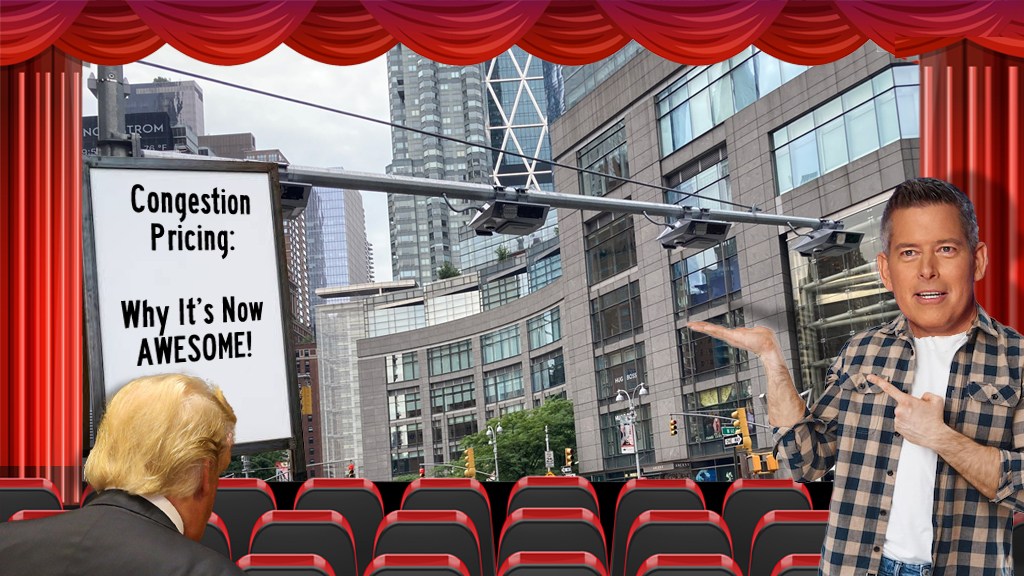
The United States Department of Transportation, which has spent two years trying to kill New York City’s congestion pricing program, has exciting news for cities across America: They can apply for grants to launch their own congestion pricing programs.
A triumphant press release from the Federal Highway Administration on Wednesday announced that cities can apply for $100 million in grants for a number of programs that reduce congestion including “HOV toll lanes, as well as congestion, cordon, and parking pricing programs” (emphasis added).
President Trump, and Transportation Secretary have famously warred with the MTA and the Empire State over New York City’s congestion pricing program, which has reduced the number of vehicles in the Manhattan core and provided a reliable revenue stream to fund capital work on the city’s mass transit system.
The federal agency’s reversal clearly surprised MTA Chairman and CEO Janno Lieber. On Wednesday, he interrupted an ongoing press conference after his agency’s monthly board meeting to acknowledge the email and wonder aloud why FHWA wants more congestion pricing programs around the country.
“Either they’ve been hacked, or Sean Duffy’s been reading the press on this subject, but either way, that’s a pretty remarkable about-face,” said Lieber. “I think it really speaks to the fact that this program has not only survived legally but has been such a success in its implementation.”
The MTA boss was magnanimous in the face of the somewhat maddening news that the proudly anti-congestion pricing administration is now promoting congestion pricing, even as the MTA continues to defend the toll in court from Duffy’s and the president’s campaign to kill it for good.
“In the long run, the fact that the program has been successfully implemented, and the legal fight about it, has been part of making sure the world understands how successful and effective it has been, is actually a net benefit to those of us who believe this kind of initiative is worth the candle,” he said.
After cutting vehicle entries into Manhattan south of 60th Street by 11 percent in its first year, the toll has continued to reduce vehicle entries into Manhattan’s central business district. In 2026, fewer than 500,000 vehicles on average entered lower Manhattan during every month but October, compared to five months that averaged more than 500,000 daily vehicle entries into the Manhattan CBD in 2025.
New York City’s economy has not fallen apart. Furthermore, the MTA has successfully defended the traffic toll in six separate federal lawsuits in the Southern District of New York, two in New Jersey and one state-level lawsuit in New York.
Of course, U.S. DOT is bound by law to offer states and cities the chance to apply for projects to reduce congestion through congestion pricing or cordon pricing. But the law does require Duffy and his agency to award grants for traffic tolls. He and U.S. DOT are free to spend all of their time and money on the other traffic-reduction strategies mentioned in the press release, such as traffic monitoring and on-demand micro-transit.
Still, as long as the federal transportation agency is mentioning cordon pricing, it is as good time as any to remind longtime readers that Duffy pronounces the word “cordon” in a weird way — as cor-DON — which really set off this reporter in early 2025.