London’s Car-Free Oxford Street Is a Lesson for Mamdani’s Fifth Avenue Redesign
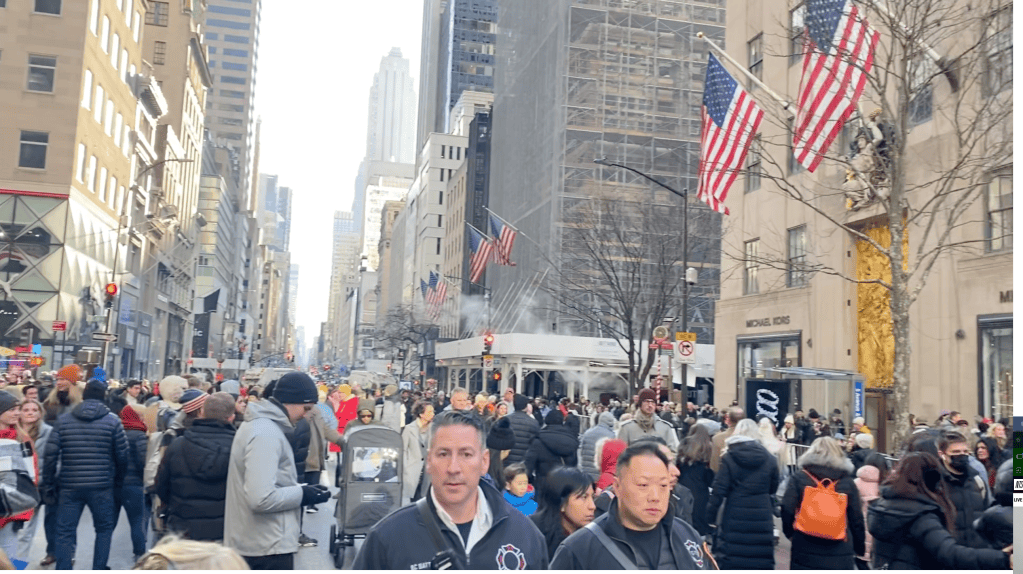
Mayor Mamdani should take a page out of London’s successful pedestrianization of Oxford Street, and banish cars from Fifth Avenue in Midtown and other shopping hubs as the holiday season rounds the corner, advocates said.
The British capital saw surges in foot traffic, spending and international visitors after the city removed cars from the globally famous retail corridor last month.
“The numbers are in: footfall *and* spending are up on Oxford Street,” London Mayor Sadiq Khan posted on Bluesky on Nov. 9. In the larger West End area, spending increased by 13 percent in the first six days of the conversion.
Three weeks ago, city transportation officials in the Big Smoke banned buses, taxis and even bikes from a roughly 0.6-mile stretch of Oxford Street. The intervention was a decade in the making and six years late under Khan’s mayoralty, and aimed at improving street safety, cutting pollution and revitalizing ailing businesses on the strip.
Livable streets advocates on our side of the pond immediately seized on the promising data to bolster the case for pedestrianizing Fifth Avenue, Manhattan’s dominant shopping artery and the city’s closest equivalent to Oxford Street. The idea dates back to 2017, when ex-Mayor Bloomberg’s former DOT Commissioner Janette Sadik-Khan proposed pedestrianizing three of the strip’s five lanes for 25 blocks south of Central Park, while leaving the remaining two lanes for buses.
But business titans along the ritzy row have foiled successive efforts by both mayors Bill de Blasio and Eric Adams to reclaim space from cars. Mamdani now has a chance to stand up to the monied interests and follow London’s lead, advocates said. “New York, it’s time to pedestrianize Fifth Avenue,” said Doug Gordon, a co-host of the War on Cars podcast.
In recent years, the city has closed the corridor to traffic on some December weekends to make room for holiday shopping crowds. But former Mayor Eric Adams scaled those events back, despite a 6.6-percent bump in spending during the car-free days.
One street safety advocate said the upcoming holiday season provides an opportunity for Mamdani to go bigger than his predecessors and set the tone for pedestrian-first shopping streets throughout the Big Apple.
“I’m optimistic that the numbers [on Oxford Street] will continue to remain pretty high and it’s something that New York should be taking very seriously,” said Samir Lavingia, the second vice chair of Manhattan Community Board 5, who noted he’s not speaking on behalf of the board. “I would love to see him lead with something visionary in Midtown,”
Lavingia suggested that Mamdani could start with an entire month of a car-free Fifth Avenue, and later bring the conversion to other busy shopping areas, like SoHo or Williamsburg. “That would be a good way to kick it off,” he said. “For people to change their behavior, it needs to be multiple days in a row.”
Two mayors have attempted to redesign Fifth Avenue, starting with de Blasio’s busway in 2020, which would have banned through-traffic for private vehicles between 57th and 34th Streets.
After big business fat cats pushed back against the idea of banning through-traffic, de Blasio watered down his proposal to allow through-traffic for private vehicles. But even the diluted plan never made it out of the planning phase before he left office.
The Eric Adams administration at first proposed a different plan with bus and protected bike lanes, before ditching the cycle path and releasing a $350 million overhaul called the “Future of Fifth.”
The plan would have widened sidewalks while preserving the majority of the roadbed for private cars. It would have also slowed bus commutes by cutting the dedicated bus lanes from two to one. The proposal received strong support from the Fifth Avenue Association, an influential group representing businesses and institutions along the corridor like the Trump Organization, St. Patrick’s Cathedral and Bergdorf Goodman.
London rerouted buses away from Oxford Street ahead of its pedestrianization. Relocating buses away from Fifth Avenue could be a challenge, since its double-wide bus lanes serve as a key south-bound surface transit artery connecting to all other boroughs, and nearby Madison Avenue serves the same function for buses heading north.
Lavingia said if Mamdani wanted to move buses elsewhere, he could work with the state-run MTA to look at alternatives in its upcoming borough-wide bus network redesign. “It’s an opportunity for the mayor to say, ‘look, I would love to see the buses off of Fifth Avenue to pedestrianize it,” he said.
The Adams administration wanted to start construction in 2028, but it’s unclear if Mamdani’s Department of Transportation still plans to move forward with the redesign. A DOT rep declined to specify the agency’s plans for Fifth Avenue, and instead cited Commissioner Mike Flynn’s Vision Zero Reimagined platform that called for more pedestrian-focused designs in the city.
“The Mamdani administration will be developing the city’s first-ever pedestrian-priority and pedestrian-only districts and we look forward to sharing more soon,” said Vin Barone. A spokesperson for the Fifth Avenue Association said it was still too early to measure success on Oxford Street, but its CEO emphasized the pressing need for more sidewalk space.
“Everyone can see Fifth Avenue pedestrians deserve wider, more attractive and sustainable sidewalks,” its CEO, Madelyn Wils, told Streetsblog. “We have studied many global examples that prove the value of investing in streetscape projects that increase the quality of conditions for pedestrians.”