Signal Problems: MTA Reports Delays On Multiple CBTC Upgrade Projects Amid Data Center Threat

It’s all red signals ahead.
New York’s efforts to upgrade signals on five subway lines are months behind schedule, MTA officials revealed on Monday, with none of the new signals set to come online until 2028 at the earliest — as data centers pose a looming threat to the agency’s efforts to complete the projects with less money.
With the exception of the recently commenced A/C signal upgrades between Downtown Brooklyn and Ozone Park, each the MTA’s individual signal upgrade projects is now running late:
- The Fulton Street-Liberty Avenue project, which upgrades the signals alone the A, C and E lines between 59th Street and High Street, was scheduled to come online in the first quarter of 2027 and now won’t do so until the fourth quarter of 2027.
- The Queens Boulevard Line East project, which upgrades signals on the F train between Union Turnpike and 179th Street, was scheduled to come online in the second quarter of 2027 and now won’t be in service until the second quarter of 2028.
- The Crosstown project, which upgrades signals on the G and F trains between Court Square and Church Avenue, was scheduled to come online in 2027 on the north piece of the line and 2028 on the south piece, and now won’t be online on either line until 2028.
The problems plaguing the communications-based train control upgrades vary by project, but mostly relate to software issues, train compatibility issues and design plans for how to safely change signals over from the old system to modern computerized signals, according to the MTA executives in charge of the upgrades.
This is most apparent on the Eighth Avenue project. An MTA executive said it was all ready to go, but that the agency found that the track geometry it fed into the computer that controls the train under CBTC was not accurate.
“We can see some issues in some of the testing,” said Mark Roche, the deputy chief development officer at MTA told the Capital Committee. “We can see there’s one silly thing that happened in the project that we have to correct. As the trains run down the system they’re telling us ‘This curve is a bit bigger than you told us, this hill is steeper than you told us.’ The accuracy of the survey that we gave the computer is now telling us back [that] there’s something a bit strange here.”
Switching trains over to being controlled by computerized signals without accurate track geometry could lead to the same problems that snarled the Queens Boulevard West line in 2022, when the agency activated CBTC and experienced up to 20 signal malfunctions per day on the line.
“We could turn this system on now, it’s ready to go,” Roche said. “But you’d have lots of problems so we’re not gonna turn it on. On the QBL West we probably turned it on too soon, we’re not going to do that again.”
The MTA is running into problems with maintaining the existing signal system on the easternmost portion of the Queens Boulevard line. The agency chose to the legacy signals in place when it designed the new system. Its leaders encountered found it difficult to ensure that an interlocking using CBTC software can respond quickly enough to provide safe and reliable service.
On the Crosstown line, Roche said the agency found a combination of physical work issues and planning issues. The MTA discovered much more serious tunnel damage and leaks, which took the agency a year to fix as it got to work installing new signals.
“State of good repair and discovering state of good repair problems on these projects is a major civil issue to make these happen quickly,” he said. “We’re finding too many things wrong with the system.”
But the agency also seems to have bitten off more than it can chew with its plans for the project. Roche told the committee that the contractor performing the work for the agency originally pitched the MTA on doing a “cutover” — the term for when a subway system moves from its legacy signals to modern signals all at once, instead of in phases as is usually done.
Despite agreeing to that, the MTA later determined that the idea wouldn’t work, and now has to work with the contractor on a phased cutover plan while the signals are being installed.
“One of those ideas was we could cut this project over in one go,” he said. “On the first day it’s non-CBTC, on the second day it’s CBTC. We’ve not been able to prove that’s a good idea. So we’ve slowed down the project. We’ve worked with [the contractor] to say hold on, let’s cut this over in five or six pieces, let’s spend a little more time.”
The MTA had some good news, too. Its leadership said that the physical work of ripping up tunnels and installing new track has gone according to plan. “The civil work, the track, switch, infrastructure — that is very much going on schedule,” said MTA Construction and Development President Jamie Torres-Springer. “The stuff that disrupts our customers, we are managing those very effectively.”
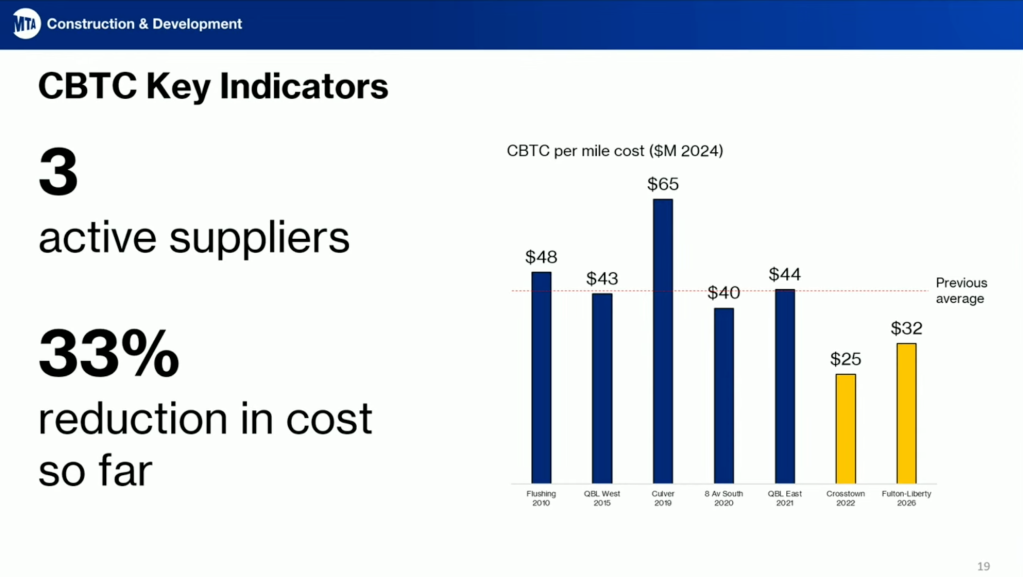
Roche also pointed out that the MTA has cut the cost of signal upgrade projects on a per-mile basis by about 33 percent, when looking at the Crosstown and Fulton-Liberty projects compared to the per-mile cost for the 7 train, QBL West, Culver, Eighth Avenue and QBL East projects.
There is a touch of grey in that silver lining though, as Roche said that everyone’s favorite boogeyman, data centers, are threatening to drive up the prices for CBTC upgrades. “We are seeing a massive competition with data centers,” said Roche. “The cables, the equipment is getting more expensive. We have a huge competition on the market with data centers.”