Highway or the Highway: Brooklynites Slam BQE Bypass Proposal
Mayor Mamdani should not simply rebuild the ailing Brooklyn-Queens Expressway, and saddle future generations with its inevitable and costly upkeep, but instead explore options to transition away from the roadway’s truck-first approach, Brooklynites said at a public meeting on Thursday night.
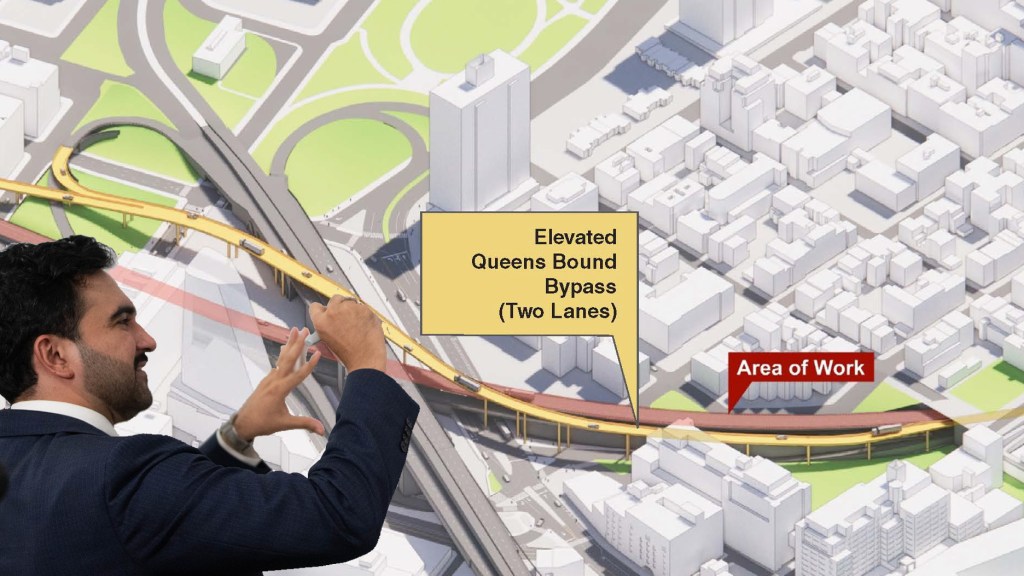
The Department of Transportation has begun gathering feedback for a required environmental review of its $4 billion proposal to rehab what it calls BQE Central, a deteriorating section of the highway between Atlantic Avenue and Sands Street, over the next decade. The agency wants to construct a temporary bypass that involves a dramatic flyover above the Brooklyn Bridge’s approach in Dumbo.
Residents and advocates called on the Mamdani administration to broaden its scope, not double down on the Robert Moses infrastructure. “You are asking New Yorkers to spend $4 billion to end up in 2040 with the same 1954, racist highway that Robert Moses built,” said Red Hook resident Victoria Hagman Alexander at the virtual feedback session with the agency. “Your scope studies two options: build it or don’t. And that’s not a choice for communities. And it’s a choice that we’ve rejected multiple times.”
According to DOT’s Oct. 2 draft scope of work for the environmental review, the agency will study the impacts of building a bypass versus not rebuilding the BQE — an approach the leader of the influential Brooklyn Heights Association described as “far too narrowly defined.”
“The purpose and scope have to include the goal of moving people and freight much more efficiently and much more sustainably throughout our borough, and preferably not in thousands of cars carrying one person at a time, as we see now on the BQE,” said the BHA’s executive director, Lara Birnback. In 2018, the BHA successfully rallied against former mayor Bill de Blasio’s proposal to erect a six-lane temporary highway atop the Brooklyn Heights promenade.
Construction is set to begin in 2030 and last 10 years, and the rebuild will extend the BQE’s lifespan until 2080. Mamdani’s DOT Commissioner Mike Flynn has argued that the city needs to renovate the BQE to facilitate the movement of its daily 130,000 motorists, including 13,000 trucks, and that the agency has run out of time to consider larger overhauls to reduce the city’s dependence on the highway.
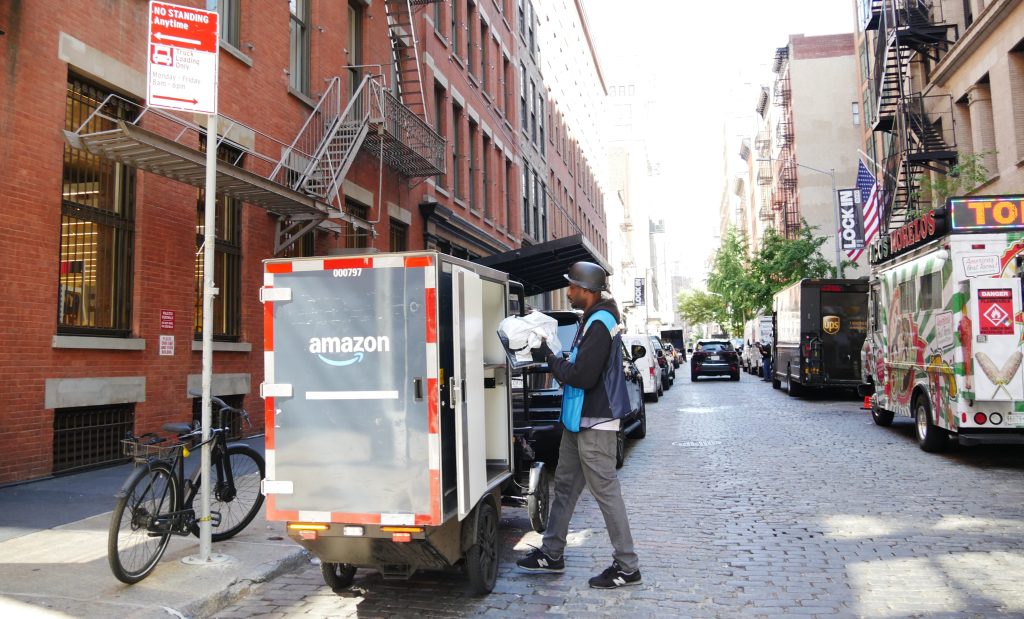
New York City maintains an unusually heavy reliance on trucks: Nearly 90 percent of all goods move through the city on big rigs, compared to a national average of 70 percent. The city could instead spend its finite time on pivoting to alternative methods of moving freight, such as Blue Highways, good-old-fashioned rail or smaller vehicles like cargo bikes.
“This draft scope of work asks us in the community and beyond — all of us adjacent to the BQE — to endure at least a decade and likely more of highly disruptive construction, just to end up with the exact same loathed and discredited infrastructure that we’ve already endured for 70 years. We have to do better,” Birnback said.
The mayor’s proposed bypass highway will run next to the triple-cantilever level with the upper roadway, and sit within feet of adjacent residential buildings like 360 Furman Street, said a representative for the building’s roughly 1,200 residents.
“The proposed bypass highway would come within four feet of our façade,” said Diane Genova. “A decade is not temporary for the people who have to live next to it.”
The city should look at construction approaches that don’t create an entirely new highway, such as a lane-by-lane rebuild with a traffic reduction plan, Genova said. In 2021, following recommendations by an expert panel, de Blasio reduced the triple-cantilever’s six lanes to just four. The intervention cut cut the number of daily vehicles on the bridge by 15 percent.
Transportation officials must also finally fix the chaotic Atlantic Avenue interchange by closing the Queens-bound on-ramp and removing the dangerous pedestrians crossings to and from the waterfront, said a representative for an area business group. De Blasio’s expert panel emphasized the same recommendation in its six-year-old report, to avoid creating exactly the kind of spillover traffic that now plagues adjacent neighborhoods. But neither subsequent mayor followed through and DOT now plans to rebuild it.
“The ramp truly just should be closed. For years, this has invited and incentivized cut-through traffic into our neighborhoods,” said Layla Passman, director of special projects at the Atlantic Ave BID.
DOT has shied away from decommissioning the structure, saying that its retirement would dump car and truck traffic onto residential streets — but that has already happened amid the agency’s inaction.
Agency officials have said closing a ramp would trigger federal reviews, which could delay the project, but former commissioner Hank Gutman recently countered that the city could temporarily shutter it without an intervention by Uncle Sam, as he did under de Blasio with an off-ramp at Cadman Plaza to shore up the triple cantilever’s retaining wall.
But the winds in Washington, D.C., have shifted with the flipping of both houses of Congress to Democratic control in the election last week, and the city should use that political leverage to think bolder, said another resident.
“When this project was conceived… there was no expectation that the extent of the blue wave that we experienced last week,” said Bill Stein of the Fulton Ferry Landing Association. “So there’s going to be fresh air, let’s say, in Washington come January, and hopefully even fresher air by November ’28.”
Preserving the Atlantic Avenue interchange has encouraged motorists to cut through residential streets between Hamilton Avenue and the Atlantic on-ramp to avoid traffic on the trench section slicing through Cobble Hill and Carroll Gardens. This led some frustrated residents to ask DOT to re-widen the cantilever to three lanes, even though doing so would encourage even more traffic.
“Having the pinch at the cantilever of two lanes has been disastrous on Columbia Street, Hicks Street. The traffic has been increased. The pedestrian safety has been decreased,” said Michelle Ocampo at the hearing. “The BQE has to be expanded to three lanes, supporting all structure implementation to make that happen.”
Another public speaker argued for the exact opposite: the city should simply shut down the highway and commerce would survive. “I think there’s a way for businesses to thrive and and take cars off the cantilever,” said Wendy Hoopes. “I personally don’t drive on it, it’s not safe. I think it should be left for pedestrians and bicyclists alone, and I don’t see how building temporary highways makes any sense when they’re four feet from where people are living.”
“We’re talking about [a] long construction period for a 40-year end frame,” Hoopes added. “You want to break up a lot of people’s lives and neighborhood to have a 40-year fix. That is not sensible, and there’s got to be a better way.”
DOT will draft an environmental impact statement over the next year, before preparing a final EIS in 2028. The city also plans to commence the city’s uniform land use review procedure, or ULURP, the same year. That will require sign-off from the City Council along with separate state approval to alienate several pieces of parkland along the project to make way for construction.
An agency spokesperson reiterated that the city has run out of time and that the deadline to repair the triple cantilever was “more immediate.”
“For too long, the BQE debate has been governed by politics. Today, it is governed by physics,” said Will Livingston in a statement. “While the triple cantilever is safe today, our latest engineering work tells us something we cannot ignore: the window to act is more immediate, and we are running out of time.”
The rep added that shoring up the triple-cantilever “does not preclude future work” to rethink the larger BQE, the majority of which is controlled by New York State. “We are out of options and must pivot towards the shortest-term rehabilitation plan needed to keep the structure safe and stable,” he said.
DOT is accepting public comment through Jan. 11 via this contact form, by emailing BQECentral@dot.nyc.gov, or sending snail mail to:
NYC Department of Transportation
Division of Bridges – BQE Central Project Team
Attention: Albert Silvestri
55 Water Street, 5th Floor
New York, NY 10041