Mamdani Will Rebuild the BQE to Last Until 2080 Despite Calls to Tear it Down
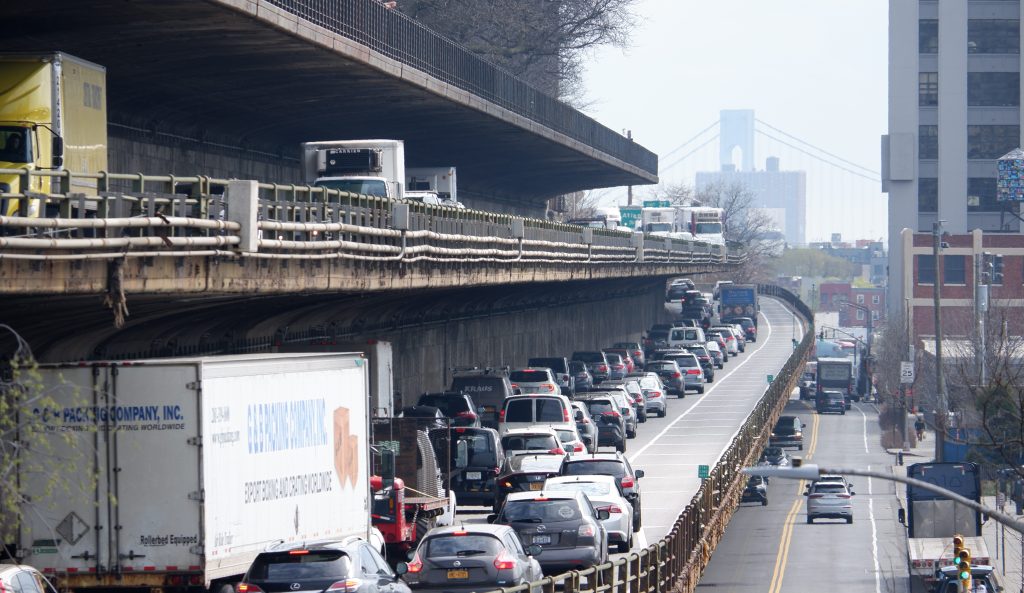
Mayor Mamdani will not tear down the deteriorating triple-cantilevered stretch of the Brooklyn-Queens Expressway, and instead pursue his own version of long-stalled plans to rebuild the segment over 10 years using a bypass structure that city officials say will be temporary.
Mamdani’s plan, which he will unveil on Monday, differs from previous plans for a temporary highway structure by not expanding the highway’s footprint through the Brooklyn waterfront. Construction will start in 2030, wrap up in 2040 and extend the structure’s lifespan to 2080, city officials told reporters at a closed briefing last week.
Past attempts to rebuild the city-owned “BQE Central” segment of the highway fizzled out under mayors Bill de Blasio and Eric Adams, who attempted to get federal funding for the effort.
The city spends $160 million a year maintaining the structure in lieu of a long-term solution, the administration said. DOT bean counters insist that any shutdown would risk diverting a “significant portion” of the 130,000 daily car and truck trips onto local streets.
“For decades, prior administrations have failed to deliver urgent long-term repairs to BQE Central — but we can no longer afford to wait for the perfect solution,” Mamdani said in a statement. “This plan allows us to safely fix the BQE without slowing our city down or wasting decades more on magical thinking. The cost of inaction is too high, and the risks to New Yorkers are too important to delay any longer.”
The Department of Transportation plans involve building a temporary two-tiered bypass highway next to the 0.4-mile cantilever along Furman Street, between Atlantic Avenue and Columbia Heights. The detour road will continue over the Brooklyn Bridge approach at Vine Street to connect back into the rest of the BQE, though its exact route near the bridge is still under consideration.
Mamdani and his team vowed not to increase the BQE’s footprint, and to keep it at two lanes in each direction, after his predecessor Eric Adams proposed rebuilding the highway as a three-lane road. But officials who briefed the media last week reiterated the city’s longstanding position that tearing the road down entirely would unleash its traffic onto local streets — despite growing calls for the city to seize the chance and phase out the BQE.
“While the city and the state must right the wrongs of Robert Moses with the BQE and other infrastructure plowed through urban communities, decades of political paralysis have left us out of options,” DOT Commissioner Mike Flynn said in a statement. “Confronting the reality of cracked concrete, exposed steel and extensive rust damage simply cannot wait for another blue-ribbon commission.”
In another statement, Deputy Mayor for Operations Julia Kerson warned the highway’s collapse would force “cars and heavy trucks…onto local streets” and disrupt “key freight transportation networks.”
“We must and will act now,” Kerson said.
If realized, the decade-long project will cost $4 billion and effectively lock the highway in place for the next half-century, but Mamdani will likely encounter local resistance.
In 2018, the de Blasio administration faced stiffed resistance to its plan to build a six-lane replacement highway atop the popular Brooklyn Heights Promenade. De Blasio ultimately kicked the can down the road, making patchwork fixes and converting the highway segment from three lanes to two to lighten the load on the aging structure. His successor Eric Adams unsuccessfully pitched the federal government to rebuild the BQE to last for another century and flirted with rewidening the highway to six lanes at the behest of car-first Brooklyn Democratic Party bigwigs, but never got sign-off from Uncle Sam.
The Mamdani administration’s plan seems designed to reduce the backlash this time by building the interim structure lower than the promenade — about at the height of the northbound upper roadway of the cantilever.
DOT will close portions of the scenic walkway for the repairs, however, but officials promised to keep it partially open at all times. DOT also plans to reconstruct the adjacent Columbia Heights overpass during the work as well.
The project will impact a long list of park space, including Squibb Park, Hillside Dog Park, Anchorage Plaza, Clumber Corner, Bar and Grill Park, Adam Yauch Park, and part of Harry Chapin Playground, according to City Hall.
The temporary bypass along Brooklyn Bridge Park will be within Furman Street’s right-of-way, but officials insisted that access to Brooklyn Bridge Park from that road will remain throughout construction.
DOT plans to ask the state to alienate parkland as part of the project, but officials vowed to tear down the temporary roadway and restore the green spaces after the work wraps.
Brooklyn Heights residents and other civic and environmental groups formed a coalition in 2024 calling on the city and state to reimagine the entire BQE corridor, from the Verrazzano Bridge and the Kosciuszko Bridge, and move away from a highway.
There are plenty of successful examples of highway removal projects, like the Cheonggyecheon in Seoul, which officials in the Korean capital turned into a river walk. Closer to home, there’s the removal of Alaska Way Viaduct in Seattle where traffic “just disappeared,” the Embarcadero Freeway in San Francisco, and, of course, the collapse of the West Side Highway in Manhattan.
Gov. Hochul also recently called off an expansion of the Cross-Bronx Expressway following pushback by residents and extensive coverage by Streetsblog.
DOT leaders said such an effort would need buy-in from the state, which controls most of the BQE, to scale back its portion of the expressway as well, along with support from the federal government, since the thoroughfare is also part of the interstate highway system.
DOT took over the cantilever project from the state during the de Blasio era; planning for the project goes all that way back to 2006. The city only owns the 1.5-mile portion of the roadway between Atlantic Avenue and Sands Streets, while the state owns and operates the remaining stretches. Albany has shown no interest in taking down the highway.
Despite DOT’s stated fears of spilling highway traffic to local streets, that already happens with motorists getting off the highway and taking shortcuts around the trenched section in Carroll Gardens and Cobble Hill, before getting back on at Atlantic Avenue.
Experts have for years recommended the city close off the Atlantic Avenue interchange to discourage the cut-through traffic and calm the chaotic on-ramps near Brooklyn Bridge Park. DOT has been studying closing the on-ramps as part of a redevelopment of the nearby Brooklyn Marine Terminal, but any work on interchanges would trigger a federal review, officials said.
The city will launch an environmental review by mid-2028, and start construction in 2029, before moving traffic onto the bypass the following year, officials said.

Read More:
Streetsblog has migrated to a new comment system. New commenters can register directly in the comments section of any article. Returning commenters: your previous comments and display name have been preserved, but you'll need to reclaim your account by clicking "Forgot your password?" on the sign-in form, entering your email, and following the verification link to set a new password — this is required because passwords could not be carried over during the migration. For questions, contact tips@streetsblog.org.