Inwood Insiders Want to Dissolve a Car-Free Plaza They Previously Championed
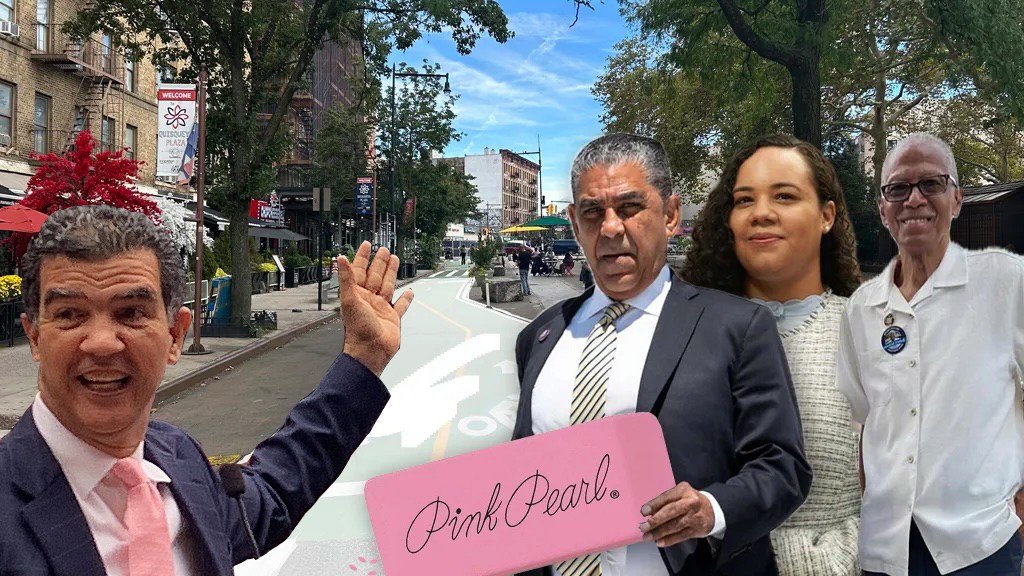
Several Inwood merchants and elected officials are having second thoughts over a five-year-old car-free plaza on Dyckman Street — after the former street-for-cars succeeded so well at providing public space for people that it became a lightning rod of neighborhood agita over noise.
Now, as DOT prepares to make the plaza permanent, restaurant owners along Quisqueya Plaza between Broadway and Seaman Avenue say they no longer want to be responsible for the space year-round, and instead want the city to bring motor automobile traffic and parking back to the small strip for the first time since 2021 by downgrading it into a summertime-only open street.
The push, however, would not address complaints from neighbors about regular loud parties on the square — many of which come, unsurprisingly, during the brighter, warmer summer months.
Some residents accused the area business owners of trying to preempt years-in-the-works capital upgrades the Mamdani administration is advancing to cement the pedestrian zone.
Some residents have complained about excessive sound levels from events on the small plot for years. But the same neighbors said the city should listen to people who live and relax in Inwood, not just influential storefront owners catering to their customers who drive to and from the upper Manhattan neighborhood.
“It would just be a shame to lose this as a public gathering space,” said Libby Lussenhop, who lives right above the plaza. “I just think we’d lose a lot more than we’d gain by turning it back to cars and parking.”
The battle over Quisqueya Plaza marks another chapter in the growing backlash against pandemic-era efforts to reclaim streets from cars, and taps into a longstanding ethnic and class divide in Inwood.
Last month, a slate of local lawmakers boosted the push by the restaurateurs by penning a letter urging DOT to “explore a redesigned approach” that reinstates car traffic and parking.
The signatories included Council Member Carmen De La Rosa, outgoing Rep. Adriano Espaillat, state Sen. Robert Jackson, Assembly Members Al Taylor and Manny De Los Santos, and Manhattan Borough President Brad Hoylman-Sigal.
The officials’ missive also asked for an update about the “removal” of the protected bike lane that runs through part of the plaza. The Adams administration had told lawmakers they would remove it, one of the signatories, Council Member De La Rosa, told Streetsblog in an interview, after DOT shifted the Dyckman Street greenway connection to a more circuitous route on Riverside Drive to preserve parking.
The issue came to a head last week when Manhattan Community Board 12 passed a resolution to support business owners’ wish to downgrade Quisqueya Plaza to a open street, after representatives for local eateries claimed they could no longer manage the space.
“Right now, the plaza is just a open space that has no purpose whatsoever other than having people coming in, and sitting, and loitering, and bringing their boomboxes,” Sandra Jaquez, owner of the Italian eatery Il Sole, told CB12 at the Sept. 22 meeting. “And unfortunately, now we’re seeing an increase in people using drugs, and just hanging out there, and homelessness.”
The statements marked a sharp turnaround from the earlier days of Quisqueya Plaza, when the organizers behind it described the spot as “an important landmark for the Dominican community in New York City.”
The board’s contested vote backing an open street came over the opposition from other residents who said the seasonal restrictions would do little to address noise complaints, and wanted to wait and see the Department of Transportation’s $7 million renovation, which the agency has yet to release.
“Making Quisqueya Plaza operate only during the warm months only maintains the status quo, because [it] is exactly during the summer months when the noise and disruption occurs,” said Tanya Bonner during the CB 12 meeting. “I also question the political motivations of this resolution as it mimics a letter sent by other elected officials saying the same thing.”
How we got here
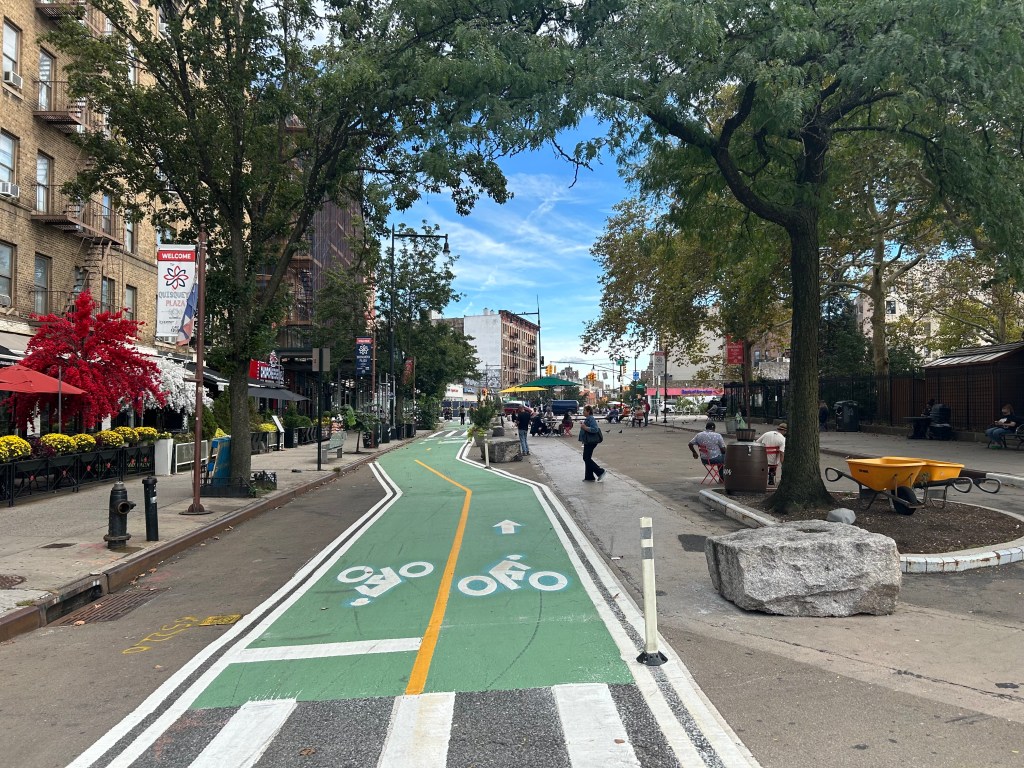
Quisqueya Plaza occupies a short block sandwiched between the Dyckman Street subway station and a community garden, flanked by a line of shops and restaurants, making it an ideal location for a public square with walkable access. It also has a two-way bike lane and a few tables and chairs, giving a feeling of seclusion from the busy roads around it.
Formerly part of Dyckman Street, the brief section became car-free in the early months of the Covid-19 pandemic, as part of then-Mayor Bill de Blasio’s open streets program. The strip previously featured angled parking on one side and parallel parking on the other, both metered.
In June 2020, it joined the open dining program and hosted outdoor seating for adjacent restaurants. In 2021, it became the first open street to become permanent car-free space, with officials christening it Quisqueya Plaza, after the indigenous name for the island of Hispaniola, a tribute to the area’s large Dominican diaspora.
“Quisqueya Plaza will become a place where local residents can gather and feel welcomed in,” said then-Council Member Ydanis Rodriguez. The DOT Commissioner at the time, Hank Gutman, hailed the plaza as “a shining example of how reclaiming space from cars can transform our neighborhoods.”
Former Mayor Eric Adams appointed Rodriguez as his DOT Commissioner in late 2021. In early 2023, the agency allocated $7 million for “capital reconstruction of the plaza as well as pedestrian safety and bike lane enhancements,” with plans to start designing the upgrades in 2024.
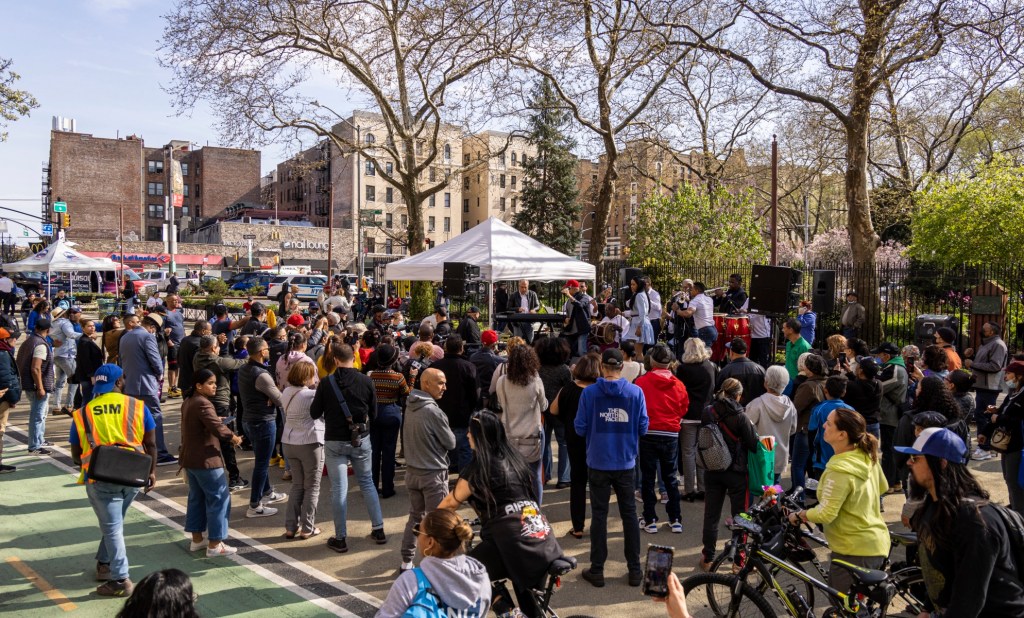
But the city never released any potential designs for the renovation to the public. Still, the plaza became a popular gathering spot for the region’s Dominican community. Large parties began to form and spill out into the surrounding neighborhood. Area restaurateurs were in charge of running the plaza’s programming.
Nearby residents began to gripe about these routine bashes, and accused the city of not enforcing noise regulations.
One resident provided Streetsblog with a folder of photos and videos of events, including images of high levels on a decibel meter.
“We were like, ‘What fresh hell is this?'” said Christianne Greiert, of the Lower Seaman Tenants’ Association, who described herself as a resident of the “impact zone.”
“This is a nightlife scene being disguised as restaurants, being disguised as an open street,” Greiert added. “There is no enforcement.”
In August, a popular neighborhood Instagram account posted a video of a loudspeaker someone had rigged to a fire escape above the plaza. The loudspeaker barked “shut up” at people mingling below.
Meanwhile, the restaurateurs also began to sour on the space. In the spring, two of them told a local radio host that the plaza car-free setup was to blame for a downfall in customers and closure of businesses on the strip.
“Nobody’s renting those [storefront] spaces, you know why? Because they don’t want to be in a street that they’re not visible, they want traffic,” Susana Osorio, owner of Mamajuana Café and Mamasushi said on a May 17 episode of “No Excuses” hosted by one-time Republican mayoral candidate Fernando Mateo. “Now, the situation is that we’re not visible, nobody knows that we’re still there.”
Handing the lot back over to car traffic would be disastrous for the neighborhood, though, and would only invite back the dangerous driving that was rampant on Dyckman before, Greiert said.
“This can’t return to traffic because it has helped with many safety needs,” Greiert said. “It used to be just a huge traffic jam on the weekends, all day and all night long, and that has alleviated.”
Political pressure
After an especially rowdy “teen takeover” on Dyckman Street and the surrounding area where one person died in August, elected officials convened a meeting of stakeholders to discuss the state of Quisqueya Plaza. The businesses denied any responsibility for the mass gathering, which spread far beyond the plaza.
The pols then penned a letter on Aug. 20 asking DOT to respond to “community concerns,” which mirror demands from business owners that want cars back.
Several lawmakers who signed the letter, like Espaillat (D-Manhattan), previously supported the city’s decision to remove cars from the plaza to provide a “thriving neighborhood haven amidst great uncertainty — providing our constituents with restaurants to dine in, neighbors to enjoy safe and distanced company and a renewed sense of community.”
But in an email to Streetsblog, spokesperson Candace Person said Espaillat had a change of heart: “While Congressman Espaillat supports open spaces and a pedestrian-friendly community, he is listening to the needs of the local businesses in the district that have requested that this becomes an open street.”
Even in New York City, it is unusual for a federal politician to weigh in on relatively minor capital projects. Quisqueya Plaza is approximately 250 feet long.
Espaillat lost the June 23 Democratic primary for the 13th Congressional District to his left-wing challenger Darializa Avila Chevalier. In the election district that encompasses Quisqueya Plaza and a few adjacent blocks, Avila Chevalier trounced Espaillat, winning 75 percent of the vote, over his 22 percent, according to granular data by the city’s Board of Elections. Avila Chevalier did not respond to a request for comment.
De La Rosa said that she favors car access over keeping the plaza fully pedestrianized.
The Council Progressive Caucus member added that removing the plaza would make it easier for people to park their cars, even though less than one-quarter of area households even have access to an automobile.
“I think that having a more flexible approach, where you know we could open it to car traffic if there is like the dead of winter and nothing’s happening there whatsoever, and there’s like 10 or 15 angled parking spots that could be reclaimed there for people who are patronizing our businesses in a limited scope of time — I’m not opposed to that,” De La Rosa said. “Everybody who lives uptown, everyone who frequents uptown knows that parking is, you know, like there’s no parking anywhere.”
De La Rosa insisted that reopening the road to vehicles would not make the street less safe, because her letter also advocates for traffic calming measures like bump outs, even though the existing plaza already achieves these goals (and then some).
“We’re not saying to DOT, ‘Just close the plaza and make it disappear,’ because if you notice, there’s parts of the letter that says, ‘Open it to vehicular traffic.’ There’s another one that says, ‘Add traffic calming measures and bumpouts,'” the Council member said.
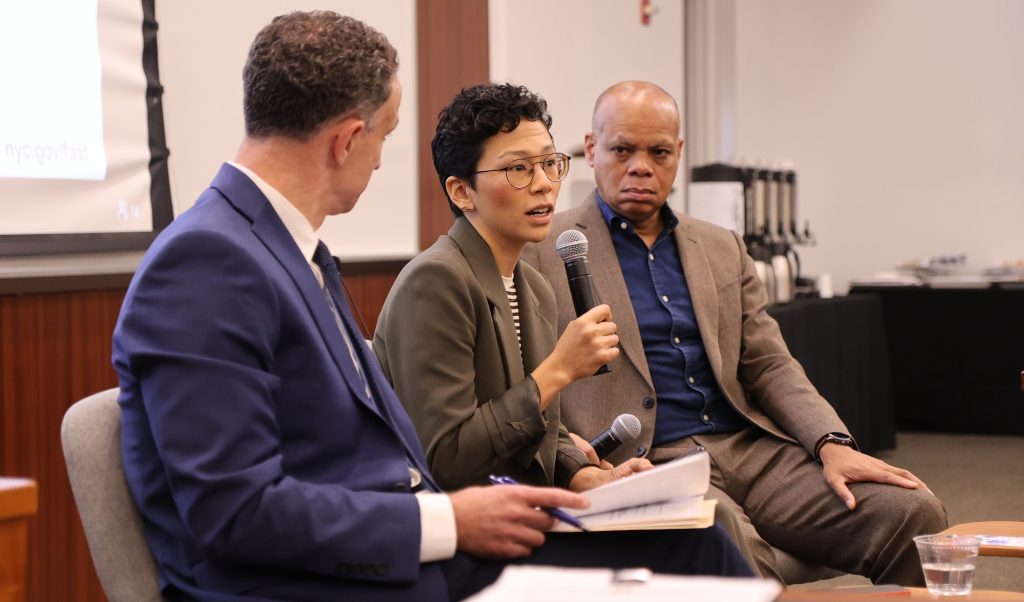
At last week’s CB12 meeting, several residents urged the board to table its advisory recommendation until DOT releases a plan, rather than trying to stack the deck against a high-quality plaza. Usually, community boards react to city plans after they’re released, not beforehand.
“I’d like to see that plan before it gets thrown out and the money spent around the neighborhood,” said Catherine O’Sullivan. “We were promised an $8 [sic] million plaza, I want to see what we’ve been promised.”
O’Sullivan also dispelled the idea that the neighborhood wanted to get rid of the plaza. She told the panel that residents who met with lawmakers and restaurateurs were not on board with the business owners’ push for a seasonal open street — because it wouldn’t address their concerns about noise.
“There was no uniform agreement with resident stakeholders, as opposed to the business stakeholders, that it should just be done away with,” she said.
The civic panel narrowly rejected a vote to table a resolution on the plaza, before passing a motion in support of reducing it into a part-time open street with 23 in favor, 15 against, and four abstentions.
Small, but critical to safety
Given Quisqueya Plaza’s relatively small footprint, it may not seem like that big of a deal to restoring traffic and parking. But its location and proximity to public transit dramatically change that equation.
In addition to being mere steps away from the Dyckman Street A train subway station and Bx7 bus, with additional access to the M100 bus.
The plaza interrupts traffic on Dyckman, a notorious corridor for speeding in a neighborhood known for drag racing and deadly driving. The intersection of Dyckman and Seaman used to be dubbed the “assault corner” for its dangerous traffic design, said Greiert, who has lived there for 15 years.
In the nine years before it first became an open street, the single block between Seaman Avenue and Broadway recorded an astounding 314 reported crashes that injured 65 people. That means drivers injured eight different people per year, just on that short stretch.
“[The plaza] has created a safe corridor along Dyckman,” said Greiert. “We’ve had this protected area and giving that back [to cars] seems very stupid.”
An email to the managing group of the plaza bounced back, and Osorio declined an interview, saying she was out of the country.
It’s unclear how DOT will respond to this backlash, but Commissioner Mike Flynn has noted that one of the most persistent misconceptions among merchants is that most of their customer base comes to their establishments by car, possibly because oftentimes they themselves get to work by automobile.
“In most parts of New York, I would say, that’s not the case,” Flynn said on an in-house agency podcast in April. “It just remains this thing that so many businesses instinctively seem to feel. I don’t know if it’s because maybe business owners tend to commute by car more.”
DOT spokesperson Scott Gastel said the agency still plans to conduct outreach on a capital project this fall.
A tale of two Inwoods
The drama around Quisqueya Plaza follows three currents in city politics: The profound racial and class divisions in Upper Manhattan, the city’s evolving campaign to remove cars from more public spaces and pockets of intense resistance to car-free spaces by the owners of businesses that abut them.
Inwood is one of the most vividly segregated neighborhoods in New York City, with Broadway dividing its western and whiter, wealthier half from its eastern, more Latino half. Quisqueya Plaza is situated immediately west of Broadway, directly on top of the Dyckman Street A train station — the heart of a growing hub of Dominican culture in New York City.
Quisqueya Plaza has become a focal point of large-scale events celebrating the diaspora — almost as it was designed to in the first place — but the frequently loud celebrations have also generated friction among residents living near the plaza.
The plaza also supplies the latest example of lingering tensions over the city’s post-pandemic settlement. During the viral crisis, city leaders quickly created car-free plazas and opened streets to pedestrian traffic as a means of reducing the spread of Covid-19. But those car-free spaces have faced constant threats from car-first politicians and their revanchist supporters, who have repeatedly persuaded city officials to roll back the measures.
That backlash kicked into high gear during the car-friendly Adams administration and continues into Mamdani’s term at City Hall. Adams and his counterpart in the City Council, former Speaker Adrienne Adams imposed catastrophic seasonal restrictions on the hugely popular roadway dining program in 2023.
Last year, right-wing pols lobbied for cars back on several pedestrianized streets within parks, like Silver Lake Park Road on Staten Island and Freedom Drive in Queens.
Mamdani has yet to reinstate full-year closures on those two streets, and his handling of hot potatoes like Quisqueya Plaza will — literally — pave the path for his administration’s promise to transform the city’s streets into the “envy of the world.”

Read More:
Streetsblog has migrated to a new comment system. New commenters can register directly in the comments section of any article. Returning commenters: your previous comments and display name have been preserved, but you'll need to reclaim your account by clicking "Forgot your password?" on the sign-in form, entering your email, and following the verification link to set a new password — this is required because passwords could not be carried over during the migration. For questions, contact tips@streetsblog.org.