‘Truck Flyover’: Mamdani’s BQE Bypass Will Pass Over Brooklyn Bridge
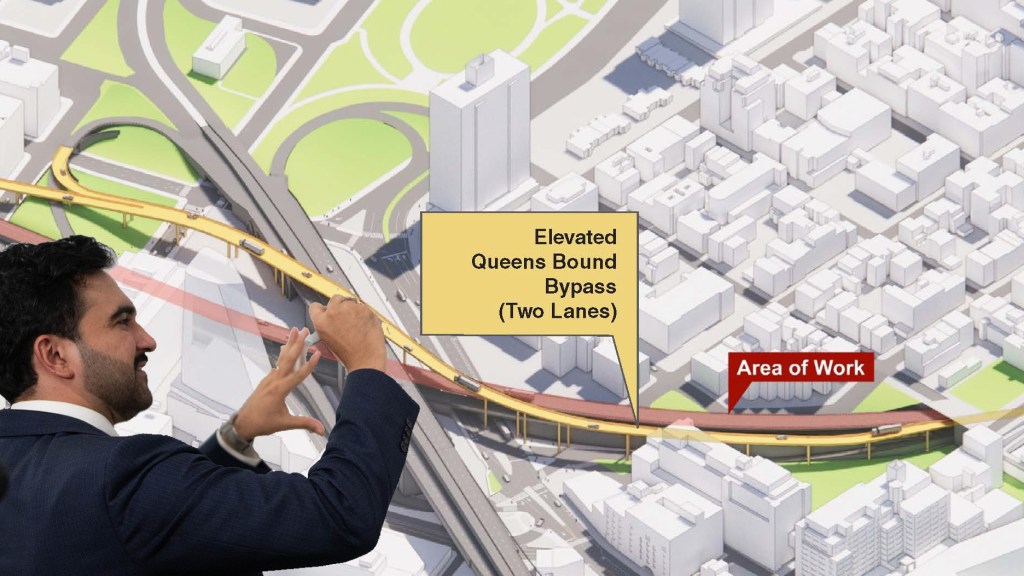
Mayor Mamdani plans to build an interstate highway bypass on top of part of the Brooklyn Bridge, according to new renderings of the temporary roadway slated for the Brooklyn-Queens Expressway repairs.
The planned detour — which Department of Transportation leaders officially characterize as a time-limited and unavoidable necessity for the city’s $4-billion rehabilitation of the BQE — will run above the span’s approach in DUMBO, arching over its pedestrian boardwalk, two-way bike path, and roadways during the expected decade-long project.
“Imagine walking over the Brooklyn Bridge and under a truck flyover — it’s not great,” said Cindy McLaughlin, a neighborhood activist and co-founder of Off-Ramp NYC, which argues for removing the city’s many highways. “It seems like a very, very outdated approach to rehabilitate a very, very outdated piece of infrastructure.”
The current highway slips below the Brooklyn Bridge at Old Fulton Street. Under the plan depicted in the new illustrations, the agency will construct the bypass with two levels and two lanes on each deck alongside the existing triple-cantilever section below the Brooklyn Heights Promenade.
The city also plans to rebuild the chaotic BQE on-ramp at Atlantic Avenue, despite years of calls from experts and advocates to close the highway interchange that encourages cut-through traffic in nearby residential neighborhoods.
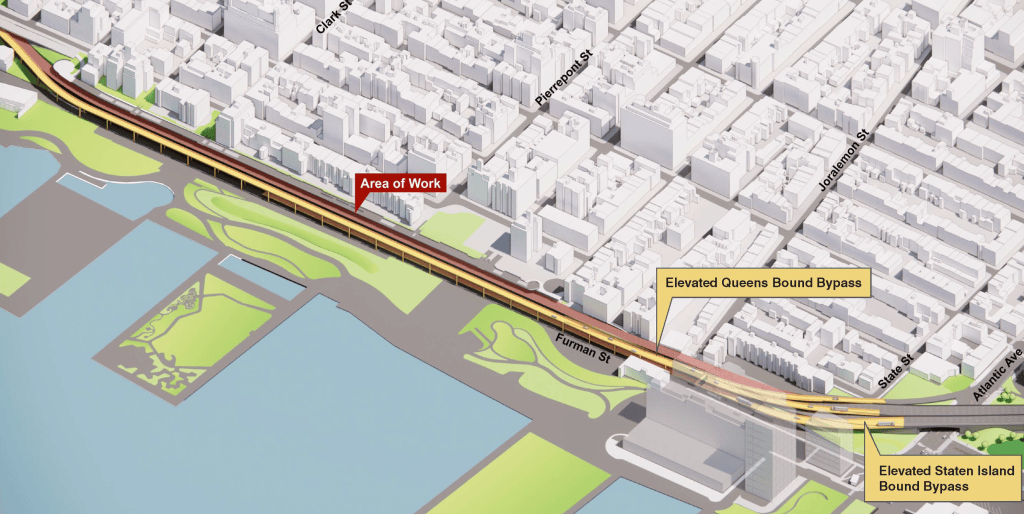
The projected path swerves into several parks and playgrounds along the way. It will directly impact Squibb Park, Hillside Dog Park, Anchorage Plaza, Clumber Corner, Bar and Grill Park, Adam Yauch Park and will require the removal of Harry Chapin Playground, which would later be restored, according to DOT.
Compared to the existing BQE, the new double-decker structure will sit much closer to Brooklyn Bridge Park and the waterfront’s luxury apartments on Furman Street.
DOT initially published a top-down view of the bypass route to coincide with the mayor’s original announcement in late August. Sometime in the past month, however, the agency quietly updated its BQE landing page with fresh renderings that more realistically depict the mega-project’s scale. DOT plans to break ground in 2029 and wrap up construction by 2040. That means the bypass will be in place for more than a decade — at a minimum.
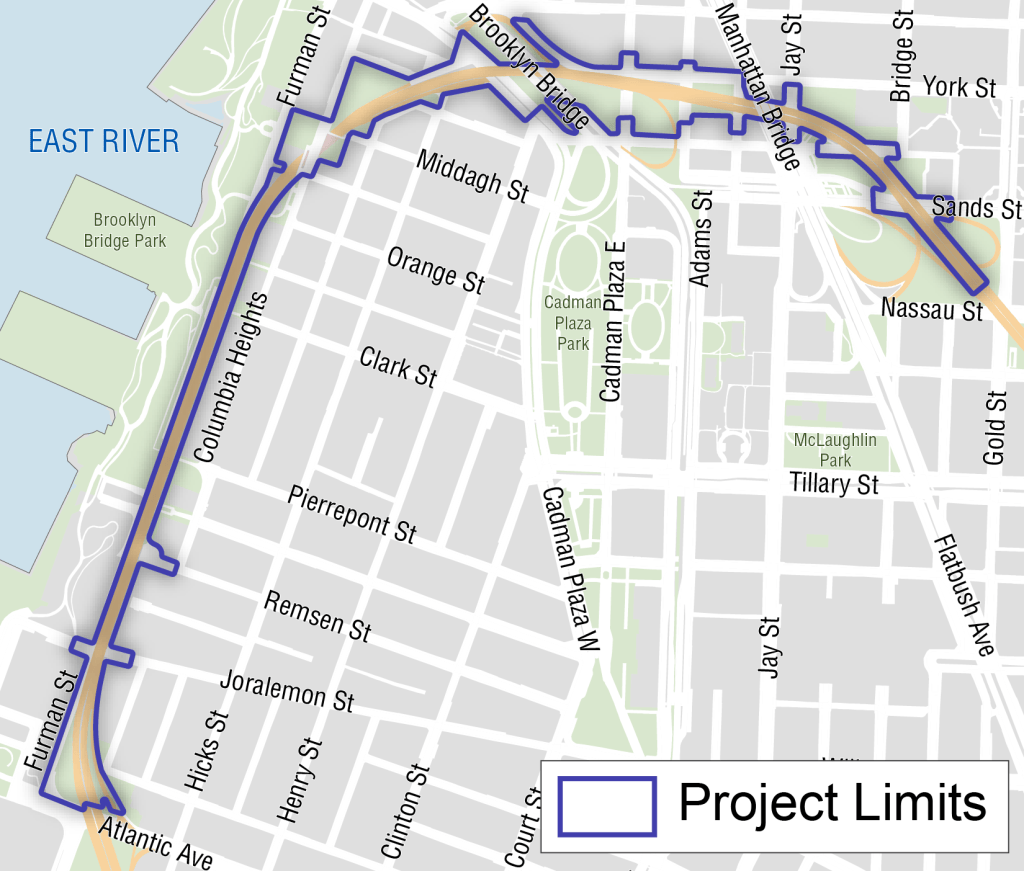
Critics of the plan have accused Hizzoner of doubling down on the master planner Robert Moses’s mistakes by cementing for decades an interstate trucking route that courses through some of the densest neighborhoods in the country. The agency plans to rehabilitate the deteriorating portion of the BQE owned by the city, between Atlantic Avenue and Nassau Street, to extend the structure’s lifespan until 2080.
Mamdani’s project resembles a proposal devised by former Mayor Bill de Blasio in 2018 that would have erected six temporary highway lanes directly atop the beloved Brooklyn Heights Promenade. But de Blasio eventually scrapped the plan after the politically influential Brooklyn Heights Association mounted an opposition campaign.
DOT floated a similar bypass highway in 2022, as part of an array of design concepts, but then-Mayor Eric Adams’s efforts to rebuild the highway with federal funding never received support from Washington.
BHA Executive Director Lara Birnback declined to comment on the latest renderings and said her group’s members were waiting to learn more. But former DOT Commissioner Hank Gutman in recent weeks questioned whether and how a third attempt at building a bypass highway would overcome highly organized local opposition.
“What’s proposed in here now is exactly what crashed and burned in 2018, no different,” Gutman said at the Sept. 17 board meeting of the city and state corporation overseeing the redevelopment of the nearby Brooklyn Marine Terminal. “And if it’s on the table now, it will crash and burn again. It destroys the experience in Brooklyn Bridge Park.”
Gutman also slammed DOT for wanting to rebuild the Atlantic Avenue on-ramp, which he said the agency they could easily close to support the renovations — just as Gutman himself did when the de Blasio administration shuttered an off-ramp at Cadman Plaza to shore up the triple cantilever’s retaining wall.
“You would be thoroughly within your rights to close that ramp to facilitate the repairs on a ‘temporary basis,’” Gutman said at the meeting. “That would allow you to study in real-time and in real life what the impact on traffic was, which would dramatically facilitate an effort to fix it permanently going forward.”
Mamdani and surrogates like DOT Commissioner Mike Flynn and Deputy Mayor for Operations Julia Kerson have tried to make the case that time has completely run out to rethink the highway, the city only controls a small portion of the BQE while the state controls most of it, and most of the larger changes would require federal sign-off from the Trump administration.
“In short, we are out of options,” Flynn wrote in a recent op-ed for Streetsblog. “Not because rehabilitating an urban highway in place is our ideal transportation policy. Not because we believe the BQE should remain cemented in place as-is forever. And not because we are indifferent to the communities — especially the more disadvantaged communities to the north and south of the city-owned portion — that have lived with its consequences for generations.
“We made the only feasible choice: go it alone and rehabilitate the existing structure,” the DOT chief added.
A senior DOT rep also pushed back against Gutman’s recent suggestion of wrapping a closure of the Atlantic Avenue on-ramp into the repair project, citing an unpredictable relationship with the current White House.
“We have to be really balanced on how we interact with the federal government, and this is a multi-generational project of which we are putting safety first,” said DOT’s Chief Strategy Officer Tiffany-Ann Taylor at the BMT meeting last month. “In order to get to a period where the cantilever is in a better state of affairs, we have to start earlier, and this is the most conservative proposal put forward for now.”
DOT plans to collect input from the public over the fall and publish the results in early 2027, before launching an official environmental impact statement later next year.
The city will need state approval to alienate several pieces of parkland to build there, and the project must clear a bevy of city and state approval bodies, according to a notice in the City Record on Wednesday. Those bodies include the City Planning Commission, the City Council, the Landmarks Preservation Commission and the Public Design Commission.
A spokesperson for DOT said the project is still in development and subject to change, and that the project would have “no long-term impact” to access to the bridge for drivers, cyclists or pedestrians.
“DOT understands the value of the parkland near the project to residents in Brooklyn Heights, DUMBO, and beyond — and will work to ensure as much of this space is continually accessible throughout construction as possible,” agency First Deputy Press Secretary Will Livingston said in a statement on Wednesday. “We are not planning for any impacts to Brooklyn Bridge Park through construction.”
DOT will hold a series of virtual and in-person feedback meetings on the new proposals over the coming months, starting with online question-and-answer sessions on Tuesday, Oct. 6. at 6 p.m., and Thursday, Oct. 22 at 11 a.m.

Read More:
Streetsblog has migrated to a new comment system. New commenters can register directly in the comments section of any article. Returning commenters: your previous comments and display name have been preserved, but you'll need to reclaim your account by clicking "Forgot your password?" on the sign-in form, entering your email, and following the verification link to set a new password — this is required because passwords could not be carried over during the migration. For questions, contact tips@streetsblog.org.