Mamdani’s BQE Plan Doubles Down on the Failures of the Past
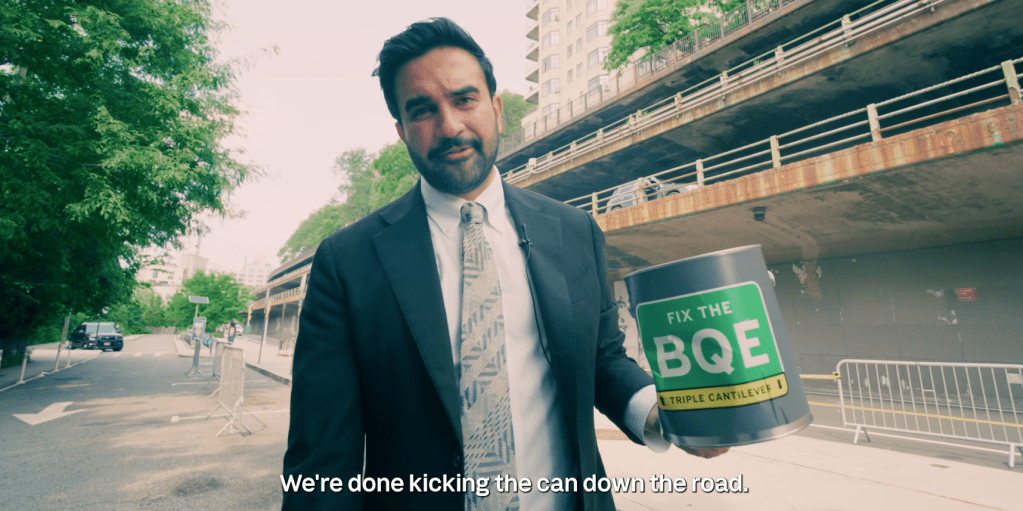
Mayor Mamdani should phase out the Brooklyn-Queens Expressway rather than cementing the Robert Moses-era infrastructure in place for another half century, transportation advocates said after Hizzoner revealed his plans to rehab the deteriorating highway over 10 years beginning in 2030.
Mamdani’s new $4-billion plan to rebuild the BQE’s aging “triple cantilever” stretch would effectively lock in the car and truck conveyor for generations, critics charged.
“Every single time we dump a lot of money into a long-term solution … we’re dooming everybody else to live with that highway for that long — or longer,” said Cindy McLaughlin, a longtime community activist and co-founder of Off-Ramp NYC, which advocates for removing the city’s many highways.
“Urban highways were not a good idea in the first place, and 70 years later we know a lot more about all of the negative consequences,” McLaughlin said.
Instead, McLaughlin’s organization has proposed the city replace the “mid-century relic” with transit and public park space, which would cost a fraction of rebuilding it for cars and trucks. Removing the noisy eyesore would also unlock space for development of sorely needed housing in the Five Boroughs, as Erik Engquist, a columnist at the real estate publication The Real Deal recently suggested.
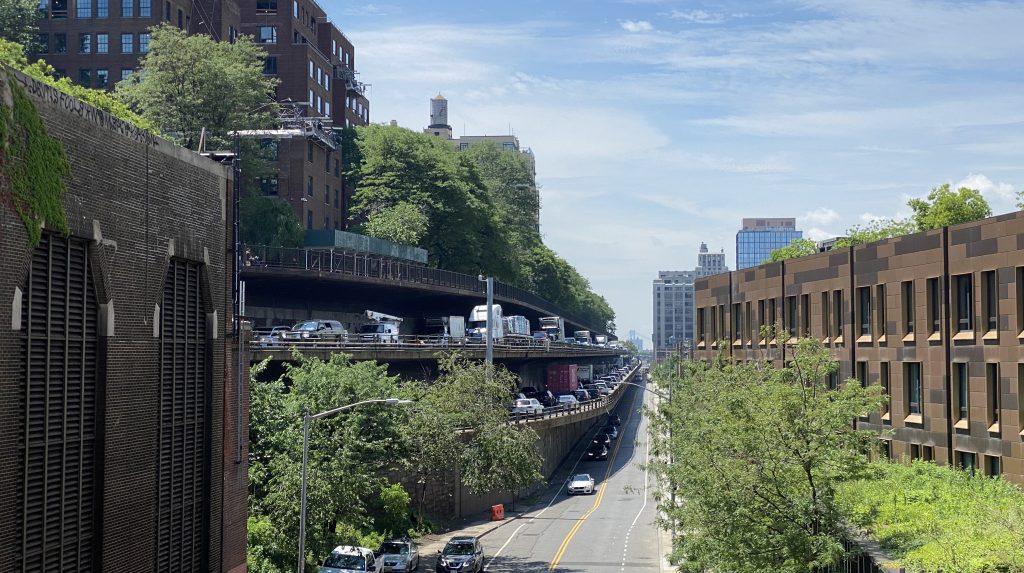
Highway removal projects have succeeded in cities across the country and globe. In Seoul, officials replaced the Cheonggyecheon highway with a river and park. In Seattle, officials removed the Alaska Way Viaduct and 90,000 daily car trips “just disappeared.” In the Netherlands, the Dutch reverted the Catharijnebaan from a highway back to a canal.
Mamdani, who promised to make city streets “the envy of the world” when he took office, won’t match that ambition with the BQE. Instead, he plans to maintain the status quo of a highway that runs 130,000 cars and trucks per day through dense neighborhoods, spewing pollution and unleashing congestion and traffic violence onto local streets.
DOT officials insist that shutting down the 1.5-mile city-owned segment of the highway is “infeasible” and would send send a “significant” amount of traffic on local streets.
Some elected officials who voiced support for the mayor’s plan are still holding out hope for “future transformative changes,” but Mamdani’s pledge to spend nine-figures to prolong the highway’s life until 2080 will discourage officials from dismantling the thoroughfare anytime soon, including when other sections are due for repair in the future, McLaughlin argued.
Decision-makers tend to stick projects where a lot of money has already been spent, also known as the “sunk-cost fallacy,” a tendency Moses skillfully exploited to ram through his massive public works for much of the 20th century.
“The thing about big connected pieces of infrastructure like highways is that when you’re spending a lot of money on one piece, you’re consigning everybody else along that highway to live with it,” McLaughlin said. “You end up on this rolling set of major repairs and you can’t ever stop because of the sunk cost problem.”
The BQE pours thousands of vehicles into Downtown Brooklyn daily, and the neighborhood has some of the slowest buses in the borough, with speeds bottoming out at 4 miles per hour on some corridors. The decision to continue to keep car traffic flowing through the heart of the city flies in the face of Mamdani’s pledge to speed up bus trips, one prominent advocate and supporter of the mayor’s transit agenda said.
“It’s not possible to both have fast buses and easy car commutes in a city like New York. We have to choose,” said Danny Pearlstein, policy and communications director at Riders Alliance. “Clogging bus hubs like Downtown Brooklyn with cars from the BQE creates an obstacle to fast buses.”
‘A throwback’
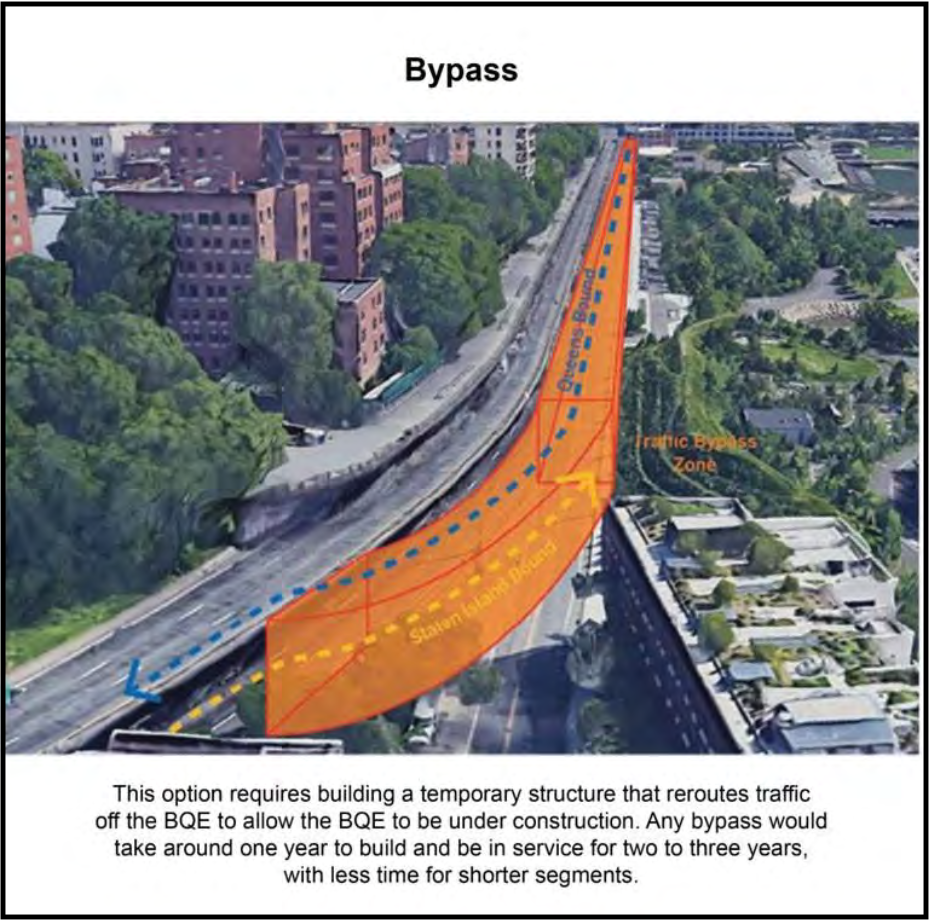
Mamdani’s plan calls for a temporary, two-story bypass along Furman Street during the 10-year reconstruction project — similar to proposals hatched by the Bill de Blasio administration in 2018, although the de Blasio DOT’s initial proposal controversially would have put the diverter highway on top of the Brooklyn Heights Promenade.
This time, the interim structure will only be as high as the upper, Queens-bound platform of the cantilever structure, and it will be narrower: two lanes and no shoulder at a width of about 28 feet. The bypass will widen to about 40 feet near Atlantic Avenue to accommodate the on-ramp there, according to DOT spokesperson Nick Benson.
Aside from slightly relocating the bypass highway, the Mamdani administration’s big innovations are to not build a wider highway and to do it all without federal funding. That avoids having to rely on fickle decision-makers in Washington to get shovels in the ground. Federal officials often push back on highways smaller than three lanes in each direction.
“That enables us to advance this project on our timeline, with our design, our scope and having complete control over our community benefits,” Deputy Mayor for Operations Julia Kerson explained at an unrelated press conference on Monday.
Interestingly, the latest proposal largely mirrors a design by architect Marc Wouters, which he drafted for the Brooklyn Heights Association to counter the promenade highway scheme in 2019.
DOT itself floated the idea in 2022, showing a parallel bypass as one of several design concepts:
Today, however, Brooklyn Heights Association wants something more transformative.
“There is an opportunity to do something for the majority of New Yorkers who don’t own cars who don’t actually drive on the BQE and who really need investments in public transit to get where they need to go,” said Lara Birnback, executive director of the association, which pushed Moses to add the scenic walkway at the top of the BQE as a concession to his highway plans in the 1940s.
More recently, the BHA joined forces with other neighborhood and environmental groups up and down the BQE corridor to push for moving away from highway infrastructure entirely.
“It just seems strange to spend billions of dollars and go through this massively disruptive when on the other side all we’re looking at is a continuation of a pretty bad state of affairs,” Birnback said, describing the Mamdani plan as “retrograde” and “a throwback.”
Trucks come first
DOT resistance to shutting down the highway reflects a stubborn truck-first approach within the agency, according to one knowledgeable source.
“There are fiefdoms within the DOT. The people responsible for freight … view as paramount the flow-through of freight,” said the person, who spoke to Streetsblog on the condition of anonymity. “They don’t want to disrupt that. It’s one of the reasons you see all those illegal trucks in the city. For any mayor or commissioner to override the philosophy within DOT is a real challenge.”
DOT estimates 90 percent of car traffic and 87 percent of trucks on the BQE are making trips that start and end in the city, while around half start and end in Brooklyn.
Beyond of the city’s 1.5-mile stretch, the state controls about 88 percent of the corridor between the Verrazzano and Kosciuszko Bridges, and as part of the interstate highway system, modifications require sign-off from the federal government.
It’s not too late for the mayor and his team to change course, advocates said.
“The project to replace the BQE triple cantilever will achieve a singular goal: the replacement of the BQE triple cantilever,” said Jackson Chabot, director of advocacy and organizing at Open Plans, which shares a parent organization with Streetsblog. “We urge the mayor and his administration to consider more fiscally prudent and transformative alternatives that don’t entrench Robert Moses’ failed urban highway experiments at the expense of our communities.”

Read More:
Streetsblog has migrated to a new comment system. New commenters can register directly in the comments section of any article. Returning commenters: your previous comments and display name have been preserved, but you'll need to reclaim your account by clicking "Forgot your password?" on the sign-in form, entering your email, and following the verification link to set a new password — this is required because passwords could not be carried over during the migration. For questions, contact tips@streetsblog.org.