New York City Cannot Repeat Boston’s Big Dig Mistake
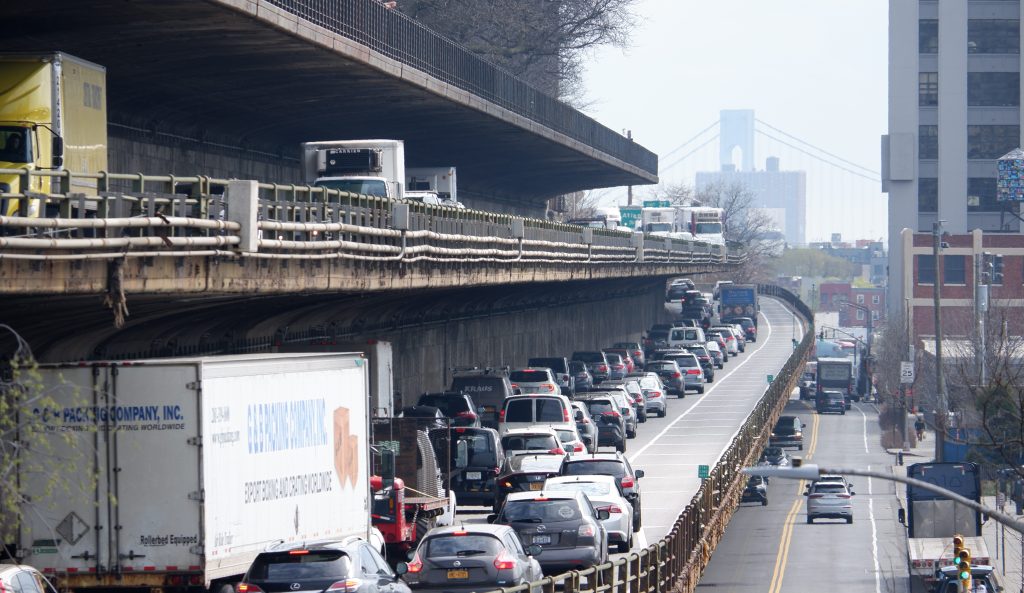
Boston’s “Big Dig” — the decades-long effort to bury its downtown highway — ranks among the most expensive, complex and instructive infrastructure projects in American history. As New York City’s highways continue to deteriorate, and the debate over their future intensifies, elected officials should study the Big Dig carefully: for what it got right and for its foundational mistake.
Boston got the highway out of sight. By reconstructing its Central Artery underground, the city freed up nearly 30 acres of new land downtown and stitched previously severed neighborhoods back together. The air cleared up. The heat island effect shrank. The South Boston Seaport attracted $7 billion in investment and 43,000 new jobs.
But the highway itself endured. The Big Dig actually expanded the roadway by widening it from six lanes to eight and adding a 10-lane bridge. Shortly after the project’s completion, congestion worsened citywide as induced demand filled the new capacity, eventually turning Boston into one of the five most-congested cities in the country. This was a predictable outcome. Scientists have observed for decades that vehicular traffic behaves like a gas, expanding and contracting to fill whatever space it is given. The Big Dig simultaneously buried and widened the highway, thereby aggravating the congestion it was designed, in part, to solve.
The lessons of The Big Dig should guide the leaders of New York City, where the conversation around crumbling highways has focused on what the city calls “BQE Central,” the one-and-a-half-mile-long stretch of the Brooklyn-Queens Expressway that includes the triple cantilever beneath Brooklyn Heights. Decades of salt and water intrusion have compromised the roadway’s integrity to such a degree that, in 2021, the city removed an entire lane in each direction and began issuing fines to trucks that exceeded weight limits.
City politicians have sent mixed messages about the best course of action. In 2020, the City Council published a detailed report about the conditions of the BQE. “As a critical route for the movement of people and goods, the BQE cannot just be removed,” read its executive summary. In 2022, former-Mayor Eric Adams proposed rebuilding the triple cantilever and widening it by up to 67 percent. And late last year, a spokesperson for mayor-elect Zohran Mamdani told the New York Times that the incoming mayor will “work to deliver a permanent solution … that preserves this essential transportation corridor.”
Mayor Mamdani has a chance to totally rethink Mayor Adams’s approach. Instead of rebuilding the cantilever, it should immediately start planning to tear down the entire BQE, from western Queens to southern Brooklyn. His administration should dismantle the overhead sections, fill in the trenched sections, and transform the corridor into public infrastructure worthy of a 21st-century city.
Imagine a graceful, tree-lined boulevard lined with new housing, wide sidewalks, light rail or bus rapid transit, protected bike lanes, dedicated micromobility lanes for cargo-bike freight, and connections to the subway, ferry, and airport. The right of way could also accommodate modern freight rail, offering a sustainable alternative to trucks for the future Brooklyn Marine Terminal.
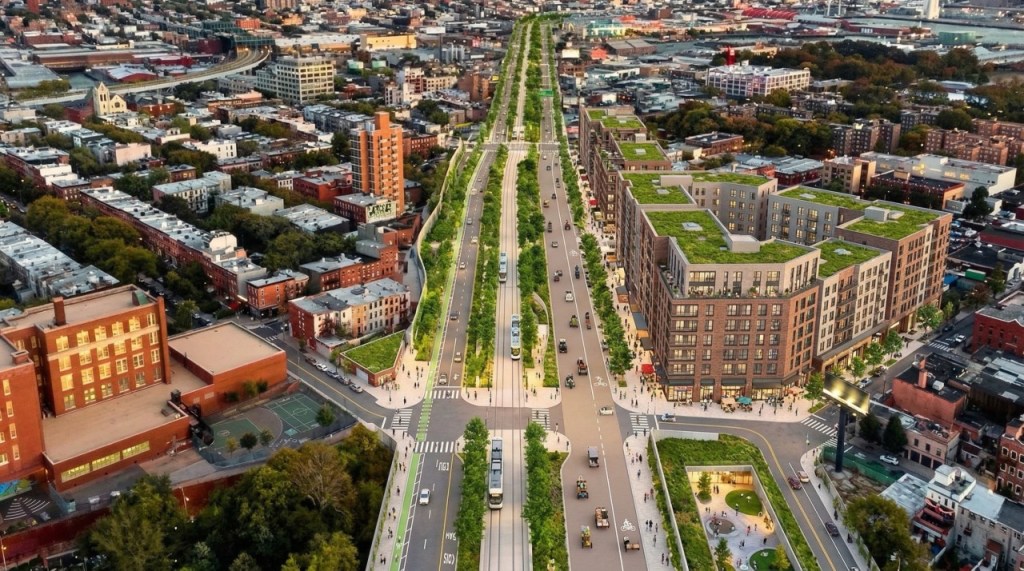
This approach would transform the BQE from an ugly, polluting liability into a productive asset, both saving billions in capital costs and enabling billions in tax and farebox revenue. At-grade, sustainable transit infrastructure is a fraction of the cost of rebuilding a highway that permits 40-ton trucks to rollercoaster through our complex, dense city. The highway’s removal also would free up many acres of public land for housing, parks and other vital infrastructure.
These savings would redound to households, too. The average American car owner spends roughly $12,000 per year on their vehicle, and car-driving New Yorkers spend even more. OMNY caps fares under $1,900. A city that lets people live car-free is inherently a more affordable one.
This scheme requires vision, a lot of political capital, a heavy dose of systemic thinking, and some old-fashioned luck. The city would need to acquire the legal authority to decommission and take ownership of the BQE, which means working with New York State’s Department of Transportation and the Federal Highway Administration to de-designate the city’s portion of Interstate 278.
It would also need to rethink how freight moves around the city, by investing far more aggressively in alternatives to trucks — step-downs to small vans outside the city, blue highway, freight rail, and micromobility for last-mile delivery. The city could even evaluate the potential of using our massive existing transit capacity: ferry, commuter rail, bus, and subway as overnight freight vehicles. This would carry the dual benefit of maximizing transit revenue and usage while further reducing truck dependency and daytime congestion.
One of the crucial questions about transforming the BQE is governance. Does a project as revolutionary as dismantling the BQE need a governing body — i.e., a group of elected officials, subject-matter experts, agency representatives, and community leaders — or does it need a single decision-maker who holds all important decision-making authority?
Here, again, the Big Dig offers a warning. Boston’s project took 25 years to plan and build, involved tangled layers of government and industry, and cost roughly three times its original estimate in constant dollars. Post-mortem accounting attributed the runaway bill to the project’s complexity and resource intensity, but also to years of political wrangling and a governance structure that delegated unaccountable authority to a powerful chairman and consortium of contractors. New York City cannot afford that model, in time, money, or trust.
The Big Dig both had too much stakeholder involvement and far too little. New York needs a tightly scoped, time-limited public planning process that engages elected officials, subject-matter experts, agency representatives, and community leaders to define clear, measurable, contractually enforceable performance benchmarks.
These benchmarks could measure different types of pollution, vehicle miles traveled, new acres of public space and much more. After the city ratifies these metrics, a smaller, more expert-driven board should take over final planning and implementation. That board should have the ability to move quickly through the design and build process, subject to regular public review against the benchmarks.
The question isn’t whether we can tear down the BQE. Cities have removed highways for decades — including the West Side Highway right here in New York City. The question is whether we still possess the will to make bold choices that radically reshape our city — not just for our own good, but for the benefit of future New Yorkers we may never meet.
We owe our kids and grandkids a fighting chance at a much better tomorrow. Mayor Mamdani and Gov. Hochul, over to you.

Streetsblog has migrated to a new comment system. New commenters can register directly in the comments section of any article. Returning commenters: your previous comments and display name have been preserved, but you'll need to reclaim your account by clicking "Forgot your password?" on the sign-in form, entering your email, and following the verification link to set a new password — this is required because passwords could not be carried over during the migration. For questions, contact tips@streetsblog.org.