Opinion: The Toughest Choice Was The Only Choice On The BQE
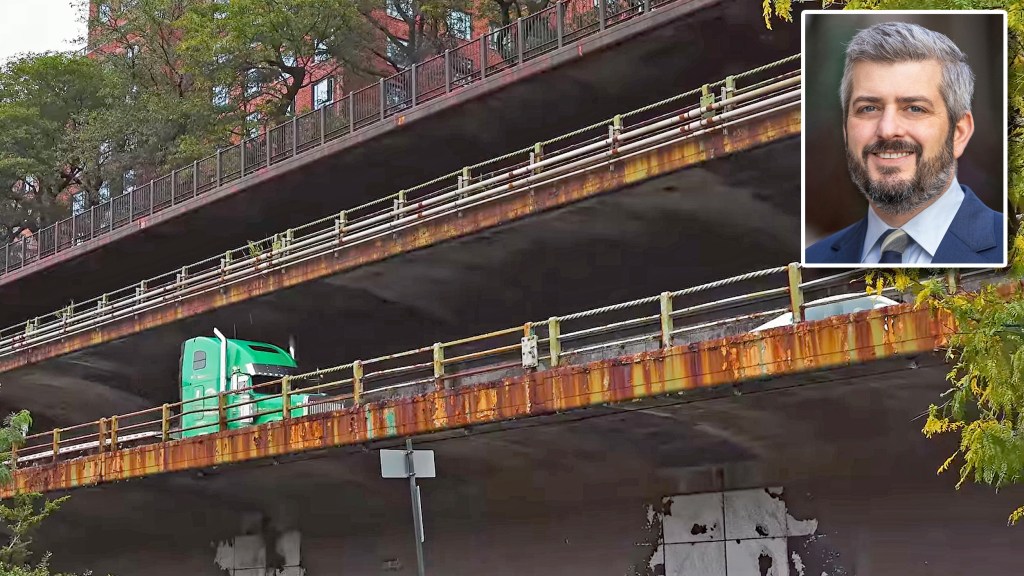
Streetsblog readers have been very critical of Mayor Mamdani for his decision to rehabilitate the city-owned portion of the Brooklyn Queens Expressway, also known as BQE Central. Given the criticism, we thought it fair to allow Department of Transportation Commissioner Mike Flynn to explain the city’s position.
— The Editors
When I became New York City’s Transportation Commissioner in January, I was warned about one of the most challenging tasks I would face: the Brooklyn Queens Expressway. While the BQE is part of the federal interstate highway system and 88 percent of the stretch in Brooklyn is owned by the State of New York, the rapidly deteriorating BQE Central — including the infamous triple cantilever — is owned by the city Department of Transportation.
It is one of the most troubled pieces of infrastructure under our control, and it also happens to be the most politically fraught. And for good reason. Urban highways like the BQE carved deep scars through our city and cities across the country. These highways divided communities, polluted the air in surrounding neighborhoods, and hardened a transportation system dependent on cars and trucks. This was a mistake, and we should do everything we can to repair the damage and learn from the past.
But, we also must deal honestly with the infrastructure we inherited and the realities we face, and that is why I am penning this op-ed. I want you to know not just what we are doing, but why we are doing it and how our decision is rooted in being out of time.
BQE Central is more than 70 years old and 20 years beyond its original design life. It carries 130,000 vehicles every day — more than double the capacity for which it was designed — including about 13,000 large trucks. Decades of piecemeal repairs and maintenance have kept it operating safely, but those repairs cannot extend its shelf-life for much longer.
The structure is safe today, but our latest engineering work tells us something we cannot ignore: the window to act is more immediate, and we are running out of time. Over the past several years, world-class engineers have conducted detailed condition assessments, concrete testing, non-destructive testing, load-rating analyses, continuous structural monitoring, and material service-life modeling. These intensive assessments have given us a clearer picture of the health of BQE Central and its estimated lifespan.
In plain English, nearly every way engineers know how to examine this structure is telling us the same thing: we have years left, not decades. That reality changed the debate.
If we had inherited this problem 20 years ago, the circumstances and calculus would be different. We do not have that luxury.
It is not only that time is of the essence, but making any transformative changes to this interstate highway, or any of its intersections with city streets, requires federal approval. For example, if we were to completely remove BQE Central, or alter even a single on- or off-ramp, it would require federal permission. So, transforming the BQE could only advance with federal, state, and local government all in lock-step, substantial funding in hand, and the luxury of the years required for planning and construction of whatever comes next.
For more than a decade, the City of New York has engaged in extensive discussions about both BQE Central and the entire highway with all involved stakeholders. It has become clear that the federal, state, and city alignment that is necessary for a fundamental transformation does not exist today and there is no reason to expect it will materialize during the remaining useful life of this structure.
In short, we are out of options. That is why we made the decision we did.
Not because rehabilitating an urban highway in place is our ideal transportation policy. Not because we believe the BQE should remain cemented in place as-is forever. And not because we are indifferent to the communities — especially the more disadvantaged communities to the north and south of the city-owned portion — that have lived with its consequences for generations.
We made the only feasible choice: go it alone and rehabilitate the existing structure.
It isn’t ideal; it is not what any of us would do if we could start from scratch. But decades of political paralysis effectively ran out the clock and we have a responsibility to ensure the safety of everyone on and around BQE Central.
So, we are going to do the shortest-term plan to keep the structure safe and stable while allowing the city to work with the state on a long-term vision for the entire highway. Our plan will repair deteriorated sections of the highway and improve drainage, railings, and lighting. The plan will also preserve access to beloved destinations including the wonderful Brooklyn Heights Promenade and Brooklyn Bridge Park.
New York City has budgeted funds for this work, but every year of inaction costs the city an additional $160 million in escalation costs alone. While the structure is currently safe, delays also increase the risk of a shutdown that would force a significant portion of daily vehicle trips, including all 13,000 daily truck trips, onto local Brooklyn streets. We cannot allow 13,000 trucks to move onto local streets where they will interact day after day with pedestrians, cyclists, and everyone else who shares our roads.
We plan to start this critical rehab work in 2030 after we secure local approvals and clear the planning and design stages. We expect that the work will take a decade. Downtown Brooklyn is a densely populated area with rich history; we know the rehabilitation will not be easy, but we need to get to work.
Rehabilitating BQE Central does not settle the debate over the BQE’s long-term future. It does not mean New York City or New York State have decided that this highway should exist forever in its current form.
Stabilizing the structure provides the time needed to make deliberate choices about what comes next. I wish that could happen today, but we can’t argue with cracked concrete, exposed steel, extensive rust damage — not to mention a federal administration with very different priorities. There is no time for another blue-ribbon commission.
For years, the BQE debate has been governed by politics. Today, it is governed by physics.
And it’s time to get to work.
Streetsblog invites its readers to comment below.

Read More:
Streetsblog has migrated to a new comment system. New commenters can register directly in the comments section of any article. Returning commenters: your previous comments and display name have been preserved, but you'll need to reclaim your account by clicking "Forgot your password?" on the sign-in form, entering your email, and following the verification link to set a new password — this is required because passwords could not be carried over during the migration. For questions, contact tips@streetsblog.org.