Brooklyn and Queens Will Need Better Streetscapes To Make the Most of the IBX: Report
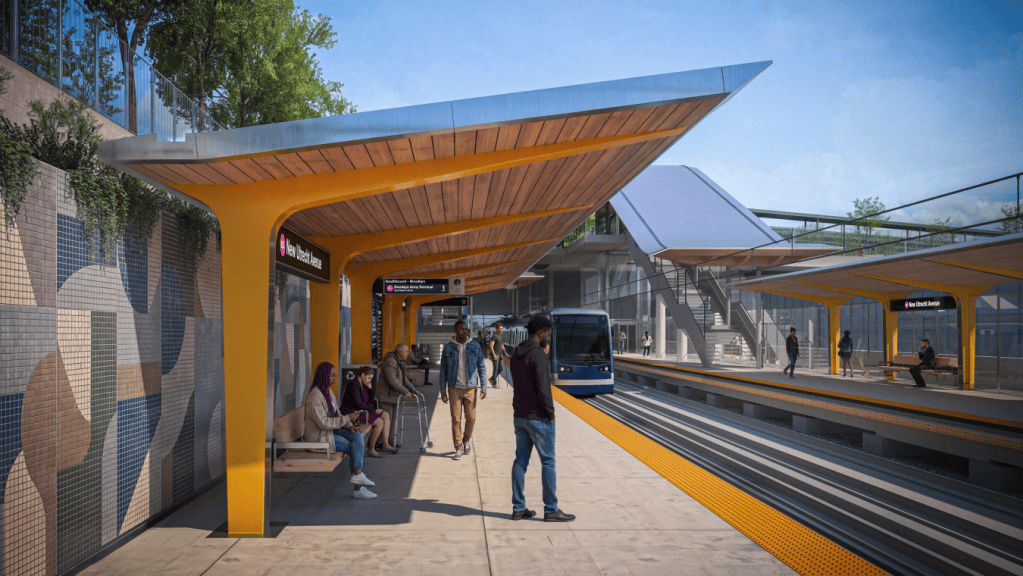
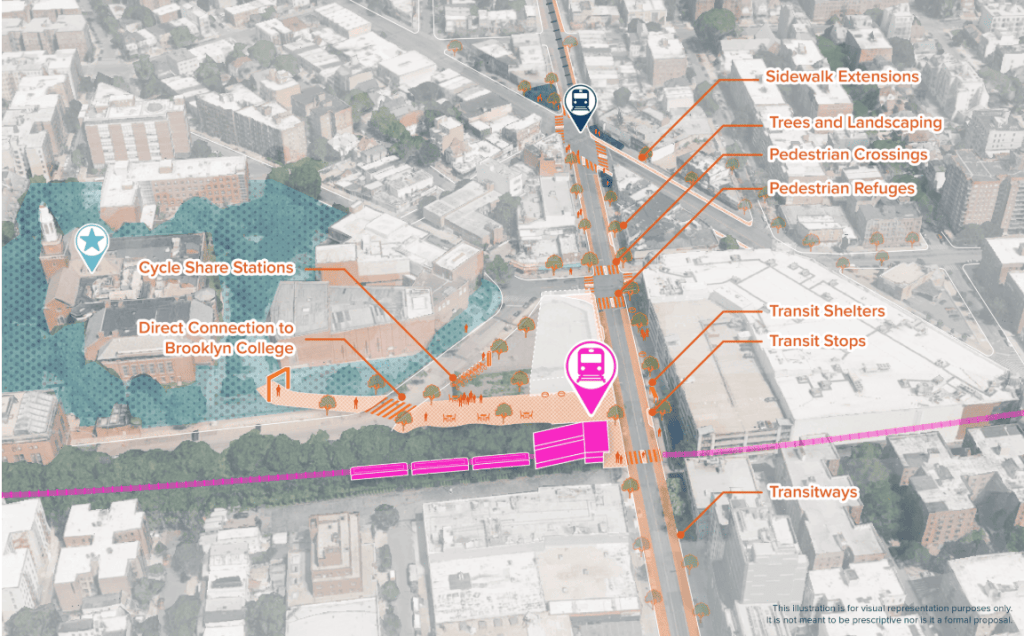
If New York City wants to get the most out of the upcoming Interborough Express, it should widen sidewalks, add pocket parks, install street seating and offer plenty of transit and bike connections around the orbital train’s new stations.
In a new report, the Regional Plan Association devised a roadmap for preparing neighborhoods in Brooklyn and Queens for the circumferential light-rail route, which the MTA wants to open in the 2030s. The train will only live up to its potential if the city makes it easy and pleasant to access, walk around and shop near its stations, RPA said.
“The IBX can deliver transformative benefits for almost 900,000 people living along the corridor,” the influential urban planning organization wrote. “However, its operational efficiency, ridership-capturing potential, and local neighborhood benefits depend on the physical quality and safety of the surrounding public realm and last-mile connections.”
To that end, the report urges the city to preemptively invest in the planned 18 stations by:
- Beefing up transit and micromobility connections to improve people’s ability to get to and from the train.
- Enlarging sidewalks on commercial corridors and creating public plazas and pocket parks near stations.
- Adding more street trees, shade and other climate infrastructure to make more welcoming walking environments.
The RPA arrived at its recommendations by examining land-use patterns within a 15-minute walk of the currently planned IBX stations, and conducting a public-feedback workshop with the MTA and both the Brooklyn Chamber of Commerce and the Queens Chamber of Commerce this past summer.
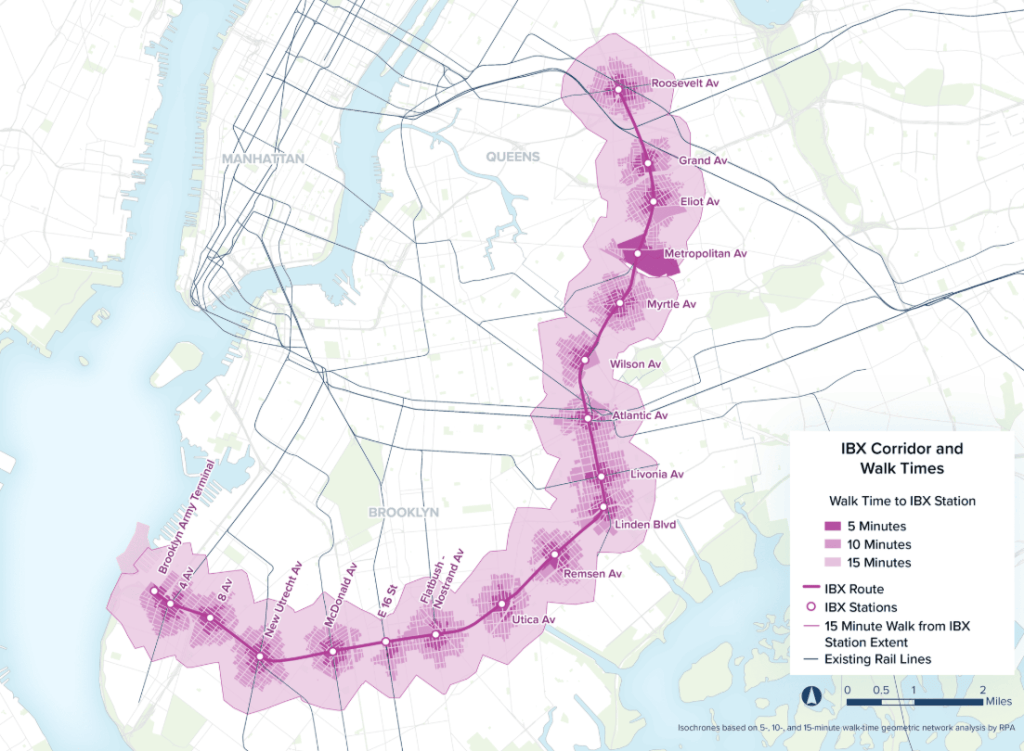
The overwhelming majority of the population living around the planned IBX stations — 93 percent — will need to walk between five minutes and 15 minutes to get to the stations. That’s why the RPA’s report argues for a focus on improved connections to the light rail, with a focus on bus lanes and micromobility. The group noted that the entire corridor, from Sunset Park to Jackson Heights, has only nine miles of bus lanes — 40 percent fewer than city average. Similarly, just 13 miles of the corridors’s bike lanes are protected, and half of the stations along the route don’t have a single Citi Bike dock nearby.
Many commercial corridors along the IBX route cannot accommodate a large influx of pedestrians — such as visitors from other neighborhoods and new residents in future apartment buildings that will inevitably crop up around the new stations.
Compared to the city as a whole, the route’s 15-minute walkshed has 29 percent fewer sidewalks that are 15-to-20-feet wide and 69 percent fewer sidewalks that are 20-feet wide. These types of streets — which are sometimes called “neighborhood streets” or “regional arterial streets” — are important for building neighborhood-scale business districts and providing room for people walking around on shopping trips or visits to the neighborhood.
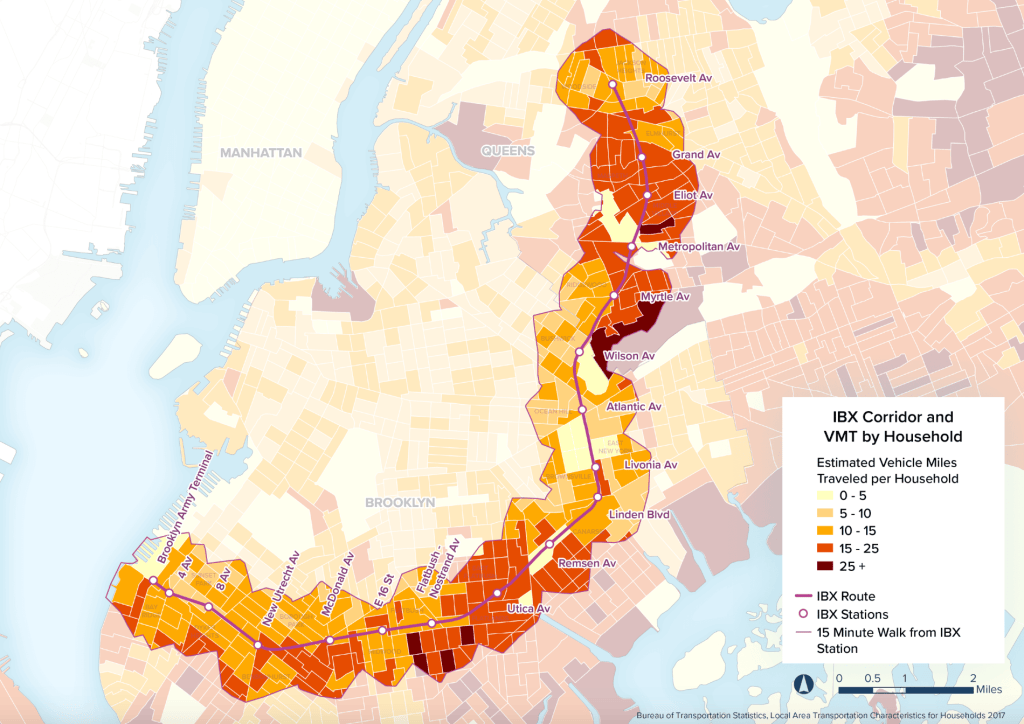
Most of the neighborhoods around the planned IBX stations implicitly encourage people to get around by car. Their street grids and amenities are hostile to other forms of transportation and as a result, households around the planned stations account for 33 percent more VMT than households in the rest of the city. According to the RPA, the city could make a huge dent in VMTs in the area by creating better pedestrian environments, transit and bike connections to the stations.
“With the opening of the IBX, combined with improvements to this first-and-last mile connectivity, a significant reduction in auto traffic is on offer as well, estimated at up to 22 million VMTs a year,” the group wrote. “This means greater safety for pedestrians and cyclists and improved air quality for everyone.”
Neighborhoods along the upcoming transit line have fewer parks and less green space than their counterparts in other parts of the city. Across the entire city, there are 69 acres per 10,000 households zoned for open space and recreation. Within 15 minutes of the IBX corridor’s planned stations, however, there are only nine acres per 10,000 households zoned for open space and recreation — an 87 percent deficit. To fix that discrepancy, the RPA encouraged the city to create more pocket parks in small vacant lots in the area, find places for more public plazas and public seating, plant street trees and forge better connections to the existing parks near some of the planned stations.
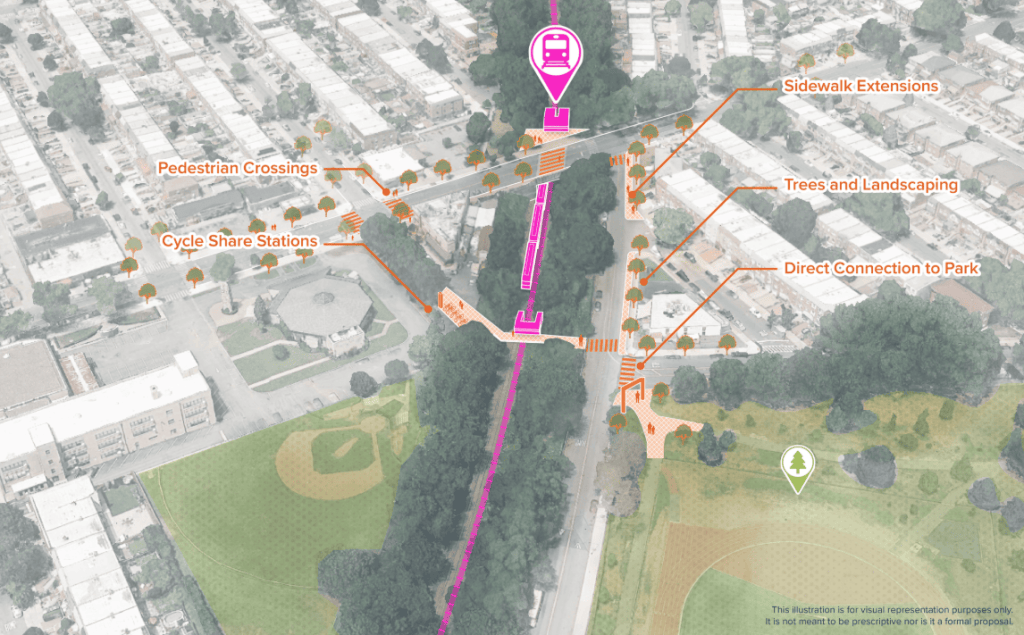
The RPA said the participants in its outreach workshops with the two chambers of commerce — which included local business owners, community organizations, and neighborhood residents — pushed for improved infrastructure, such as expanded sidewalks, better transit connections and more outdoor space, since they recognized that the light rail could be more than just a new train line.
“Beyond creating new connections between Brooklyn and Queens, stakeholders emphasized that the IBX should improve everyday mobility, strengthen local business districts, enhance public spaces, and reflect the unique character of communities along the corridor,” the organization wrote.
The report is the latest effort to chart a way forward for the IBX. In October, advocates with the Effective Transit Alliance pressed the MTA to adopt full automation for the project, in order to maximize the amount of service the agency can run. The group said the change could help push the ridership on the line well past the MTA’s estimates of 160,000 riders per weekday.
After MTA leaders said they were exploring ways to fund the Interborough Express, in light of the Trump administration’s hostility to New York’s transit priorities, other advocates said the MTA and the city should work on a land value tax to raise money for the project, which almost almost certainly create to higher property values along its route.
It remains unclear whether the federal government will fund any of the project. Gov. Hochul has pitched her flagship transit expansion as a means to unlocking massive amounts of transit-oriented development in neighborhoods that will suddenly enjoy much easier access to Manhattan’s business districts and other areas that are harder to access via transit.
And the MTA itself has held a series of workshops where members of the public can weigh in on what they want to see around the proposed stations. That provided the agency with valuable feedback and attracted some intense NIMBY grousing.