Shoppers Rejoice! The Flatbush Avenue Bus Lanes Are Officially Open
You can’t spell “business” without “bus.”
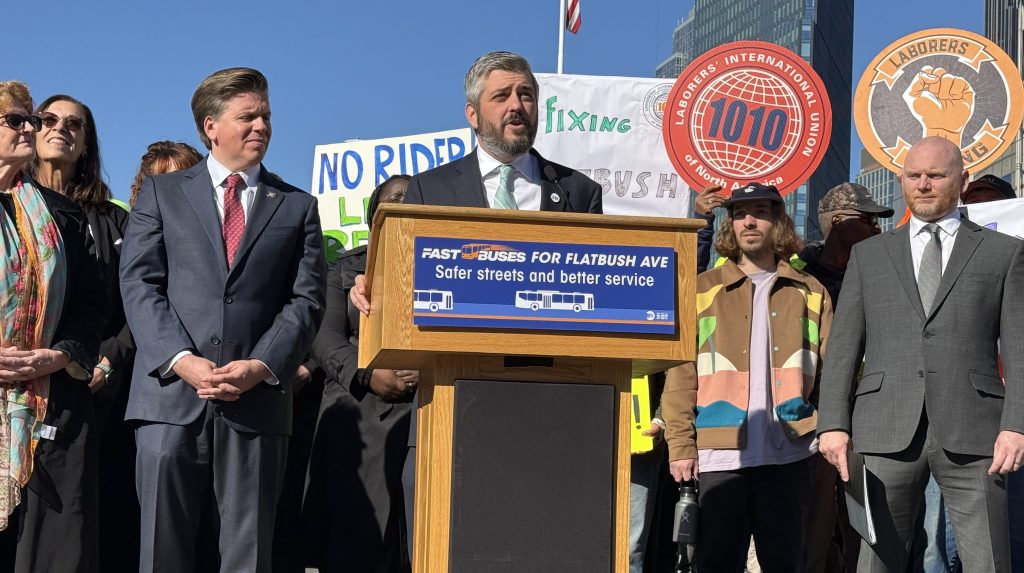
Department of Transportation Commissioner Mike Flynn and a key Brooklyn business representative threw cold water on some merchants’ claims that Flatbush Avenue’s new bus lanes threaten their livelihoods, during a Tuesday ribbon-cutting where the pair highlighted transit improvements that will boost commerce and bring more people to the popular retail corridor.
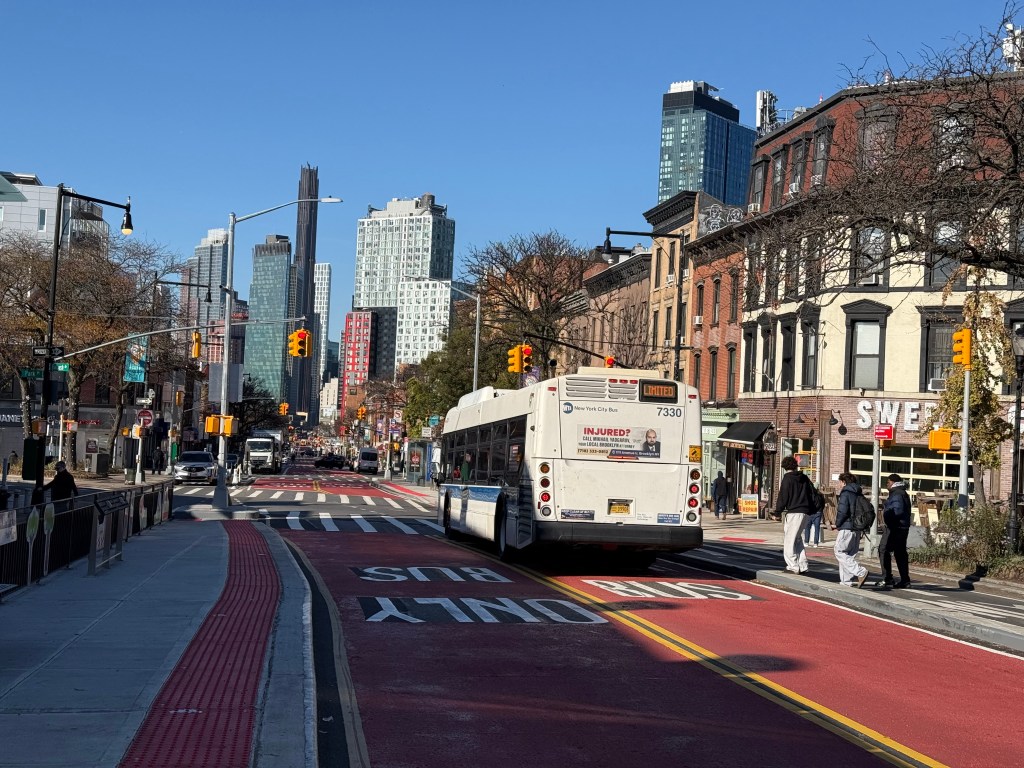
Flynn and a clutch of elected officials, advocates and DOT employees merrily opened the new bus lanes on Flatbush, which run down the center of the street from Grand Army Plaza to Livingston Street — where they connect to the existing Livingston Street busway, thereby creating about 1.5 miles of the dark red lanes in each direction.
The commissioner noted that 55,000 daily bus riders traverse the stretch between Grand Army and Livingston every day. Those passengers will now see their commutes and trips for leisure or important appointments become quicker and far more reliable, while pedestrians will benefit from fewer and slower private cars.
“The design separates bus lanes from general traffic lanes,” said Flynn. “That means riders are no longer suffering from commutes slowed by double-parked cars or general traffic, and commuters are not losing time as busses weave into and out of the curb lane for pickups and drop-offs. This will help Flatbush feel less like a busy highway and more like a calm neighborhood street that’s easier to cross.”
As with any street redesign project on a thriving commercial corridor, purveyor-critics of the Flatbush bus lanes have said that rebalancing the street to favor public transit users will kill their businesses. The owners of Antonio’s Pizzeria and El Gran Castillo complained about the project in August. But Flynn pointed out that DOT research has found that the vast majority of people shopping on this piece of Flatbush do not drive cars to the area.
“We want to move busses faster, we also want to make it easier to do business in New York City, and we want small businesses to succeed,” Flynn told reporters. “It’s definitely a consideration. We did a pedestrian intercept survey, we sent our street teams out and found that about 92 percent of folks on Flatbush arrive by walking or transit.”
The Flatbush redesign didn’t ignore local businesses. DOT updated curb regulations on and around the street to encourage turnover, added metered parking and designated new loading zones to clear the curb for delivery trucks. Flynn emphasized that people often mistake street redesigns’ attendant traffic and construction headaches as a new and permanent status quo — especially when the project involves a street that must carry traffic during construction.
“This is one of the largest and most complex projects that we’ve done in this way,” he said. “Typically, you would do something like this as a capital project, and it would take years. But we’ve been able to deliver it in months. Because you have to stage the construction and the traffic patterns change, there’s always that period that’s a little less comfortable, and there’s some inconveniences. I think what we’ll see as people adjust to it is that it’ll become the new normal. And I think businesses should see, like we found, the vast majority of their customers are arriving on foot or are bus riders.”
Flynn was hardly alone in singing the praises of the bus lane as a potential business booster.
“I think this project is bigger and more transformative to the benefit of all the users of the district, people coming from afar, people using the neighborhood to get to A and B,” said North Flatbush Business Improvement District Executive Director James Ellis. “We’re a very transit-rich district, and we want to recognize that. But we also recognize that there needs to be some of these changes to make the district more hospitable.”
Ellis echoed Flynn’s observation that the construction itself could temporarily disrupt business owners and that people get used to doing things a certain way.
“Dealing with change is a pain, specifically with some of the businesses we’ve heard from that have been there a long time, running their business the way they’ve been running for a long time,” he said. “Change is real, and we’re sympathetic to that. But we also hope that these transformative changes that are coming will make the experience for everybody and they’ll see the benefits in the long term.”
As a representative of business interests up and down the Flatbush corridor, Ellis is perfectly positioned to understand whether the elimination of 41 parking spots on a mile-long corridor makes the difference between a lively shopping district and a ghost town. His verdict? The bus lane could attract more people to the area.
Council Member Lincoln Restler, who represents the northernmost end of Flatbush, told reporters that he avoided Flatbush before the city added the new bus lanes and traffic calming measures. Ellis later referred back to Restler’s remarks.
“I think locally we’re going to see neighbors be more attracted to coming here,” he said. “We heard from other some other speakers, Flatbush was something to maybe avoid at times, unless you had to, unless you had to make that connection to a train or a bus, or make that doctor’s appointment, or meet friends at the arena for a game. Hopefully, now with it being a little bit more hospitable and more like visitable, we’ll see even neighbors coming around to use this system more frequently.”