Feds Characterize Trump As Mercurial King In Latest Bid to End Congestion Pricing
New court, same losing argument.
The federal Department of Transportation continues to insist that the president and his agencies can do whatever they want, whenever they want, as the Trump administration tries without success to destroy congestion pricing in New York City.
In June, U.S. DOT appealed Judge Lewis Liman’s March decision in favor of the MTA, which sued the federal government over President Trump’s attempt to kill the Manhattan toll. In their brief, the feds asked court, not for the first time, to endorse the idea that Trump’s whims, rather that the law, have the final say over his government’s actions.
The brief contained two main arguments. The first, which will be familiar to longtime followers of this increasingly absurd legal saga, is that Liman never had the authority to hear the MTA’s lawsuit because it involves a dispute over a financial contract. If that were true, the entire case should have been heard by the smaller and more specialized Court of Federal Claims, not the larger and more general Article III court system.
The second and newer argument is similar to what the Trump administration argued in lower court: that the FHWA can do whatever it wants at any time. But instead of arguing that the president is a de facto sovereign who enjoys unlimited powers, Department of Justice attorneys argued that the FHWA can simply change its mind at any time.
“[E]ven if the Agreement were considered in [Administrative Procedure Act] terms — not as a contract but as a ‘regulatory grant of approval to build toll infrastructure on a federal aid highway,’ or perhaps as a similar agency action granting a benefit or establishing a federal program—the agency would have the inherent power to reconsider and revoke it,” the attorneys wrote.
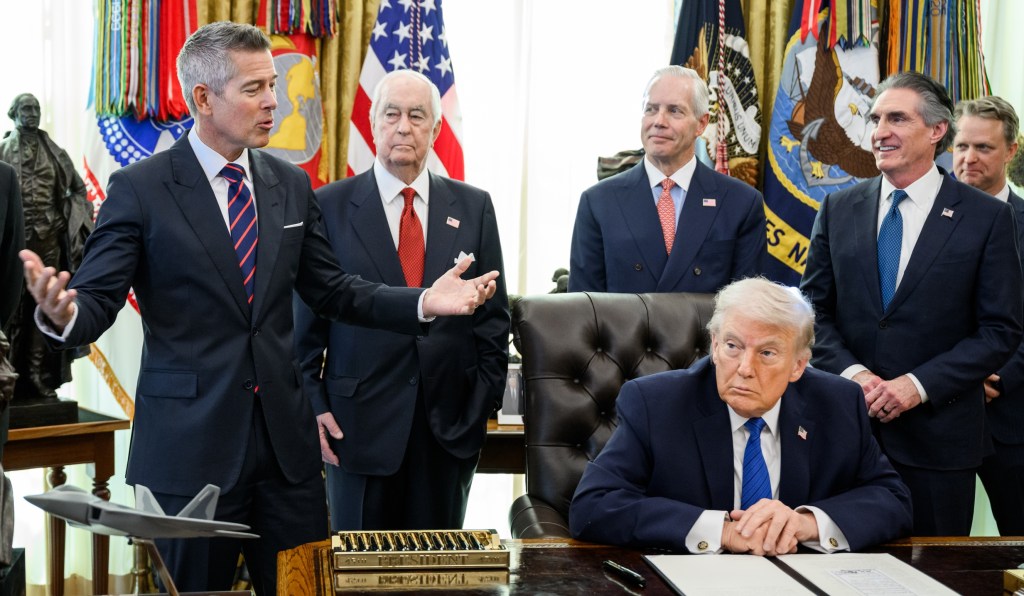
The argument is consistent with the federal government’s longstanding position from the moment President Donald Trump kicked off his attempt to kill congestion pricing: that the president has inherent king-like powers to do whatever he likes. After Transportation Secretary Sean Duffy sent his first letter demanding New York end the toll in February 2025, Trump dubbed himself the King of New York. Ever since, the rest of the federal machinery has scrambled to stand up his argument.
Last January, in a hearing before Judge Liman, DOJ lawyer Eric Hamilton argued unconvincingly that the president and his agents possessed an absolute power to cancel contracts or agreements the federal government signs with other parties. Liman described that argument as “breathtaking” and “wrong.”
So the brightest legal minds still willing to work for the Department of Justice tried once more to convince the judiciary that American law allows the federal government to be an unreliable partner. Instead of insisting that the president can cancel contracts, DOJ lawyers argued that federal agencies can just change their mind about previous approvals. “The government must be empowered to adjust to changing circumstances or to changed priorities,” they wrote.
The problem with the new argument, as one legal expert pointed out, is the very same problem that tripped up Duffy when he tried to end congestion pricing: the agreement that authorized congestion pricing, the Value Pricing Pilot Program, lacks a kill switch and the overall law authorizing the program lacks a “revoke whenever you want” clause.
Among the cases the federal government cited as precedent was California Sea Urchin Commission v. Bean, which involved a dispute over sea otter relocation program. That program followed an agreement with a specific clause that allowed the program to end under certain conditions — an arrangement found nowhere in the VPPP.
“It’s a stretch to say they have any inherent authority just to change their mind,” said NYU law professor Roderick Hills, Jr. “I don’t know of any case that said an agency can just always change its mind, regardless of the statute under which the initial decision was made, regardless of the correctness of the original decision.”
Hills said that precedent does allow for an agency to reverse itself if it can prove that it authorized a program based on an actual error. But since the FHWA didn’t rely on Duffy’s very first argument — which is that the VPPP never actually authorized cordon pricing — Hills was perplexed as to why the government cited case law that’s hinges so strongly on human error.
“Almost all the cases they cite involve an initial agency decision that was a mistake, or that the agency claimed was a mistake,” he said. “Since they don’t claim or identify any error that was made in the initial decision here, it’s hard to see how they can claim they have power to correct an error that they don’t indicate. How can you correct an error that doesn’t exist?”
The argument is also out of place because the federal government didn’t raise it when the MTA sued the FHWA in district court. A district court will hear all sorts of weird legal arguments that a plaintiff or defendant puts forward. But at the appeals court level, judges only consider whether there the lower court’s ruling committed a legal error. A requirement known as “appellate preservation” requires a party in a suit raise the specific issue if it wants to be able to raise it on appeal.
Since the government never suggested in the lower court that it ordered an end to congestion pricing because a federal agency can just change its mind, the judges hearing the case could decide to ignore the argument entirely.
“The simplest thing to do would be not to rule on the merits at all, but say on second argument, you didn’t raise it below. It’s waived,” said Hills.
Because of these discrepancies, the Second Circuit may choose to exclusively analyze the federal government’s argument that the original VPPP contract, between the MTA and the FHWA, should be reviewed by the Federal Court of Claims, which considers federal disputes over contracts for money. Liman rejected that argument in the lower court.
There is no strong evidence that shows the dispute over congestion pricing is a contractual dispute over money. Furthermore, the MTA has been levying the tolls for nearly two years now and New York City has yet to fall. Both of these elements bode well for the MTA and the future of congestion pricing.
“Sean Duffy is the one who’s trying to change the status quo,” said Hills. “For almost two years, the MTA has been chugging along, and Sean Duffy’s been on the sideline saying, ‘Judge, stop that guy.’ In general, judges, like everybody else, don’t like to get involved with something unless there’s a good reason to get involved and change the status quo.
Hills continued: “In this case, the legal arguments are weak, and the policy here seems fine. The Second Circuit has to hear the case. They have mandatory review, so they’ll have to say something, but after two 100-page opinions, I imagine that they won’t think they need to say a whole bunch.”