Q&A: Mamdani Biz Regulator Sam Levine Isn’t Afraid To Take On Big Tech
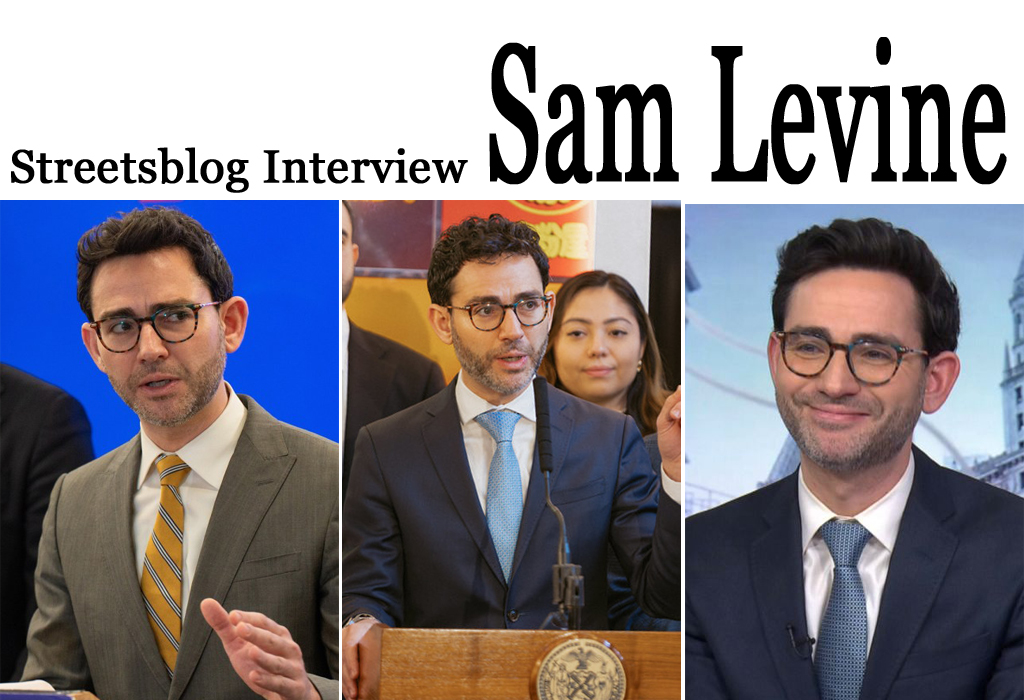
No one in Mayor Mamdani’s administration has had a busier first month than newly appointed Department of Consumer and Worker Protection Commissioner Sam Levine.
The Biden administration Federal Trade Commission alum has hit the ground running with announcement after announcement — clearing a backlog of cases left to collect dust under former Mayor Eric Adams, forcefully demanding app companies comply with new worker-protection laws, and pledging to hold corporations and their CEO‘s accountable to the law.
Levine’s worker and consumer protection agency has emerged in recent years as a key regulatory force against the fast-growing delivery app industry, which has huge consequences for the city’s public realm. Levine has doubled down on that mission.
As of last month, grocery delivery app companies like Instacart must pay their workers the city’s minimum pay standard of $21.44 per hour, and all app companies must give customers the option to tip at checkout and give workers access to discounted e-bike subscription memberships or trade-in programs. More working protections passed by the City Council last year go into effect in early 2027, prohibiting the apps from firing workers without cause.
Enforcing all those new regs will require mandatory resources, and more funding, for DCWP. Levine sat down with Streetsblog’s Sophia Lebowitz at his office earlier this month to discuss the city’s attempts to rein in the abuses of the gig economy, and how he plans to reel in the delivery-app industry, which has some 80,000 bike-riding private contractors out on the roads.
This interview has been edited for length and clarity.
Streetsblog: At Streetsblog, we cover the app delivery industry through the lens of street safety and the public realm. So I’m curious, since moving here, what is your perception of the app delivery industry’s use of the public space in the city? And what have you been noticing about workers on the street?
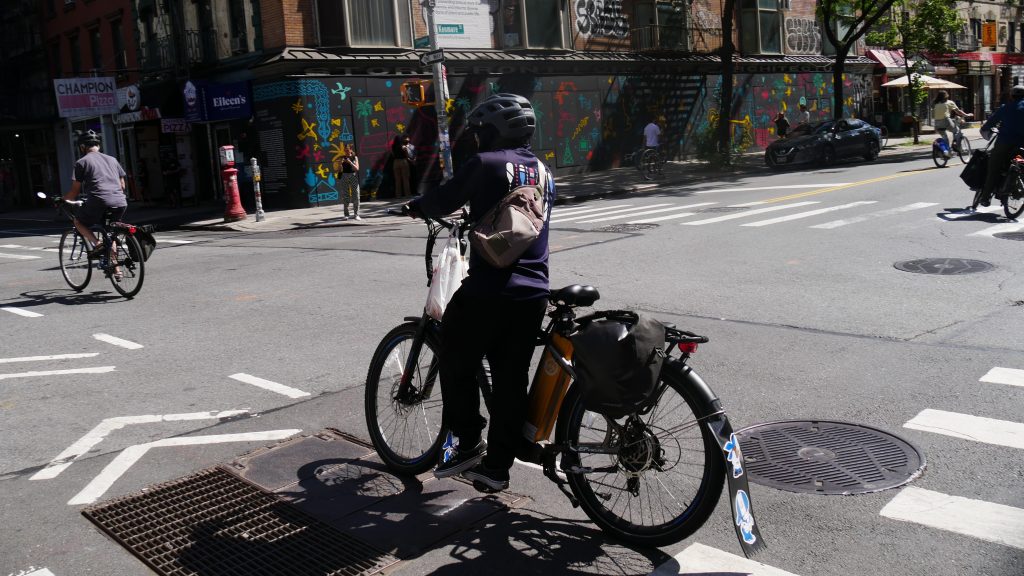
Sam Levine: Well, I’ve noticed the ubiquity of it. I was out this weekend when it was below 0º, or felt below 0º, and there weren’t a lot of people out in my neighborhood, but the deliveristas were everywhere. I had food delivered this weekend, too.
I have not personally had an issue with safety. I find they stay in the bike lanes. I realize that’s a concern others have raised, but it really does feel like there’s this whole army coursing through the city of deliveristas all over. It’s incredible. I say it over and over, but they really keep the city running — it’s 80,000 people. I gotta say, when I came into this job, I knew that this was a big part of the portfolio, but if you had asked me to guess how many deliveristas there were in New York City, I wouldn’t even tell you what I would guess, it would’ve been way under.
It’s a surprising number. And that’s a conservative estimate.
It’s like a mid-sized city, it’s huge. And my perception is that there’s been a lot of exploitation, given the demographics of many of these workers, given the fragility of these jobs and the weak protections around them, I think there’s been a lot of exploitation.
Do you think New York City differs from other cities in the U.S. because we have so many workers on bikes, and they’re just so much more visible? You can tell exactly who’s a delivery worker and who’s not, versus in other cities where maybe they’re in cars and it’s not as obvious.
Yes, I think so. I think it’s more regimented here. So people are generally on bikes. In D.C. you definitely saw the volume, but never in the volume like you do here. I think a lot of folks are in cars too. You also have a lot more protected bike lanes here, so you see the volume like on First Avenue. The physical infrastructure looks different, and sort of feels different than other cities.
Because of all this, do you see the streets as a workplace? And would you want to see companies — like GrubHub, DoorDash, Instacart — that utilize all of this public space to have more of a buy-in on making that space work well for everyone?
I think this is something they should take more responsibility for. Their business model relies on the free use and access to New York City streets, to say nothing of the labor. I think they do have a real responsibility to be partners in making sure those streets are safe for everyone who shares them.
We know that when some of these companies, and I am thinking of one in particular, moved to the city first with ride-share, there was a real attitude of move fast and break things. And the city’s now spent years trying to make sure that the workers get paid, the cab drivers can keep their heads above water [and] that this doesn’t come at the expense of our mass transit system.
In the same way, our streets are a public good, and when these app companies are using streets as a means to generate billions of dollars in profits, certainly in New York City, millions of dollars in profits, I do think they certainly have a shared responsibility to make sure that the streets are safe and that they’re not putting expectations on deliveristas that are forcing them to choose between their safety and their livelihood, which I think is, certainly in my conversations with folks, I hear more about this than almost any other issue.
About safety?
The safety, yeah.
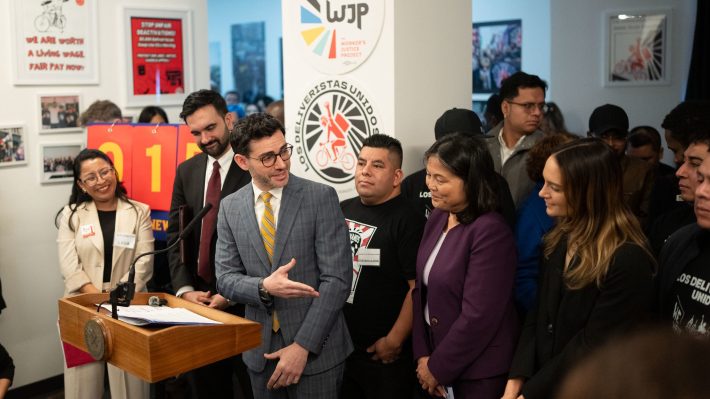
Just to build on that, I think I saw this weekend that Los Deliveristas Unidos has two open GoFundMe pages for worker-organizers that have been injured in crashes. One is for William Medina, who has been a really outspoken organizer, but that’s certainly not the extent of the injuries that their members experience. It’s been reported that the app delivery industry is more dangerous than construction, and the workers aren’t really getting any of those safety benefits like workers compensation protections or anything. I’m curious what you think about that, and if that’s something that you think the city can do more on in regards to the dangers of doing that job?
I think it’s something we need to think about carefully. One of my concerns with their business model is it’s a model that’s placed all of the risk on the drivers, on the workers, and none on themselves. This is the advantage of not having employees and using this business model where if a deliverista gets injured on a job, that’s their whole livelihood. But for one of these delivery app companies, it’s just another worker they can sub in. I really don’t want there to be a culture where deliveristas are seen sort of as interchangeable inputs, but I do worry that that’s how companies treat them.
This is why we needed deactivation protections, because people were being deactivated constantly for reasons they didn’t even understand. And it makes me wonder whether the churn isn’t an accident, whether the companies actually see that as a feature of their business model. When you have churn and when you cycle through a lot of different people, it’s harder to organize, it’s harder to fight for the kind of rights you’re describing. It’s harder to actually build power as a movement. I think that’s something we have to pay careful attention to, but we also have to pay attention to the conditions under which the workers are disempowered, which is a business model in which I think folks too often are treated as disposable and interchangeable.
What do you think that you bring to this role that differentiates you from past commissioners? Do you think anything from your time at the Federal Trade Commission gives you a different perspective?
I have a lot of respect for my predecessors. I’ve spoken to most of my recent predecessors. I think what I do bring is many years of experience enforcing the law against major companies. I am not afraid to take large companies to court. I’m not afraid to take executives to court. I’ve already sued Grubhub. I’ve sued Lyft. We sued Drizly shortly after I left the FTC, and the FTC sued Instacart. And it’s not just the gig companies, we had cases against TikTok, against Microsoft, against Facebook, against TurboTax.
So I think what I bring is a strong prior knowledge that there are two sets of laws in this country, one for the wealthy and connected and the corporations and the other for small businesses and consumers and workers. A north star of my career has been trying to make sure that big companies have to follow the same laws as the small companies.
And two, it’s just knowing some of the tricks they play, knowing some of the ways they try to impede and obstruct investigations, and making sure we get around them and making sure we can actually hold them accountable when they leave workers holding the bag when they abuse consumers. So I think what I really bring is a focus on enforcement and making sure the laws in the city, which are some of the most worker protective in the country, actually live up to their promise.
Because we have some of the strongest worker protections, do you see New York City as a place where these companies develop their playbook when it comes to fighting these types of protections? How do you see what happens in New York City as a domino effect, affecting maybe countrywide corporate practices or even worldwide? Because these companies are multinational.
I think it’s a hugely important point that I think about all the time. I believe New York can be and should be a model for how we can actually have a functioning, balanced marketplace ecosystem where all of us can thrive, where we can realize the promise of these laws. And I think if we succeed in that, we can be a national example and an international example that other cities can replicate.
I think many of these companies, from what I can tell, are very determined to teach the opposite lesson, to try to ensure that these laws fail to find work arounds, to find ways to punish consumers, to find ways to punish workers. First they fight in the City Council — which it’s their right to do. Then they’ll fight it in the courts, then they’ll fight it on their apps and fight it in their messaging. And they’re determined to send a message to every other jurisdiction. “Don’t do what New York is doing.” So it’s going to be a real battle over the next couple of years. I told our team here, especially for the new laws coming online, it’s going to take more resources but we need to make sure that these laws succeed, first and foremost, because that’s what we owe to the workers of the city.
I really think it’s not dramatic to say the whole world is watching. The whole world is grappling with what role these gig economy companies play in our economy and how these workers are going to be treated. New York has an opportunity to show the way for a more equitable economy that respects the people who deliver the food, who drive the cars. And it’s essential we succeed.
In terms of resources — obviously we’re going to know more about the budget soon. But the mayor has said he wants to double the DCWP budget. I know that when the the new laws passed last year, there were pretty clear, you know, gaps.
Chasms, one might say.
However the budget shakes out, if you do get more resources is enforcement the biggest thing you’re looking to fund? Or are there other things you’re looking forward to being able to do?
That’s going to depend on what the resources look like. Certainly there are things out there I want to do, but the first thing we need to do is what the Council has directed us to do. For example, on gig worker deactivation, that’s a mandatory enforcement responsibility. And we need a significant headcount just to monitor compliance to the minimum pay rate, that’s a significant responsibility. We already inherited a whole docket of cases where we are still trying to play catch up. Frankly, we don’t have the staff we need to enforce the laws already on the books.
But certainly I hope there are also resources to develop and to bring in great minds from all over the country to develop forward leaning policies. I think this place can be a great incubator for research and policy ideation, and for bringing more significant litigation. If we have more resources, we don’t need to say yes to settlements. We can take more companies to court. We’ll be able to move through cases faster. So there’s a lot more we can do with more resources. But before I get to do the fun, quote on quote, stuff our first responsibility is making sure we enforce the laws that Council charges us with enforcing.
Do you have a wishlist of legislation you’d want to see the Council pass, if resources weren’t a problem?
I don’t want to get ahead of City Hall. What I will say is this, in both consumer protection, where I’ve been for a long time, worker protection, which is more recent, there’s a real accountability gap. Oftentimes the reason so many people turn to DCWP is because workers often can’t bring cases on their own. They’ve not been able to organize, and they often can’t sue because they’re stuck with arbitration and can’t form class actions. This is very true in the consumer context. You get ripped off by a payday lender or by any number of products, you’ve already agreed to arbitration, and you’re likely not even going to be able to get your day in court.
This is another area where I feel New York can lead the way is restoring some measure of accountability for companies that abuse consumers and workers and small businesses. I won’t get ahead of City Hall on this, but that’s what I’m thinking big picture. As much as I love bringing lawsuits, and I do, I’d rather have a world in which companies actually took their legal obligations seriously.
During the Adams administration, there was a lot going on with the delivery app industry. Now you’re inheriting these new laws. But we also saw this shift — where we had Mayor Adams, standing with delivery workers, passing the landmark minimum pay law to him, then vetoing the Instacart minimum pay expansion. One of the things that he promised was what he called a “Department of Sustainable Delivery,” which is now a part of DOT. They’re basically enforcement officers that can give tickets for certain things. But the Adams administration also drafted legislation with a more thorough plan for this proposed department. I’m curious if you’ve seen that document, if you’ve looked at it and if there’s things in it that you like?
I haven’t seen that document. I don’t want to get ahead of City Hall on this. What I’ll say is that a, sort of, myopic focus on enforcement, I do think misses the forest for the trees a little bit when you have apps that are tying people’s compensation and their ability to remain on the platform to highly unrealistic timing expectations, sometimes quotas. I spoke to some workers at a recent event we did and they were just telling me they feel they will lose their job if they don’t hit a wild number of deliveries.
You can’t have a conversation about safety that just puts more burden on workers and sets them up to fail. I just don’t think, personally, this is an area where the police or enforcement is the solution. It can be part of the solution, certainly if there are egregious violations, but we need to look at what are the corporate incentives that are putting deliveristas in a position of having to choose between their livelihood and safety. It’s an ongoing conversation with [the Department of Transportation]. And I think whether we have the department or not, I’m committed to working with [DOT] Commissioner Flynn to make sure we work together on this. Because we do not have the expertise on speed limits, volume that is not our thing, but we do have an understanding of some of the games these companies can play that outsource risk onto workers.
One thing that’s thrown around a lot about this type of regulation are “the algorithms.” Former Comptroller Brad Lander called on the city to not allow the app companies to use their algorithms to incentivize speed and things like that. When these companies do get sued, it’s really hard to get them to reveal their algorithms in any way — they are considered trade secrets. I wonder how likely you think it is that the city would be able to penetrate the black box of the algorithms?
It’s an interesting question. Let’s think about it in the pay context. So we know that there is an algorithm. There’s a black box around driver compensation. But the way the city has approached that is not to say, “Oh we need to tweak the algorithm,” and get a bunch of computer scientists to look at it. No, they said, “here’s the minimum pay. Here is a substantive protection, and we’re going to make sure that you are at $21 an hour.”
I think you can take a similar approach to safety. I think the comptroller [was] absolutely right that there’s a black box, and there are a lot of concerns there, but I also don’t think we should see that as a barrier to effective intervention. I think you’ve seen with minimum pay that you don’t need a computer science degree. We take this concept from 130 years ago, like, from the Lochner era, a minimum wage…
… and you just tell them to make it work?
Make it work, yes, exactly. You set benchmarks they need to meet. With respect to safety, it might be more complicated. But at the end of the day, it’s a pretty simple equation. You look at the number of trips, the distance, you estimate what the safe speed would be — that’s something DOT can do without hiring an army of computer scientists. So I do have a lot of concern around the opacity of these black box algorithms, but I don’t want that to be seen as a barrier to effective intervention, because I think New York has a track record of overcoming that.
Do you look to other countries for guidance on this type of stuff? In Spain, they have the “Rider Law,” and they force the app companies to classify the workers as employees. And then there’s the EU Platform Work Directive, that’s taking shape now. In Europe, they’re more dealing with the question of, “Should these workers have to be classified as employees or not?”
I haven’t, but I’m generally interested in it. It is something I’m planning to explore more. You know, before this, I did a lot of privacy work, where we paid a lot of attention to Europe, which was way ahead of the U.S. They did things that worked, and they did things that had a lot of unintended consequences.
So I’m very interested in models from other countries. I’m also interested in models from other cities. I mean, Seattle’s done a lot of work in this area, too. So I don’t have an opinion yet on what’s happening in Spain, but it’s something I want to learn more about.

Streetsblog has migrated to a new comment system. New commenters can register directly in the comments section of any article. Returning commenters: your previous comments and display name have been preserved, but you'll need to reclaim your account by clicking "Forgot your password?" on the sign-in form, entering your email, and following the verification link to set a new password — this is required because passwords could not be carried over during the migration. For questions, contact tips@streetsblog.org.