Exclusive: Mamdani Picks Construction Chief Eager to Speed Up Street Redesigns
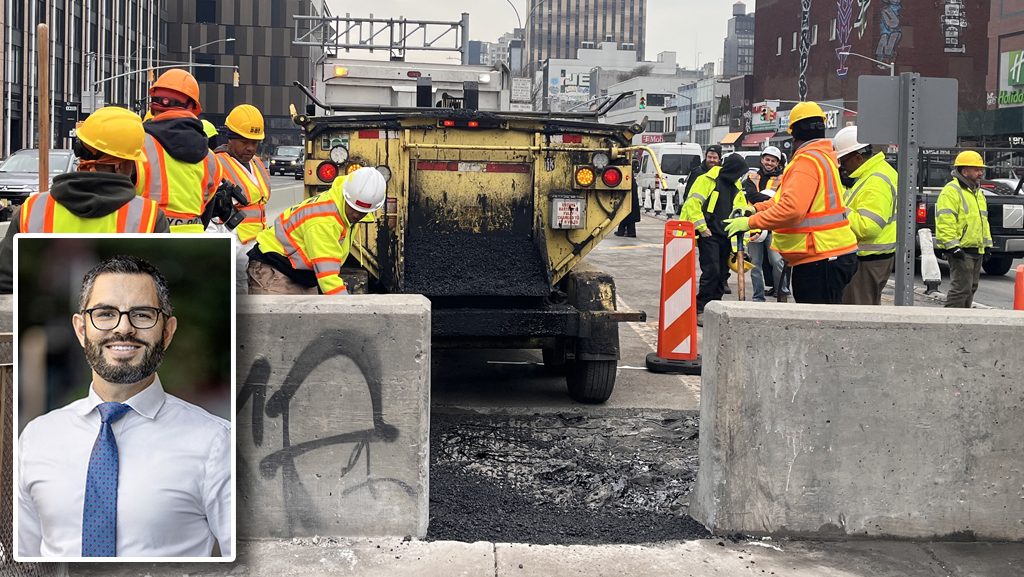
The Mamdani administration has chosen senior Department of Transportation official Paul Ochoa to lead the city’s delay-plagued capital construction division, the Department of Design and Construction.
Ochoa, 37, wants DDC to speed up its projects, which include hard transportation infrastructure for buses, bikes and pedestrians. Advocates said these initiatives will be instrumental in fulfilling the mayor’s promise to turn the Big Apple’s streets into “the envy of the world.”
“Delivering infrastructure for New Yorkers, the infrastructure that they deserve and expect, faster, is going to be my top priority at DDC,” Ochoa told Streetsblog in an interview. “I’m looking forward to taking a deep dive on expanding the things that work and ending the ones that don’t.”
Former Mayor Rudy Giuliani created DDC in 1996 to make infrastructure construction “more efficient and cost effective,” by consolidating capital divisions from several departments under one helm, but the agency has long struggled to quickly turn street redesigns from mere paint and plastic into hardened concrete buildouts.
DDC project timelines routinely span more than a decade, and easily run up $100-million tabs to reconfigure just a handful of blocks, because they often involve tearing up an entire street for sewer work (which the agency also manages).
“If you really want streets that are the envy of the world, this is the challenge,” said Jon Orcutt, a former DOT director of policy under former mayors Michael Bloomberg and Bill de Blasio, and a longtime transportation advocate.
DDC’s dysfunction prolonged the reconstruction of Pearl Street Plaza in Dumbo for 17 years and the construction of a greenway on Flushing Avenue around the Brooklyn Navy Yard for 11 years. Bloomberg-era pedestrianization projects at Herald and Madison Squares remain paint-based nearly two decades later.
These delays mean that costly revamps are already obsolete when they finally go online. Narrow bike paths around the Navy Yard are dangerously over-capacity, and a proposed section of similarly tight cycling paths in Greenpoint won’t be finished until 2030.
So-called raised or mountable bike lanes that DDC built in the Bronx, Brooklyn and Queens immediately proved ineffective, as they encouraged drivers – including NYPD cops – to park illegally on them.
Ochoa is familiar with the issues, having worked on the DOT side as the agency’s executive deputy commissioner since 2022, overseeing a $1.5-billion expense budget and a $34-billion 10-year capital plan.
DOT’s so-called street improvement projects, or SIPs – which feature paint, plastic and sometimes planters or boulders — are intended to transition into harder infrastructure, not deteriorate indefinitely.
“The works that we do in-house … they tend to be temporary in nature,” Ochoa said. “The elements that we use to build them are not meant to last decade.”
Ochoa said he wants to more quickly move into concrete work if a DOT project works well, and rely on “alternative delivery methods,” like design-build, meaning the agency combines designing and construction in one contract to save time and money.
“We don’t have to wait for years for a SIP to know whether or not it’s successful,” he said. “We will know in a season or two, and then move forward for a full reconstruction capital project.” He cited DDC’s recently completed Shirley Chisholm Recreation Center as a good example, which the city built in a relatively short three years.
“I think DDC has done a really good job at implementing design-build and other alternative delivery methods for vertical projects,” he said. “I don’t think they’ve done enough for these alternative delivery methods for horizontal projects, so street reconstruction, sewer work.”
The state should give the city more leeway to jointly bid capital work and utility relocation at the same time, which currently requires reauthorization in Albany on a yearly basis.
“There’s nothing that drives me more crazy than going through a street that was just repaved or just redone, and then there’s a utility cut,” Ochoa said.
DDC undertakes large-scale sewer replacements and other public works, like the six-year reconstruction of East River Park for better flood prevention that is scheduled to wrap up later this year.
Orcutt suggested decoupling sewer work if only one side of the street is redesigned, such as with Flushing Avenue’s greenway, which could dramatically cut costs and timelines for several such projects.
Ochoa should look to other cities that are the envy of the world, like Paris, which quickly builds out interim projects, or London, where officials go straight for hardened upgrades, Orcutt said.
“At least the projects are measured in years and not in decades,” he said. “Let’s lift our eyes up a bit and look at the world and learn how to do it.”
Ochoa starts at DDC next week, according to a City Hall spokesperson. Before DOT, he worked at the Department of Sanitation as chief strategy officer and director of city legislative affairs in the Mayor’s Office under de Blasio.
Mayor Mamdani praised Ochoa, saying he “exemplifies what real leadership and government excellence should look like.
“With an extensive career in public service, Paul knows how to pull the levers of government to deliver for New Yorkers,” Mamdani added. “I am beyond excited and inspired by his dedication that will work to welcome a new era in our city.”

Read More:
Streetsblog has migrated to a new comment system. New commenters can register directly in the comments section of any article. Returning commenters: your previous comments and display name have been preserved, but you'll need to reclaim your account by clicking "Forgot your password?" on the sign-in form, entering your email, and following the verification link to set a new password — this is required because passwords could not be carried over during the migration. For questions, contact tips@streetsblog.org.