FIRST ON STREETSBLOG: Mamdani To Fully Fund Trash Containerization
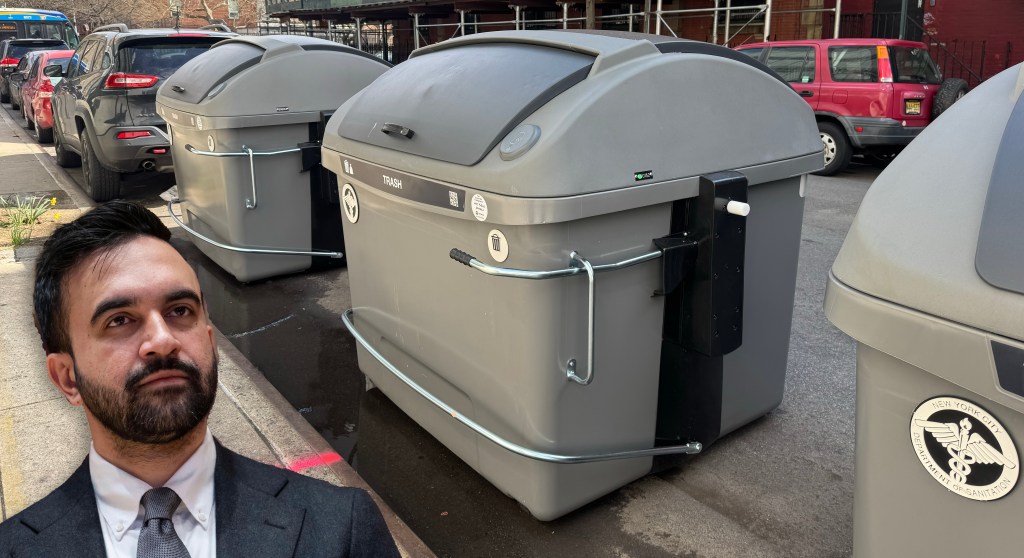
He’s finally trimming New York’s 5-o’clock shadow.
Mayor Mamdani announced Sunday that the Department of Sanitation will containerize all residential trash citywide by the end of 2031, addressing concerns that the new administration might fail to advance the previous administration’s pilot effort to get stinky garbage bags off the sidewalk and into containers in the curbside lane.
“We will containerize all trash at all residential properties,” Mamdani said Sunday evening at a Maspeth rally to mark his 100th day in office. “There will be at least one fully containerized community district in each borough by the end of next year. We will begin aggressively rolling out new containers to store that trash, and new trucks to pick it up. And we will accomplish fully citywide containerization by the end of 2031.”
In the same remarks, Mamdani described waste removal as “one of the most persistent challenges that faces our city” and noted the contrast between the city’s financial resources and the state of its streets. “In the wealthiest city in the wealthiest nation in the history of the world, no one should have to live surrounded by garbage,” he said.
The mayor also distanced himself from his predecessor, former Mayor Eric Adams, who installed trash containers on a single street in Harlem but soon gave up on installing them anywhere else in the city.
“In 2024, voters overwhelmingly supported moving forward with trash containerization,” he explained. “Empire bins were rolled out in Harlem. They were promised in Brooklyn. And then, as so many New Yorkers have come to expect from government, the momentum stalled. No date was given by which it would be completed. No funds set aside to make it real. The promise was empty.”
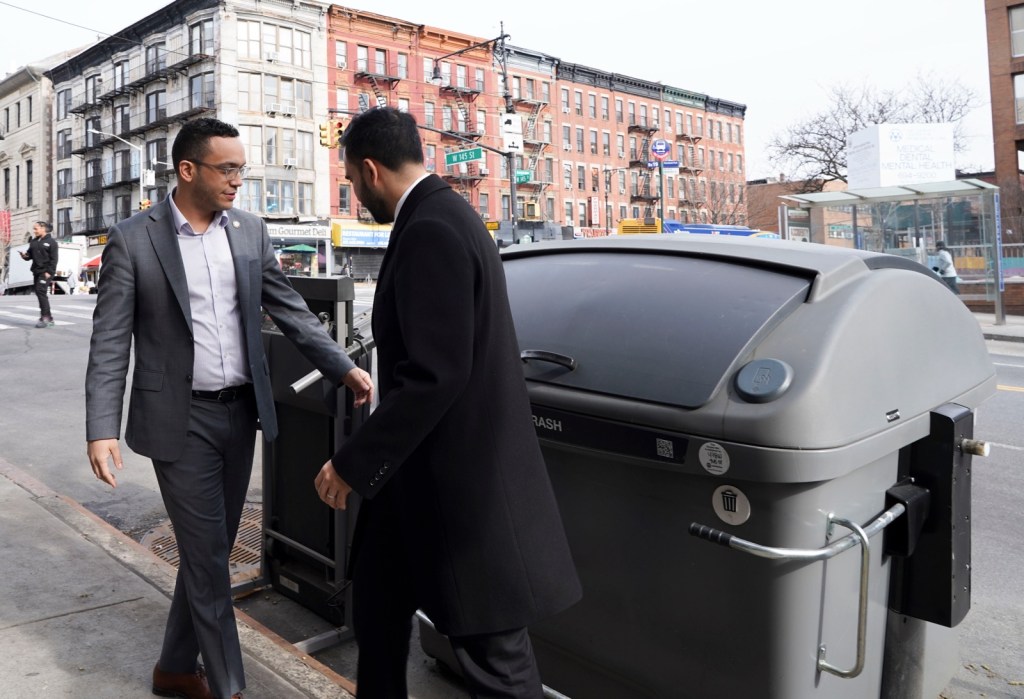
Council Member Shaun Abreu (D-Harlem) hailed the mayor’s announcement.
“The groundwork we laid in West Harlem was always meant to be a model for the city, and that day is finally here,” said Abreu, who championed containerized trash when he was the chairman of the Council’s Sanitation Committee. “Our streets don’t have to be an eyesore. We can get trash off our sidewalks and reclaim our most visible public spaces for pedestrians, eateries, playgrounds, and more. With this announcement, Mayor Mamdani is making changes that will truly improve the experience of being in New York City.”
The only real remaining question is funding — how much it will cost to containerize the city, and where that money will come from. The mayor did not specify how he will pay for the new containers and trucks in his Sunday speech, and his office did not immediately respond to a request for clarification.
Mamdani’s push for containerization comes years and even decades after most prosperous cities devised ways to eliminate garbage bags and place trash in communal bins in the roadway. Streetsblog has repeatedly drawn attention to the issue, and was on hand when then-Sanitation Commissioner Jessica Tisch announced the very beginning of the current plan in 2023.
The city’s effort to remove garbage from the paths of pedestrians, and create more space for walkers, has been popular, despite some drivers’ concerns about “lost” parking spaces. The city has roughly three million parking spaces, and full trash containerization is expected to take about 150,000 spaces, or 5 percent.
The mayor’s announcement belongs to a larger effort to highlight his first hundred days. In a press release, City Hall touted several promises that will be familiar to Streetsblog readers: Committing to finishing a stalled street safety project on McGuinness Boulevard, a bus lane on Fordham Road, a missing protected bike lane on Ashland Place, and bike lanes in Midwood and Flatbush; completing and extending the 31st Street bike lane; reviving a bus project on Madison Avenue; and implementing the redesign of the Brooklyn Bridge pedestrian and cycling entrance in Manhattan.
The Mamdani administration has also begun its own initiatives, such as redesigning the already successful 14th Street corridor, improving the pedestrian experience on Ninth Avenue, implementing lower speed limits around schools, installing more red-light cameras (which Mayor Adams had halted), and ending criminal summonsing of cyclists.
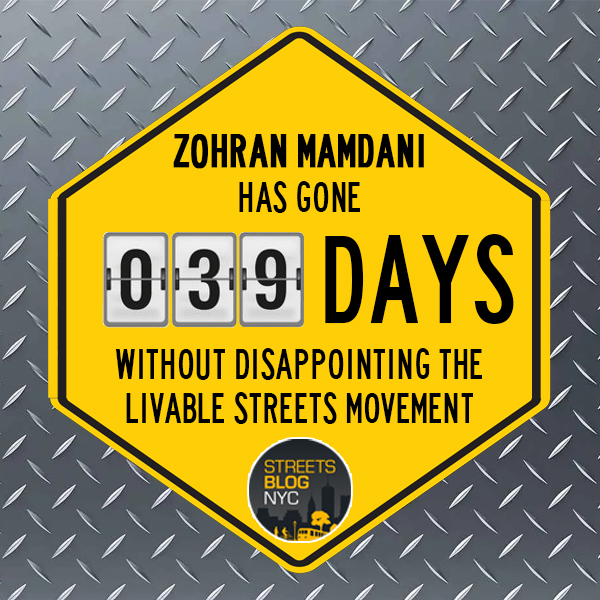
It’s worth noting that Streetsblog’s Mamdani-O-Meter has reached a record 39 days (through April 11) and has not been reset back to zero since close to 20 people died in the first winter blizzard.
In addition, Streetsblog has been tracking the Mamdani administration’s actions over the first 100 days. Readers can find it on our homepage or embedded below:
Streetsblog has migrated to a new comment system. New commenters can register directly in the comments section of any article. Returning commenters: your previous comments and display name have been preserved, but you'll need to reclaim your account by clicking "Forgot your password?" on the sign-in form, entering your email, and following the verification link to set a new password — this is required because passwords could not be carried over during the migration. For questions, contact tips@streetsblog.org.