Hochul’s ‘Solution’ To Allegedly High Car Insurance Costs Is A Band-Aid On Society’s Larger Wound
There’s a lot New York can learn from Canada.
Residents of the Great White North pay far less for auto insurance than their counterparts in the Empire State. But fraud, Gov. Hochul’s favorite scapegoat for the state’s allegedly high premiums, isn’t the reason why auto insurance is cheaper above the 49th Parallel.
Auto insurance is simply cheaper in Canada because Canada has fixed so many of the societal ills that linger in America: a broken health care system that creates haves and have nots while also encourageing lawsuits, and an out-of-control explosion in large vehicles that cause more damage. Fixing these blots on U.S. society would likely save drivers much more than $300 in annual premium costs, the specious figure that Hochul has used to push her proposals.
All car owners in New York must buy at least $25,000 in coverage per person for crash injuries, $10,000 in liability coverage for property damage (which shields car drivers if they harm someone else or damage property with their insured vehicle), and $50,000 in personal injury protection, also known as no-fault insurance.
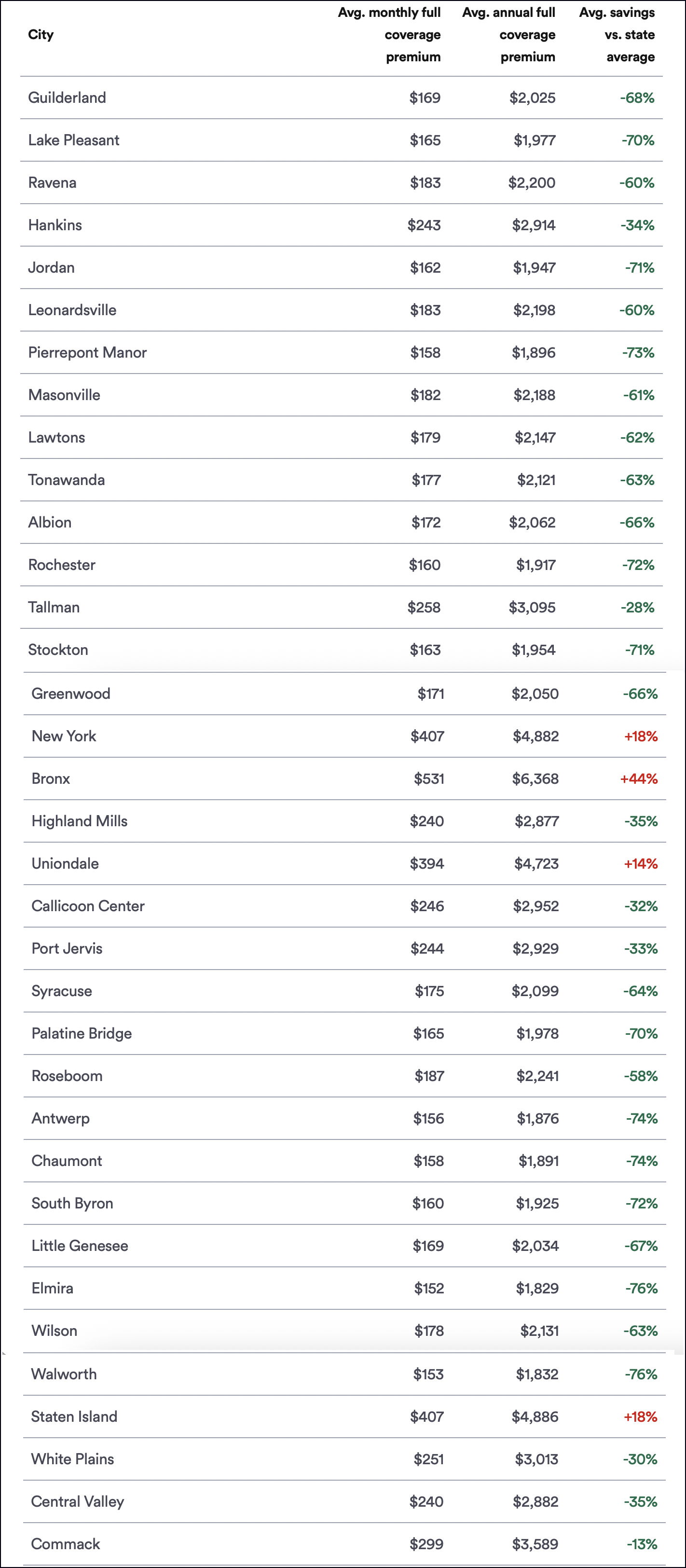
The cost of that coverage varies by many factors, including a driver’s address, their credit rating and their driving history — among other things about which the insurance industry is entirely mum — making it difficult to know what the average New Yorker pays. That said, for most New York car owners, premiums are far less than the $4,000 per year that Hochul claims (see chart, right).
In countries such as Canada or the United Kingdom, with government-funded universal health care, crash victims don’t need to worry as much about health expenses.
In the U.S., no-fault insurance essentially becomes a crash victim’s health insurance, covering $50,000 in medical expenses, including up to $25 per day for essential transportation and up to $2,000 per month for lost wages. This money kicks in regardless of who is at fault and is designed to quickly cover lost wages and medical expenses.
That $50,000 is sometimes burnt up quickly, so many victims are forced to sue the driver for adequate compensation for the full range of injuries, lost work and trauma that occur in even minor car crashes. If the driver’s coverage is depleted before it can pay the full amount, the court issues a judgment to go after assets, such as a house or car.
If the driver does not own assets, the victim can file a claim with the Motor Vehicle Accident Indemnification Corporation, the state-formed insurance pool of last resort. But payments only come after much paperwork is approved.
‘It’s kind of crazy’
Hochul’s current plans would hurt crash victims, making it harder for them to sue drivers and receive compensation after a crash and narrowing the state’s definition of a “serious injury,” which entitles crash victims to compensation beyond a driver’s bare minimum coverage.
Instead of fraud, Hochul should focus on reducing the frequency and severity of crashes, experts said.
“What’s being proposed right now is that we’re not going to change any of our behavior, which we know drives up rates, drives up injuries, drives up injury severity, drives up costs,” said Peter Beadle, a safe street advocate and Queens-based lawyer who often represents crash victims. “Instead, we’re going to make it harder for people to get compensated who have been hurt. That’s not right. It’s kind of crazy, actually.”
Two critical tools are already in the governor’s tool box: increasing street safety through infrastructure and disincentivizing the purchasing and operation of large vehicles could also lower costs, Beadle added. Pickup trucks and SUVs have become some of the most popular vehicles on the road, dominating the 2025 bestselling new cars list. They’re also more dangerous and could even be associated with riskier driving behaviors.
To combat this trend, Beadle said auto insurance should cost more for larger vehicles and less for smaller ones. In combination with road-safety measures like redesigns and lower speed limits, costs would come down across the board as the frequency and severity of crashes decline. But this isn’t part of Hochul’s specific proposal on car insurance.
What the U.S. can learn from the Great White North
In addition to having cheaper auto insurance, Canada’s coverage is also better.
In Alberta, where the average annual cost of auto insurance premiums is around $1,400, all drivers are legally required to carry at least $200,000 in liability insurance, which covers all injuries and property damage and, as such, differs from the split-up system in the U.S. And most drivers buy $1-2 million in liability coverage, according to Rob de Pruis, national director of consumer and industry relations at Insurance Bureau of Canada, a trade association that represents insurance companies in Canada.
Even in Ontario, a province that is similar to New York State in that it has a huge metropolis (Toronto) and a largely rural “upstate,” the average annual cost is under $1,600, which is still cheaper than the average annual cost for a good driver in some of the less-expensive U.S. states.
Auto insurance isn’t sold by private insurance companies in every Canadian province or territory. It’s a public function in British Columbia, Saskatchewan and Manitoba, and there’s a hybrid public-private model in Quebec. In the fully public provinces, insurance is generally cheaper because the middleman has been removed.
In British Columbia, individuals generally can’t sue for damages related to most motor vehicle crashes. Instead, injured parties claim crash benefits, such as medical expenses and lost wages, directly through the Insurance Corporation of British Columbia, the province’s public auto insurance company. This system lowers legal costs and reduces premiums.
The system does cap payouts for minor injuries and, instead of relying on courts, uses civil resolution to adjudicate disputes. Since ICBC switched to this model in 2021, it has lowered rates and issued rebates to customers.
Repairs are also cheaper under this model. Public auto insurance is the only provider of the mandatory coverage, so the government can set hourly labor rates for different kinds of repairs and only pay those rates at all repair shops in the province.
Universal health care also helps. Auto insurance premiums decrease when there aren’t lawsuits for medical expenses, said David Marlett, a professor of risk management at Appalachian State University.
Beadle echoed this, calling a universal health care system “a much more efficient way of dealing with our health care costs.” The U.S. hasn’t implemented universal health care, which spreads societal costs across everyone in society.
“We instead insist that there has to be a middleman who can collect profits and payment and divert a lot of that cash from premiums into their own pockets before actually paying out the benefits that are needed,” Beadle said. “It’s a hugely inefficient way to do it.”
A spokesperson for Gov. Hochul disputed the framing put forth by opponents of the governor’s proposal.
“Ambulance-chasing trial lawyers and their army of well-paid lobbyists are desperate to keep New Yorkers’ rates high and their pockets lined by maintaining a status quo that rewards dangerous driving and fraudulent claims,” the spokesperson, Sean Butler, told Streetsblog in a statement.
“Gov. Hochul has been clear: this system is unsafe, unfair, and unsustainable. New Yorkers need relief, and by taking on fraud and bad behavior behind the wheel that is exactly what her proposal will deliver.”

Read More:
Streetsblog has migrated to a new comment system. New commenters can register directly in the comments section of any article. Returning commenters: your previous comments and display name have been preserved, but you'll need to reclaim your account by clicking "Forgot your password?" on the sign-in form, entering your email, and following the verification link to set a new password — this is required because passwords could not be carried over during the migration. For questions, contact tips@streetsblog.org.