Gov. Hochul’s Car Insurance Proposal is a Disaster for Crash Victims’ Rights
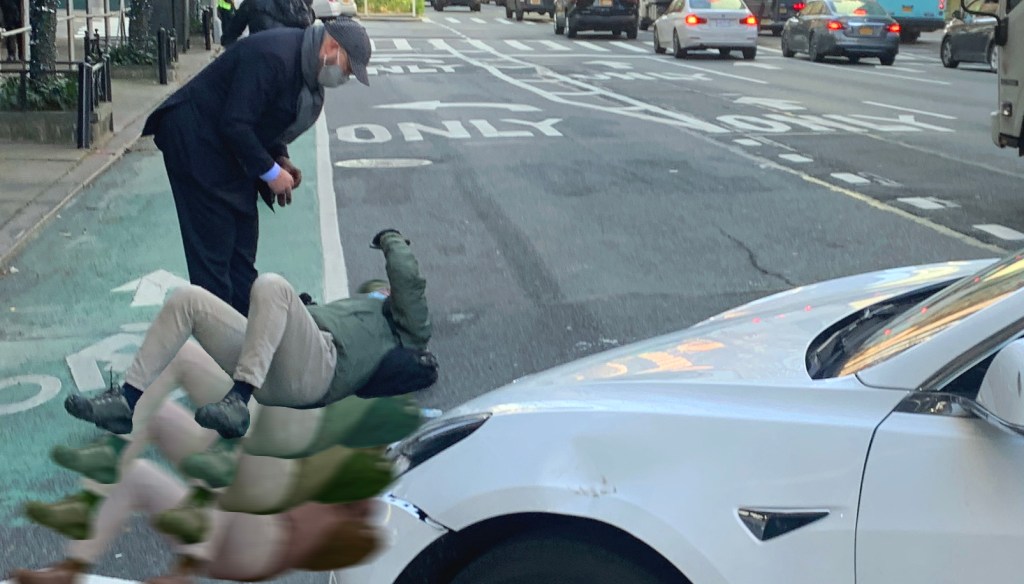
If you ride a bike or walk in New York, you already know the danger. We watch for turning and speeding cars, doors that swing open without warning, drivers staring at their phones, and trucks squeezing into bike lanes. We know that even when we do everything right, we are still one bad driver’s actions away from the ER.
Now Albany wants to make it worse.
Gov. Hochul’s latest budget proposal would quietly strip away basic legal protections for people injured by cars — especially pedestrians and cyclists — and dump the costs of traffic violence onto victims, their families, and taxpayers. The people who cause the harm, and their insurance companies get a pass.
For New Yorkers who bike and walk every day, these are not abstract policy tweaks. They are the difference between getting your life back and being made whole — or being financially destroyed after a crash you did not cause.
Redefining ‘serious injury’ is wrong
New York’s no-fault insurance system is designed so that anyone involved in an auto crash gets immediate medical care and compensation for lost wages, no questions asked. But those benefits typically max out at $50,000 — an amount that disappears fast when you are dealing with long hospital stays, physical therapy, and months off work.
To seek damages beyond the $50,000 in no-fault coverage, a crash victim must meet the legal definition of a “serious injury.” For decades, one category defined as a “serious injury” is an injury that keep you from living your normal life for the first 90 days after a crash.
The governor’s proposal will wipe out that category.
That means a cyclist who suffers a severe concussion, a traumatic brain injury, herniated discs or spinal damage, Could be told: Sorry, not serious enough.
Anyone who has ever struck by a car driver knows how absurd that is. These injuries might not be “permanent” on paper but are still serious and, indeed, take a lasting toll. They can keep you off your bike, off your feet, and out of work for months. If you are delivery worker, a restaurant worker, tradesperson, or anyone trying to meet the financial struggles of New York living, three months out of work is not just inconvenient — it can be devastating to you and your family.
Under Gov. Hochul’s proposal, you would lose the right to sue the negligent driver who caused this category of injury.
And despite what the governor claims, this change will not stop frivolous lawsuits. It just slams the courthouse door on injured crash victims whose lives are turned upside down by traffic violence. And when insurers don’t pay, Medicaid does, shifting the responsibility back to the public vs. where it belongs, the insurance company for the negligent driver.
Letting big companies off the hook
Most serious crashes are not simple. They often involve multiple negligent actors: a distracted driver piloting a speeding vehicle, a poorly designed roadway, a double-parked car. Multiple bad decisions lead to an injured crash victim.
The term describing this is “joint and several liability.”
The long-standing legal concept of “joint and several liability” existed so that innocent victims are not left uncompensated when more than one party is responsible. It makes sure the risk falls on all the people who caused the harm when a jury decides that more than one party contributed to the crash.
The budget proposal guts that protection.
Under the governor’s proposal, if the one individual driver does not have enough insurance to cover the damages, the other driver, despite being negligent as well, would not have to cover the shortfall.
The crash victim is left without full compensation. The insurance company avoids fiscal responsibility, and the burden shifts back to the injured victim to pick up the rest.
This defies basic sense: When multiple actors contribute to a crash, it is upon them all to make the crash victim whole.
‘Modified Contributory Negligence’ is open season on victims
New York, like most states, has long used a comparative negligence standard, a common-sense approach to deciding fault and recourse. This system evaluates each party’s actual level of responsibility and recognizes that each can contribute to a crash. A jury, at trial, decides fault and addresses any comparative negligence of the claimant by apportioning any share of their own responsibility and then awards a dollar amount that corresponds to fault.
The governor’s proposal throws that out. Under the new rule, if you are found just 51 percent at fault, you get nothing instead of, currently, 49 percent.
You can quickly see where the governor’s “modified contributory negligence” concept goes south.
Drivers already blame cyclists for everything. Under this system, a driver could be 49 percent responsible for a crash — and his insurance company would pay zero.
This amendment encourages victim-blaming, more denied claims, and more injured crash victims without compensation. It rewards dangerous driving and leaves victims without recourse.
Damage caps mean some pain matters less
The proposal also seeks caps on non-economic damages (pain and suffering) at $100,000 for certain groups, including uninsured drivers. Every crash victim has a story. Life puts us into all types of situations, some good, some bad. By creating groups automatically entitled to less compensation is unjust. A jury should hear your story and decide, under the facts: “Are you entitled to compensation?” By setting statutory limits on recovery for certain groups before trial, takes that right away.
An injury is an injury and pain is pain. Being unable to ride, work, or live independently or lose the ability to support yourself and your family does not hurt less because of your status.
These caps ignore the reality of injuries and replace individualized justice with blunt, unfair rules.
It won’t make streets safer — or insurance cheaper
None of this will prevent crashes. None of it will protect victims. And none of it will guarantee lower insurance premiums, the guise of these changes. The few states that have implemented similar measures did not see insurance rates drop.
What it will do is make New York’s streets more dangerous by removing accountability, discouraging safety, and forcing injured cyclists and pedestrians to rely on public assistance instead of the insurance system that is supposed to cover these claims.
As a state that values walking, biking, and Vision Zero initiatives, we cannot allow the governor to gut the rights of the people most at risk.
Read More:
Streetsblog has migrated to a new comment system. New commenters can register directly in the comments section of any article. Returning commenters: your previous comments and display name have been preserved, but you'll need to reclaim your account by clicking "Forgot your password?" on the sign-in form, entering your email, and following the verification link to set a new password — this is required because passwords could not be carried over during the migration. For questions, contact tips@streetsblog.org.