Gov. Hochul’s Uber-Backed Car Insurance ‘Reforms’ Threaten Payouts To Crash Victims
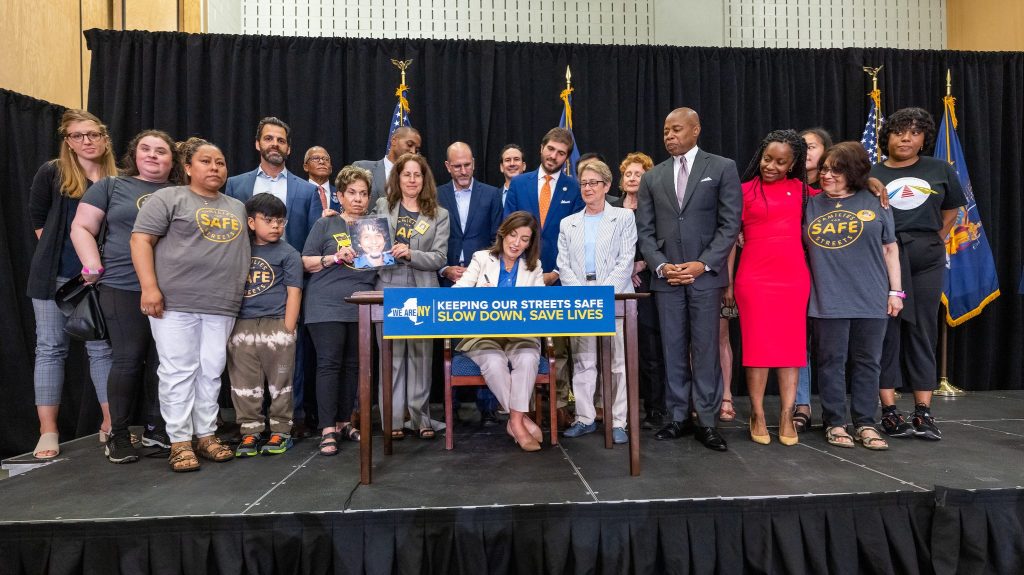
Gov. Hochul is pursuing an Uber-backed plan to limit payouts to crash victims, under the guise of “affordability” and bogus claims that “staged crashes” drive up insurance rates, advocates and experts said.
Hochul announced the plan, which narrows the state’s definition of a “serious” traffic injury, during her State of the State address on Tuesday. Mayor Mamdani, who ran on a platform of street safety as well as affordability, endorsed the proposal on the same day.
The new policy would shift the cost of traffic injuries and deaths from drivers and insurance companies onto crash victims, according to attorneys who have represented them.
“Who’s going to pay for traffic violence?” asked attorney Steve Vaccaro. “Is it going to be people who drive, through higher insurance rates, or is it people who are going to pay through life and limb?”
In her plan outlining her budget priorities, Hochul said that she wanted to cut insurance costs for drivers by “tightening” what the state considers a “serious injury,” which entitles victims to more generous payouts. New York’s annual budget serves as the state’s primary policy vehicle, and Mamdani’s endorsement will help Hochul push her proposal through Albany.
The governor claimed that car insurance rates in New York are “crushingly expensive,” averaging $4,030 annually for a family’s full coverage. That is indeed more than the national average of $2,680, but advocates said the high cost of car insurance is inevitable in built-up cities like New York.
“It’s a dense urban environment with a lot of people who can get hurt moving around, so that’s just built in,” Vaccaro said.
But Hochul blamed a “morass of outdated, overly complex laws” and “increasingly sophisticated actors [who] stage elaborate accidents” for rising insurance costs.
“Car insurance rates are just too damn high, especially at a time when families are feeling squeezed by the cost of living,” the governor said in her speech on Tuesday. “High car insurance rates don’t just impact drivers, they impact all New Yorkers when businesses pass on increased costs to customers.”
A spokesperson for Hochul referred Streetsblog to her press release without further explanation — and then forwarded a separate press release attributed to Citizens for Affordable Rates, but that had actually been forwarded to the governor’s office by a representative of Uber, which backs the group. The self-named “Citizens for Affordable Rates” has lobbied Hochul since last year, and her State of the State address lifted some of its data from the group’s materials.
Nina Sabghir, a member of Families for Safe Streets who was doored by a driver in Brooklyn while cycling to work, told Streetsblog she was “appalled” by the governor’s push to narrow the definition of a serious injury and devalue experiences like hers by focus on the very small portion of crashes that turn out to be fraudulent.
“The likelihood of [fraud] happening is extremely rare and this proposal would in fact punish the people who are legitimately injured,” Sabghir said. “There are a lot of tests to be done to show the actual damage. It’s not simply a matter of, ‘Ouch I hurt my elbow,’ you go to the hospital and you come up with a $1 million settlement.”
Pressed on the impact of the proposal on crash victims at an unrelated press conference on Wednesday, Mayor Mamdani doubled down on his support for lowering automobile insurance rates.
“The reason that I was supportive of Gov. Hochul’s actions to start to reduce auto insurance rates is that this is another way in which New Yorkers are being pushed out of the city,” the mayor said. “The focus will always be, ‘How do we make it as easy as possible to get around the city as cheap as possible?’ There’s no competition with public transit.”
History repeats itself
Hochul’s proposal follows a familiar playbook. Last year, the New York City Council passed a bill that reduced insurance requirements for cabbies with similar arguments of boosting affordability — even if it came at the expense of crash victims. Former Mayor Eric Adams signed the bill into law over the summer.
The head of the New York State Trial Lawyers Association, which advocates for more stringent insurance requirements, said Hochul’s supposed reforms will benefits large insurers’ bottom line — and won’t even lower insurance costs.
“The governor’s proposals not only fail to address affordability for New Yorkers, they simply shift costs from Big Insurance to taxpayers,” said Association President Andrew Finkelstein. “This address asks New Yorkers to believe that billion-dollar insurance companies will lower premiums if crash victims get less care. History shows the opposite. Insurers cut costs, pocket the savings, and premiums never go down.”
The governor should instead focus on curbing traffic violence, advocates said, because reducing crashes would help achieve Hochul’s stated goals.
“The best way to lower car insurance costs is to reduce the number of car crashes,” said Ben Furnas, executive director of Transportation Alternatives. “The street safety policies we’re fighting for … will not only make our streets safer, they’ll also make car insurance more affordable for New Yorkers by decreasing the degree of risk in the insurance pool.”
Vaccaro, who represents victims in both New York and New Jersey, pointed to the Garden State, where lawmakers passed insurance reforms in the late 1990s that made it harder for victims to receive adequate compensation for their injuries. “I have seen how in New Jersey auto coverage has been dramatically transformed to be much, much worse,” he said.
Redefining ‘serious injury’
Hochul’s plan narrows the state’s definition of a “serious injury,” a designation that entitles victims of car crashes to compensation beyond medical expenses or lost wages. The governor criticized the existing definition as “vague, applied inconsistently, and [inclusive of] temporary injuries that only sideline an individual for a short time following an accident [sic] rather than the more significant injuries that would merit further payouts.”
State law defines “serious injury” as death, dismemberment, significant disfigurement, a fracture, loss of a fetus, loss or significant limitation of a body function or organ, or a non-permanent injury which prevents a person from their daily activities for more than 90 days after the crash.
Hochul said this definition allows people to “game the system to win astronomically high ‘jackpot’ awards” — but juries usually award payouts commensurate with their injuries, said another attorney who has represented crash victims.
“Not a single person received an ‘astronomically high’ award in a case unless they also have an astronomically terrible injury,” Peter Beadle, a Queens-based lawyer, wrote in an email. “Even if someone meets the threshold – e.g., they broke their pinky finger in their non-dominant hand – they aren’t getting very much.”
Almost all cases end in a negotiated settlement anyway, Beadle said, and the state should focus on safer streets, rather than making it cheaper to own and drive motor vehicles.
“The governor’s thinking is backwards. We should not be sacrificing victims to make it easier for people to buy larger and more expensive vehicles, which in turn cause more serious injuries and are more deadly than ever before,” Beadle added.
Hochul didn’t spell out exactly how she wants to change that framework, but she wrote that the reforms would follow “objective and fair medical standards.” She included a list of methods for addressing fraudulent insurance claims and staged crashes, including criminal penalties against anyone found responsible for devising what she called a “staged accidents.”
Some of Hochul’s car insurance-related proposals should cheer street safety advocates, however. For example, Hochul wants to limit monetary damages for drivers that were either breaking the law at the time of the crash — such as being uninsured or driving drunk — or those found “mostly” at fault for causing the collision.
She also wants the state to target drivers who illegally register their cars in other states to get cheaper coverage, because this practice inflates costs for others. Drivers with out-of-state plates are notorious among pedestrians and cyclists for causing traffic violence.

Read More:
Streetsblog has migrated to a new comment system. New commenters can register directly in the comments section of any article. Returning commenters: your previous comments and display name have been preserved, but you'll need to reclaim your account by clicking "Forgot your password?" on the sign-in form, entering your email, and following the verification link to set a new password — this is required because passwords could not be carried over during the migration. For questions, contact tips@streetsblog.org.