Gov. Hochul Is Playing With Toys — And The Facts — In Latest ‘Propaganda’ Video on Car Insurance: Lawyers

Trial lawyers are shooting down this trial balloon.
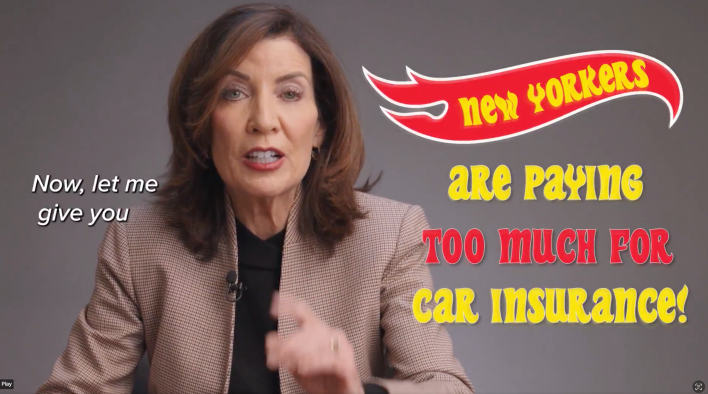
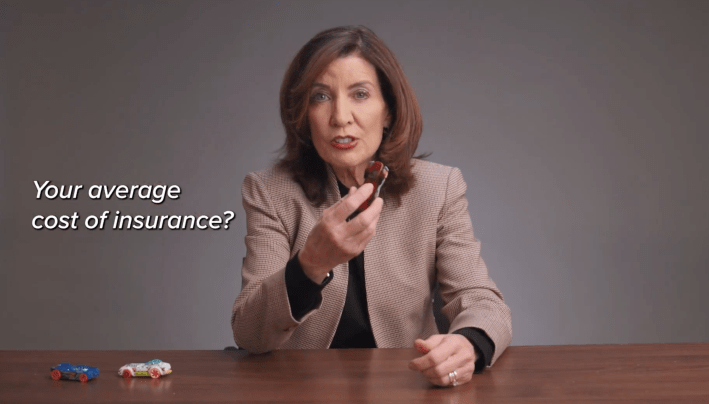
Attorneys who fight to ensure that crash victims receive adequate compensation for their life-changing injuries are slamming Gov. Hochul’s latest video, posted on Friday, defending her proposal to reduce car insurance premiums as propaganda designed to protect the wealthy insurance industry from scrutiny and deny injured people full legal recourse.
Minutes after Hochul’s office posted its latest video on X.com to champion reducing insurance prices, lawyers started reacting negatively.
“This is a deeply disingenuous video,” tweeted lawyer Peter Beadle. “The governor’s actual proposals go well beyond what she says here and will significantly impact your ability to be compensated fairly by a negligent driver if you are hit.”
Another lawyer, Adam White, was flatly outraged.
“Why is Hochul acting as a shill for the insurance industry using their well worn go to message how fraud is rampant and [that] most folks who [are] claiming injuries based on negligent drivers are likely committing fraud?” asked White (full disclosure: White’s law firm is a supporter of Streetsblog). “Her message is itself a fraud.”
At issue for state trial lawyers is a central pillar of Hochul’s effort to reduce the prices charged by the insurance industry, whose profits are booming: Hochul says she can bring down premiums, in part, by changing the way victims of car crashes are compensated for their injuries.
Currently, victims can sue drivers, and juries allocate compensation based on their determination of each person’s level of fault. In other words, if a jury finds one driver 75 percent responsible for a crash, the victim would get a payout that reflects that portion of blame.
But under Hochul’s proposal, a victim of a crash could end up with no compensation beyond the basic $50,000 in no-fault coverage if a jury determines that the victim is actually 51 percent or more responsible for the crash.
As a result, “negligent drivers and their insurance carriers get a free pass,” White said.
Beadle explained what happens when a victim needs to sue a driver after the $50,000 no-fault insurance coverage runs out: “If you are in a crash and there is fault to be shared, currently the jury determines each party’s fault and your recovery is reduced by your part of the blame. That’s fair and ensures you still get some compensation for the other person’s fault. The governor proposes to change our system so that if you are 51 percent at fault, the person who was 49 percent at some fault in causing your injuries, walks away and pays nothing. You suffered a debilitating injury caused substantially by the other person but now you get nothing. How is that fair?”
Another lawyer pointed out that the governor is engaging in asymmetric warfare, inferring that crash victims are greedy or that their attorneys are merely chasing ambulances for “jackpot” paydays when, in fact, some of the most powerful forces in our society — Big Insurance, Big Tech and Uber — are backing the governor’s effort.
“This is a ruse funded by Big Tech and Uber to protect their pockets,” said lawyer Daniel Flanzig. “No one is arguing that fraud doesn’t exist. … Fraud exists in all insurance, and auto insurance fraud pails to that of Medicare and Medicaid fraud. Are the insurance companies willing to guarantee rate reductions in writing? Is Uber willing to guarantee a reduction in fares? I am sure they will not.
“This simply Uber and Big Tech pumping millions of dollars into the governor’s campaign,” Flanzig added. “In the end, it’s thousands of injured New Yorkers who will pay the price by not receiving just compensation and the cost of their medical bills being shifted away from the insurance companies and onto the taxpayers.” (As Streetsblog reported, an initial round of questions that we sent to the governor’s office was answered … in the form of talking points that had been sent to the governor’s office from Uber.)
Flanzig added that auto insurance companies are hardly cash-strapped and must soak their policyholders for every dollar. According to The Center for Justice & Democracy, a respected unit at the New York Law School, “the profits of these companies have ballooned to unprecedented levels due to two things: massive investment income and underwriting profits caused by the unrestrained price-gouging of policyholders. These companies place enormous importance on their ability to tout both developments to their shareholders and/or financial analysts. It is fantasy to expect that ‘tort reform’ will stop this. History clearly shows that it won’t.”
Industry profits are soaring, the Center added. “S&P Market Intelligence reported in November 2025 that ‘the U.S. property/casualty insurance industry had its best quarter in at least a quarter of a century — and maybe longer.’”
Of course, trial lawyers are also a major lobbying force in state politics, but they still take exception to Hochul’s notion that the compensation they receive as a result of their representation of victims.
“Nearly half of my clients were hit by a taxi, Lyft or Uber driver,” Beadle said, reminding that city law allow taxi drivers to carry insurance with coverage capped at $100,000 in compensation. “Outside New York City, Lyft and Uber provide $1.25M of coverage! We should require Lyft & Uber to do the same here in NYC.
“Instead of punishing the victims who have been hit, we should be focused on reducing the number of people who get hit and the severity of their injuries, while making sure the billion-dollar rideshare companies carry some of the burden,” he added.
The governor’s office disagreed with the attorneys, whom Hochul spokesman Sean Butler called, “Ambulance-chasing trial lawyers and their army of well-paid lobbyists.”
Trial lawyers, Butler said, “are desperate to keep New Yorkers’ rates high and their pockets lined by maintaining a status quo that rewards dangerous driving and fraudulent claims. Gov. Hochul has been clear: this system is unsafe, unfair, and unsustainable. New Yorkers need relief, and by taking on fraud and bad behavior behind the wheel that is exactly what her proposal will deliver.”
Butler repeated the governor’s claim that her proposal alone would reduce state drivers’ insurance rates by 8 percent or $300 per year. But such a reduction would mean that state insurances rates are, on average, $4,000 per year, which does not appear to be true.
To bolster that claim, Butler cited a Washington Post story that cited a study by Bankrate, a trade publication of the banking industry. But Bankrate’s website features other studies that suggest that most New Yorkers aren’t paying anywhere near $4,000 a year for auto insurance.
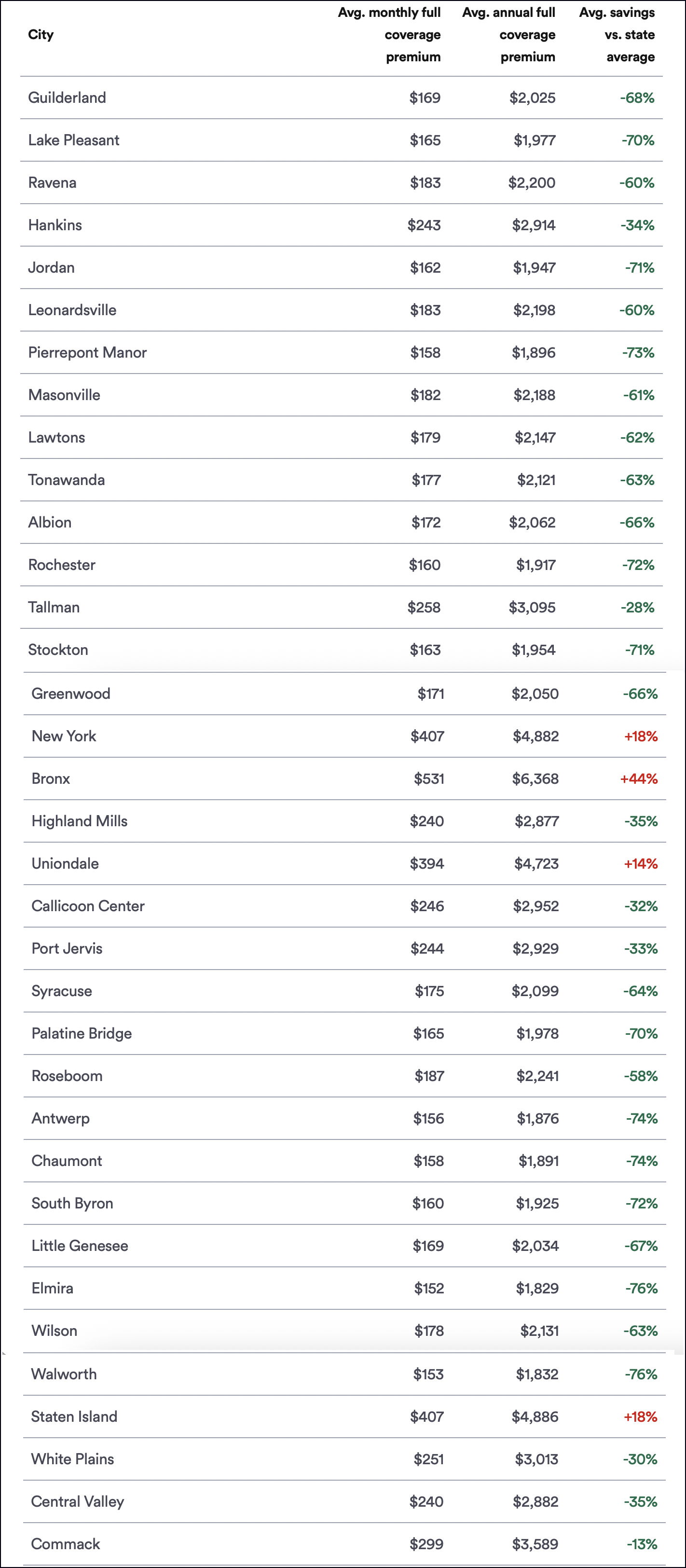
For state minimum coverage, the website states, New Yorkers pay, on average, $148 per month or $1,776 per year. In addition, the website printed a lengthy list of prices that residents across the state pay for “full coverage” (see photo right), and insurance in very few places costs anywhere near what the governor is claiming. (Reminder: the figures cited in the city-by-city breakdown are averages which can be deceptive because, obviously, more people live in the Bronx than in Elmira.)
Butler also denied Flanzig’s claim that the state should get in writing promises of lower insurance rates, pointing out that New York State consumer protection laws would not allow an insurance company to reap profits from the proposed reform. He added that the Department of Financial Services must approve any rate change, and cited $400 rebate checks sent to car owners by the governor of Michigan, according to a press release from the governor of Michigan.
A news story about the 2021 rebate program says the refunds came from a state health care account, into which drivers had paid, that had accrued a $5-billion surplus, more than $2 billion of which was refunded to the drivers.
He also disputed the Center for Justice & Democracy report on soaring insurance profits, saying that the report unfairly conflates New York’s insurance costs with the rest of the country.

Read More:
Streetsblog has migrated to a new comment system. New commenters can register directly in the comments section of any article. Returning commenters: your previous comments and display name have been preserved, but you'll need to reclaim your account by clicking "Forgot your password?" on the sign-in form, entering your email, and following the verification link to set a new password — this is required because passwords could not be carried over during the migration. For questions, contact tips@streetsblog.org.