New Details: Hochul’s Car Insurance ‘Affordability’ Pitch Will Shortchange Crash Victims
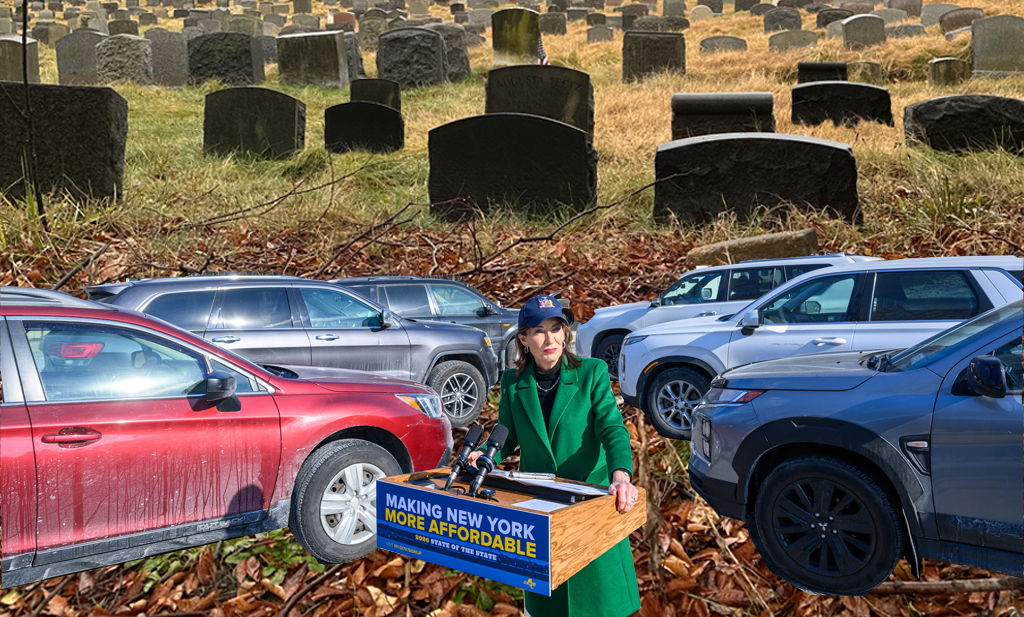
Who’s the bad actor?
Gov. Hochul’s Uber-backed bid to lower auto insurance rates in the name of “affordability” will disqualify some crash victims from compensation and make it harder for them to sue drivers — yet the state’s chief executive on Thursday framed short-changing victims as a war on scammers, as she released details of the proposal she initially mentioned in her State of the State address.
Hochul’s plan, unveiled in her budget legislation, would narrow the state’s definition of “serious injury,” which entitles crash victims to compensation beyond a driver’s bare minimum coverage. But it would also prevent people injured by drivers from recovering any damages if a jury finds them even slightly more culpable than other parties in a crash. Currently, compensation is awarded on a sliding scale based on fault.
Responding to a question from Streetsblog, Hochul seemed to only reflect on drivers who are injured in crashes with other drivers, not the thousands of New Yorkers who are outside of cars when they are injured by drivers.
“If you’re not at fault, you won’t be impacted by these changes,” Hochul said on Thursday, referring to victims of crashes. “If you are at fault, you’ll still get your lost wages and medical coverage. You’re just not going to get the extra cost awards for pain and suffering, so that’s where we’re drawing the line.”
Hochul’s efforts come after a lobbying campaign by a shadowy, Uber-led coalition called Citizens for Affordable Rates (CAR), which has spent upwards of a million dollars in ads and deployed lobbyists Albany to further their cause over the past year, as Streetsblog reported.
Attorneys who represent the victims of car crashes warned that the so-called reforms — which Hochul pitched as a bid to punish dangerous drivers and a supposed scourge of staged car crashes — will in fact hurt the people injured by those dangerous drivers.
“This is shifting the burden of traffic violence on to victims,” said Steve Vaccaro, a safe streets advocate and attorney who represents pedestrians and cyclists injured in car crashes.
Hochul, who faces competitive primary and general elections this year, has routinely expressed sympathy for drivers over rising costs of their auto-centric lifestyles. She paused congestion pricing in 2024 on the grounds that the $15 charge to drive into the most transit-dense urban area in the country was “too much” for “hard-working families.” She eventually set the toll at a less-effective $9, which she defended as an affordability measure as recently as this month.
“Some accidents [sic] are truly that, just accidents [sic], things happen,” the governor said. “But others are the result of a system that’s riddled with bad actors, and fraud, and obsessive greed that’s rewarding criminals’ and bad actors’ behaviors, and who loses out? New Yorkers, and for millions of New Yorkers, owning a vehicle is not a luxury, it’s a necessity.”
Hochul’s press conference on Thursday centered almost entirely on the notion of bad actors and scammers cheating the system as a major cause of what she calls New York’s sky-high insurance costs.
But in press release about the alleged scams, the governor’s office claimed that “in 2023, there were 1,729 staged crashes in New York State,” which is a tiny fraction of the hundreds of thousands of reported crashes every year. New York City alone had roughly 100,000 reported crashes in 2023, so even if every single “staged crash” occurred in the five boroughs, they would comprise less than 2 percent of all reported crashes.
Even the governor’s press release couldn’t spin those alleged scams into a true “affordability” crisis, claiming that “insurance fraud” is “inflating everyone’s premiums by as much as $300 per year on average.”
Devil’s in the details
The governor’s proposal released late on Wednesday would narrow the definition of “serious injury” by disqualifying wounds that are not permanent — even if they prevent people from going to work or doing their daily tasks, like taking care of children, for as many as 90 days after a crash. Not to mention lingering trauma that doesn’t show up on an ER admitting form.
Under current state law, a “serious injury” entitles victims to compensation for their pain and suffering beyond the basic $50,000 that they receive for medical expenses and lost wages under the state’s so-called “no-fault” insurance requirements.
“That $50,000 will be evaporated within the first 48 hours of a hospital stay,” said Daniel Flanzig, an attorney with New York Bike Lawyers.
Another controversial proposal by Hochul would “bar” someone from getting any damages in a personal injury lawsuit if their “culpable conduct” is “greater” than the person they’re suing.
Currently, someone filing a personal injury lawsuit to get damages from a crash gets compensated proportionately to how much they are to blame for the collision. So, even if a jury finds a crash victim to be, say, 51 percent at fault, they could still recover 49 percent of the damages.
Apportioning blame is subjective, however, and juries could find a crash victim is at fault if, for example, they’re a cyclist that didn’t wear a helmet, rode outside of a bike lane, or didn’t have a working light, said Flanzig.
“Modern thought, which New York and most states follow, is that payment should simply match a party’s actual level of responsibility and recognizes that a crash … can have multiple causes,” said Flanzig. “Any other system is gamed to help the insurance company and incentivize them to deny claims.”
Since lawyers — who get a cut of the damages — tend to only want to take on cases in which they have a good chance at winning, eliminating any damages for people who might be found mostly at fault would create a high hurdle for victims suing for damages.
“In theory, plaintiffs can roll the dice and pursue their claim … but in practice, it’s going to dramatically reduce representation,” said Vaccaro. “This is going to dramatically reduce the rights of crash victims, practically speaking, because it will lead to attorneys turning down cases where there’s any evidence of any fault on the part of the victim.”
The governor’s press conference at a State Police post on Wards Island came days after she raised auto insurance as crucial to her “affordability” agenda in her State of the State address. But since the announcement, it has come under fire from crash victims, safety advocates and lawyers who seek just compensation for victims from shortcomings of the insurance industry and the criminal justice system.
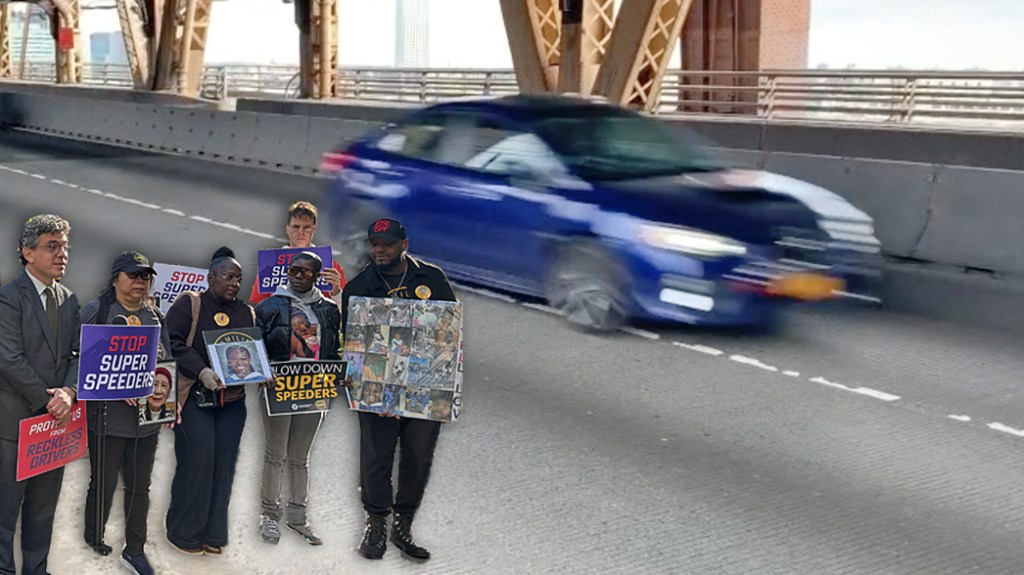
Crashes are the leading cause of injury-related death in the state and they cost the state $33.6 billion in 2023, according to the research group TRIP.
“As someone who has been injured in a traffic crash myself — and suffered the physical and financial consequences — I believe the best way to reduce car insurance rates is to reduce car crashes,” said Kate Brockwehl, a co-chair of the advocacy group Families for Safe Streets.
But Big Tech is mostly interested in its bottom line.
CAR bills itself as a “coalition of concerned citizens, advocates, and organizations united in the fight for fair and equitable insurance rates.”
But only part of that is true. CAR is, first and foremost, a business group. And it’s hiding in plain sight: When Streetsblog reached out to Gov. Hochul’s office for comment after her State of the State proposal, a spokesperson merely answered our question by forwarding CAR talking points that had been forwarded to the governor’s spokesperson from Uber’s spokesman.
And Uber is not looking out for victims, but its costs.
“Uber’s priority is Uber,” John Kaehny, executive director of the watchdog group Reinvent Albany, told Streetsblog. “The basic equation here is whether or not drivers have to pay for the damage they do. That is an extremely high cost to society, and that cost should be internalized with the users, not subsidized by the taxpayers – that’s insane.”

Read More:
Streetsblog has migrated to a new comment system. New commenters can register directly in the comments section of any article. Returning commenters: your previous comments and display name have been preserved, but you'll need to reclaim your account by clicking "Forgot your password?" on the sign-in form, entering your email, and following the verification link to set a new password — this is required because passwords could not be carried over during the migration. For questions, contact tips@streetsblog.org.