Non-Profits With City-Issued Parking Placards Harbor Super-Speeders, Data Shows
The city gives out thousands of parking placards to non-profit organizations — and as worthy as those groups are, they employ lots of repeatedly reckless drivers who endanger the very public they were hired to serve.
Vehicles with parking placards issued to non-profits by the city are 88 percent more likely to have at least 16 school-zone speed-camera violations than the general population of vehicles with any speed-camera violations, according to city records obtained through a Freedom of Information Law request.
New York City’s speed cameras slow down most drivers: 87.2 percent of vehicles that got a ticket between July 1, 2025 and June 30, 2026 didn’t get more than two more. And another 12.2 percent got more than three more.
Just 0.64 percent of vehicles with any speed camera violations got 16 or more.
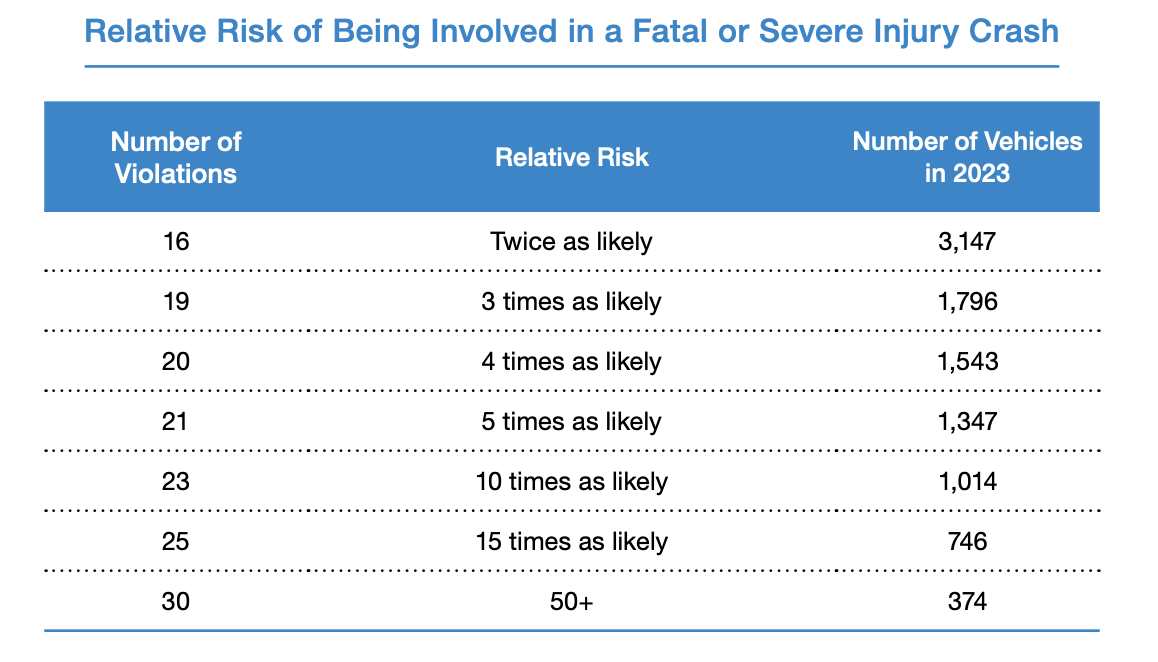
This threshold is significant: the city Department of Transportation found these vehicles are twice as likely to be in a crash resulting in death or serious injury. The danger rises quickly. Vehicles with 19 violations are three times more likely to be involved in a serious crash, four times with 20, five times with 21, and 50 times more likely with 30 speed camera violations.
An illuminating list of placardholders
The 765-page list of parking placards I got under FOIL included several categories of placards including city agency vehicles, individual permit holders, non-profit organizations, houses of worship, and parking permits for people with disabilities. It did not include the thousands of placards issued by the NYPD.
DOT redacted personal information, but kept license plate information. This allowed me to run the plates through the NYC Open Data database to determine their speed-camera violations.
Scores of placard holders — 101, to be exact — exceeded 16 speed camera violations in the 12-month period from July 1, 2025 to June 30, 2026, making them super speeders under the state’s definition. Starting next year, such drivers will be required to install a speed-limiting device inside their cars, but for now, these drivers are among the greatest threat to safety on our streets.
Nearly one-quarter of those placards were issued to non-profit organizations — the highest category. And vehicles with placards issued to non-profit organizations that had at least one speed camera ticket were nearly twice as likely as general population cars with at least one speed camera violation to have 16 or more. Comparing license plates of these vehicles to open data of speed camera violations, I found that 2,005 of these vehicles got at least one speed camera violation, of which 24 (1.2 percent) got 16 or more. This is 88 percent higher than the 0.64 percent of the general population of vehicles with at least one speed camera violation that got 16 or more.
These organizations do critical work to serve at-risk New Yorkers. Nonetheless, we need to make sure they do not endanger New Yorkers in the process.
These vehicles’ owners, including organizations that are city contractors, have paid tens of thousands in fines, including for repeated speeding and failure to stop at red lights, raising questions of oversight by their leadership and boards, the city, and the state.
SCO Family of Services, a non-profit organization and city contractor that has received over $158 million in city payments in Fiscal Year 2026, according to checkbook.nyc, had 179 vehicles with placards that amassed a total of 299 speed camera violations and 63 red light camera violations. One of its placarded vehicles, a 2023 Toyota Sienna, had 23 speed camera violations, making it 10 times more likely to be in a crash involving a serious injury or fatality. It also had five red-light camera violations, making it 102 times more likely to be in a crash involving a serious injury or fatality.
The organization, which provides care, housing, education, and behavioral health support to vulnerable children, adults, and families, paid $66,260 in fines for all violations. An organization spokesperson said it is “committed to the safe and responsible operation of our vehicles.”
“We maintain strong oversight of our fleet and continuously reinforce safe driving practices to protect those we serve and the communities in which we operate,” the rep added.
Another non-profit, Rising Ground, also a city contractor, had three Ford Transit vans over the threshold, two with 23 speed camera violations and one with 20. These vehicles are 10 and four times more likely to be involved in a serious crash than the general population. Altogether, the organization, which was founded as an orphanage in 1831 and provides services focusing on education and youth development, has 146 vehicles with placards, which received a total of 271 speed camera violations. These vehicles also got 34 red light camera tickets. In total, they paid over $62,000 for all violations during this period.
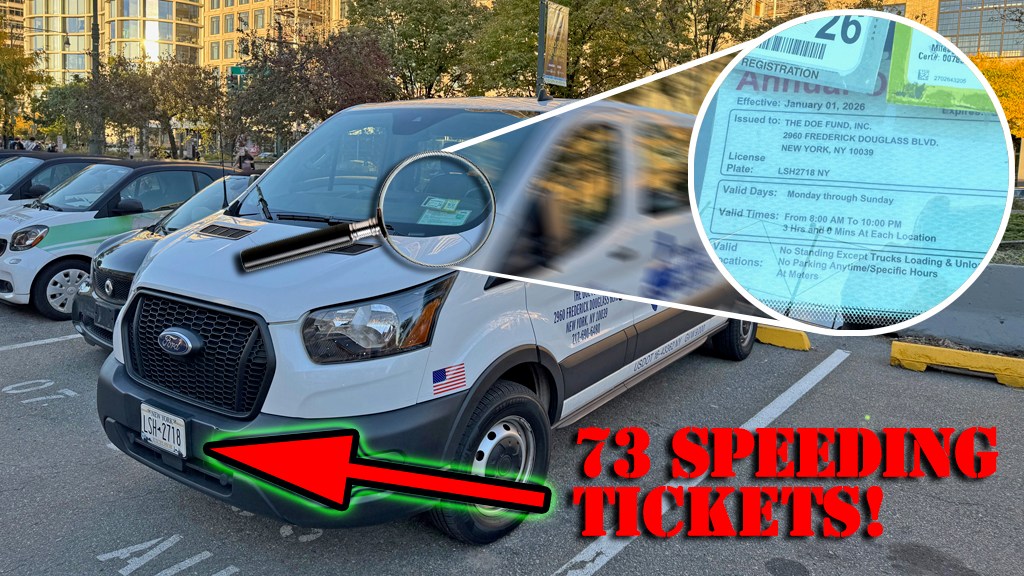
The Doe Fund provides opportunity, housing, and supportive services to help New Yorkers recover from homelessness. Also a city contractor, the organization had 35 vehicles with placards that received 158 speed camera violations. One 2024 Ford Transit 350 received 46 speed camera violations, making it over 725 times more likely to be involved in a serious crash, based on DOT’s analysis. The organization paid $4,100 in fines for this vehicle alone towards a total of over $58,000 in fines for this time period.
Bowery Residents Committee, another city vendor, is the non-profit that paid the most in fines, a total of $93,675 in this 12-month period for a total of 859 violations. The organization, which provides a range of services including homeless outreach, substance abuse treatment, and mental health services, didn’t have any vehicles over the 16 threshold, but its 83 vehicles were caught speeding a combined 197 times. Its vehicles also received citations for blocking bus lanes 291 times, costing over $50,000 in fines.
Following is a table showing all organizations with vehicles with 16 or more speed camera violations:
Ten other private vehicles that were issued parking placards that had 16 or more speed camera violations in this time period:
In response to a request for comment, the city’s Department of Investigation, which oversees city marshals, pointed to the handbook, which states that city marshals “must obey the law in all their activities, both official and personal.”
A DOI spokesperson added, “City Marshals are expected to follow the law and are not exempt from traffic laws. … DOI does follow up on allegations reported to us involving personal vehicles involved in the marshal’s official duties.”
The DOT, New York City Public Schools, Bowery Residents Committee, Rising Ground, the Doe Fund, Chevra Hatzalah and Innovative Resources for Independence did not respond to requests for comment.
A call to action
DOT’s speed-camera program effectively identifies the small number of super speeders on our streets, and its report makes clear the obvious: these vehicles are far more likely to be involved in crashes with serious injuries and fatalities.
Under the state’s Stop Super Speeders Act, which goes into effect in May 2027, the city can require vehicle owners who accumulate 16 or more city speed-camera violations within a 12-month period to install a speed-capping device. But the law exempts vehicles owned by a business that are routinely operated by two or more workers, so it may not apply to these vehicles.
Thus, it is critical for the city to take every action possible to slow down vehicles repeatedly driven dangerously, or to get them off the roads prior to a tragedy.
Owners of vehicles who are given special privileges should be held to an even higher standard to ensure they are operated safely and not endangering the city residents they are supposed to be serving. Just because an organization performs critical work in supporting vulnerable New Yorkers doesn’t mean it should be exempt from life-saving traffic laws. In fact, the opposite is true – organizations and public servants must ensure that they are not endangering people.
To that end, DOT should revoke parking placards issued to owners of vehicles with more than a minimal number of camera speeding or red light violations. For example, once a vehicle has six speed-camera or red-light violations, it should have its parking placard revoked. And if it doesn’t do so already, DOT should also ensure that all fines are paid prior to issuing parking placards.
Beyond the DOT’s role, organizations’ leadership and boards should ensure that non-profit staff members are properly trained to ensure that they are not endangering the very communities they are dedicated to serving. They also should be first in line to install speed-limiting devices in their fleets, even if the law does not require it.
The costs of the installation would certainly be less than what they are paying in tickets!

Read More:
Streetsblog has migrated to a new comment system. New commenters can register directly in the comments section of any article. Returning commenters: your previous comments and display name have been preserved, but you'll need to reclaim your account by clicking "Forgot your password?" on the sign-in form, entering your email, and following the verification link to set a new password — this is required because passwords could not be carried over during the migration. For questions, contact tips@streetsblog.org.